

Supreme Court Exposes Trap of Dowry Demands After Marriage
 Copy Link
 Share
Share Save
Save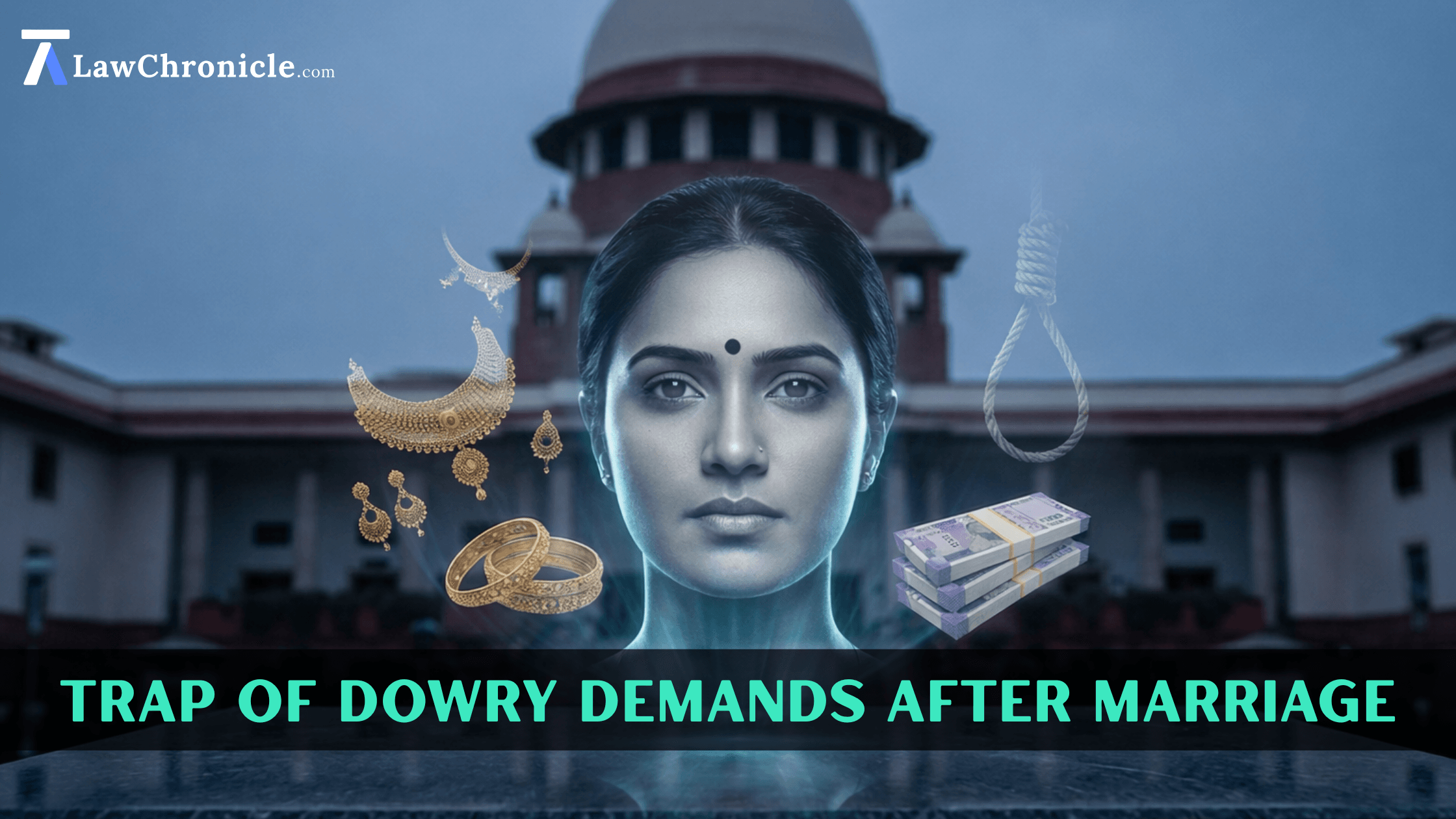
Dowry is an ill-practice in the Indian society, usually associated to the traditions performed during marriage. However, the Supreme Court questioned the tricks played by the groom’s family, for dowry demands after marriage. The Apex Court in Mahesh Chand v. State of Uttar Pradesh (Order dated 30th April, 2026) expressed concerns over bail granted to a husband accused of causing dowry death of his wife. Here is a reflection upon the agony expressed by the Bench of Justice JB Pardiwala and Justice Vijay Bishnoi regarding the perils of dowry in India.
Law on Dowry in India
Dowry is a well-known concept in India, where marriage is founded upon the valuables exchanged as terms of marriage. The Dowry Prohibition Act, 1961 prohibits giving and taking of dowry. In fact, the erstwhile Indian Penal Code as well as now in force Bharatiya Nyaya Sanhita, 2023 punishes cruelty on demands of dowry and dowry death. The instant matter sprouted from a chargesheet for offences under Sections 85, 115(2), 352, 351(2) and 80 of the BNS 2023, and Sections 3 and 4 of the 1961 Act. The Allahabad High Court allowed bail to the accused, and the matter came before the Supreme Court in appeal.
Dowry under the Garb of Gifts
In its order, the Supreme Court cited an article written by Aditya Mukherjee in Free Press Journal, wherein, it said that “in India, where a daughter is traditionally considered paraya dhan, there exists a deeply ingrained, yet often unspoken, custom of parents or guardians giving ‘gifts’ at weddings, hoping to secure their daughter’s happiness in her marital life. However, things don’t end there, as in many cases, the groom and his family begin pressuring the newly married bride for additional dowry, demanding cash, cars, or other expensive items.”
Dowry Demands After Marriage
While discussing the menace of dowry, the Supreme Court hinted at gifts given from the bride’s side to the groom’s family at the time of wedding. However, expectations and demands carry on after marriage.
As per the Court, “This often turns into a trap that many women realise, albeit too late, only after marriage. Before the wedding, the groom’s family rarely makes exorbitant demands, but once the marriage is formalised, they begin exerting pressure, believing that the bride’s parents will have no choice but to comply in order to maintain the marriage. This marks the beginning of an insidious cycle of coercion and blackmail. In Indian marriages, an unwritten norm dictates that when the groom earns a handsome salary, the bride’s family often feels pressured to provide a larger dowry to avoid any displeasure on his part.”
States of Uttar Pradesh, Bihar and Karnataka
The Supreme Court expressed concern over newly married young girls being mercilessly killed at matrimonial homes for want of dowry. Either they are forced to commit suicide, or murdered, a result of dowry demands and incessant harassment. The Court pointed at the dreams of happy marital life, longing to raise a family, ending with merciless killing at her matrimonial home. The Court found the problem more common in the three States in Bihar and Karnataka. Against total 6156 dowry deaths across India in 2023, data shows dowry deaths of 2122 in Uttar Pradesh, 1143 in Bihar.
The Court referred to its decision in In Re : Enforcement and Implementation of Dowry Prohibition Act, 1961(2005 CaseBase(SC) 1111), wherein a social revolution was suggested to put an end to the menace of dowry deaths.
Bail in Dowry Death Case
In this case, the Allahabad High Court allowed bail for the husband accused of causing dowry death. The Supreme Court reversed the High Court’s order, stating no good ground being assigned for grant of bail in such a serious crime. The Apex Court explained the judicial expectations from a High Court while considering a case like this. The Supreme Court highlighted that the FIR lodged by deceased’s father disclosed more than a prima facie case. The wife dies within 7 years of marriage and the case reflected upon serious allegations of dowry demand along with incessant harassment. The Supreme Court reminded the High Court of the provision under Section 118 of Bharatiya Sakshya Adhiniyam, equivalent to Section 113B of Evidence Act.
Delay in FIR
The Court conveyed distress on bail granted in this case - “We are at pains to observe that the High Court has not even recorded the facts correctly far from the erroneous line of reasonings assigned for the purpose of grant of bail to the accused in a serious crime like dowry death.” The Supreme Court was not convinced on High Court’s reasoning of delayed FIR in a case when the same was lodged by the parents the very next day when they came to learn about their daughter’s death. The Apex Court asked “Assuming for the moment that there was some delay in lodging the FIR, should that by itself in a serious crime like dowry death be a ground to release the accused on bail?”
Cause of Death
Looking at the postmortem report, the Supreme Court stated that the cause of death was asphyxia due to strangulation, which will be analysed by the trial court.
Bail Reversed in Dowry Death Case
While cancelling the bail granted by the High Court, the Apex Court further added that “a bail court at any level should remain very careful to ensure that its order like the one impugned before us should not be seen or read by the society at large that the courts are taking serious crimes against women very lightly.”
 Breaking News