Supreme Court grants 15 lakhs as Stray Animal Attack Compensation; Recommends Effective Mechanism
 Copy Link
 Share
Share Save
Save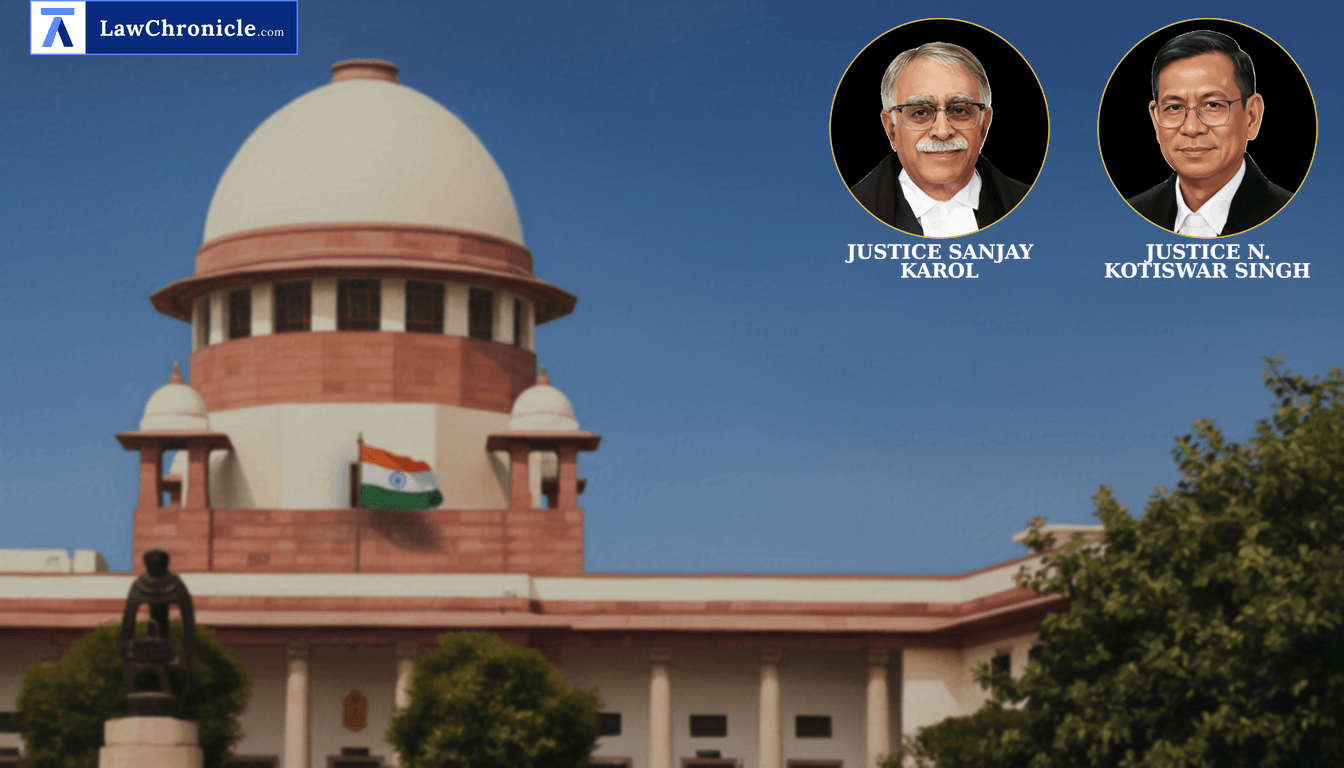
Addressing the nationwide menace of stray animal attack accidents, the Supreme court awarded Rs 15 lakh compensation to a widow. The Court further made suggestions to the Central and State Governments to enforce animal tagging and establish structured compensation frameworks.
A bench of Justice Sanjay Karol and Justice Nongmeikapam Kotiswar Singh heard an appeal filed by the widow of a man who sustained fatal head injuries after being hit by a stray bull in 2007. The High Court's Division Bench had previously set aside a Single Judge order granting Rs 29.32 lakh compensation, ruling that disputed factual questions could not be adjudicated under Constitution of India, 1950 writ jurisdiction and directing the family to approach a civil court. The Supreme Court ruled that dismissals of writ petitions solely on grounds of 'disputed questions of fact' become untenable after a long passage of time, as remitting long-pending claims to civil courts leaves victims entirely remediless.
Efflux of Time in Stray Animal Attack Compensation
Reversing the High Court's Division Bench decision, the Supreme Court highlighted that the writ petition was filed in 2010 and dismissing it after fifteen years would unfairly deny justice to the Stray Animal Attack victim's family. The Apex Court noted that the incident itself was never denied or disputed by the authorities in any prior administrative proceedings or police reports.
The Supreme Court, in its reasoning, observed: "On the first blush, the reasoning of the Division Bench is appealing, but a closer examination of the facts leads us to think otherwise. The Writ Petition before the High Court was filed in the year 2010, and it was finally decided on 27th May 2019. The impugned judgment is dated 12th November 2025. Now, after such a long time, even if there is legal merit in the statement that a claim should have been filed before the competent Civil Court, where does that leave the claimants? The simple answer is, remediless. On that short ground alone, i.e., the efflux of time, the impugned judgment warrants interference and, in the interest of justice, adjudication on merits."
Directives Issued For Bovine Management And Compensation
Addressing the systemic issue of stray animals roaming public roads, the Supreme Court outlined crucial suggestions for governments across the country to mitigate road hazards and establish clear liability mechanisms for stray animal attack compensation.
Supreme Court Suggestions on Stray Animal Accident
The Apex Court made the following suggestions for the authorities pertaining to accidents caused by stray animals:
- All States that have enacted their own laws pertaining to cattle should take steps to ensure complete and immediate implementation thereof in letter and spirit;
- Necessary amendments may be carried out or rules promulgated, as is deemed fit by the competent authority, to develop a mechanism for payment of compensation in accidents caused as a result of bovine/cattle, in both categories of cases i.e., pedestrian or vehicular;
- Tagging of all animals be mandated. This furthers the ability to keep track of them, ensuring their long-term health service, linking to veterinary check-ups and vaccinations;
- The reality of animals being let go after they cease to serve a useful, economic purpose cannot be denied. The owners choosing to make such a decision should be held responsible and ensure safe transfer of such animals to the shelters run by the appropriate authority. The authorities at such shelters should issue a receipt acknowledging such transfer and cause the details of such animal to be entered/altered in the database of tagging;
- In order to ensure that the tagging, digitisation of records and smooth running of these shelters is duly undertaken, the authorities may depute a particular officer in every Corporation/Department who shall be the nodal officer for such purpose."
Stray Animal Laws in India
Evaluating the broader statutory ecosystem, the Supreme Court examined historical and constitutional frameworks, referring to Cattle-Trespass Act, 1871 and statutory obligations under the Prevention of Cruelty to Animals Act, 1960. It also considered precedent in State of Gujarat v. Mirzapur Moti Kureshi Kassab Jamat on constitutional duties toward living creatures, alongside Animal Welfare Board of India v. A. Nagaraja ( "(2014) 7 SCC 547": 2014 CaseBase(SC) 290) and Animal Welfare Board of India v. Union of India ( "(2023) 9 SCC 322": 2023 CaseBase(SC) 166) on animal rights, and noted economic observations from Mohd. Hanif Quareshi v. State of Bihar. Provisions under Motor Vehicles Act, 1988, Indian Penal Code, 1860, and Jan Vishwas (Amendment of Provisions) Act, 2023 were also underscored during the analysis.
Key Takeaways
- Procedural Bar Relief: Long-pending writ petitions under Constitution of India, 1950 cannot be thrown out solely for civil remedies due to sheer efflux of time.
- Mandatory Animal Tagging: States must enforce 12-digit ear-tagging or similar identification measures to trace owners abandoning cattle.
- Statewide Compensation Schemes: Governments are pushed to formulate statutory compensation frameworks for pedestrian and vehicular bovine-related accidents.
- Shelter Accountability: Owners abandoning uneconomic animals must safely transfer them to registered shelters with proper database logging.
Ratio
When a writ petition challenging state inaction or seeking remedy for public hazard injuries has remained pending for a substantial duration, it should not be dismissed on technical grounds of alternative civil remedies if doing so leaves the aggrieved party entirely remediless due to efflux of time.
Background of Stray Animal Attack and Compensation Claim
The dispute originated on September 21, 2007, when Vijay was fatally injured by a stray bull in Sangrur. After his representation for relief to local authorities yielded no result, his wife filed a writ petition in 2010. The Single Judge granted compensation based on principles from the Motor Vehicles Act, 1988. However, the Division Bench quashed this order in 2025, directing the family to approach a civil court. Reversing the appellate judgment, the Supreme Court awarded a lump sum compensation of Rs 15 lakh to the widow, ordering payment within four weeks.
Case Details:
Case No.: Civil Appeal No(s). of 2026 (Arising out of SLP(C) No(s). 4663 of 2026)
Neutral Citation: 2026 INSC 774
Case Title: NISHA v. MUNICIPAL COUNCIL SANGRUR & ORS.
Source: 2026 CaseBase(SC) 711
 Breaking News