


Supreme Court holds General Allegations Against In-Laws in Matrimonial Disputes as Abuse of Law
 Copy Link
 Share
 Save
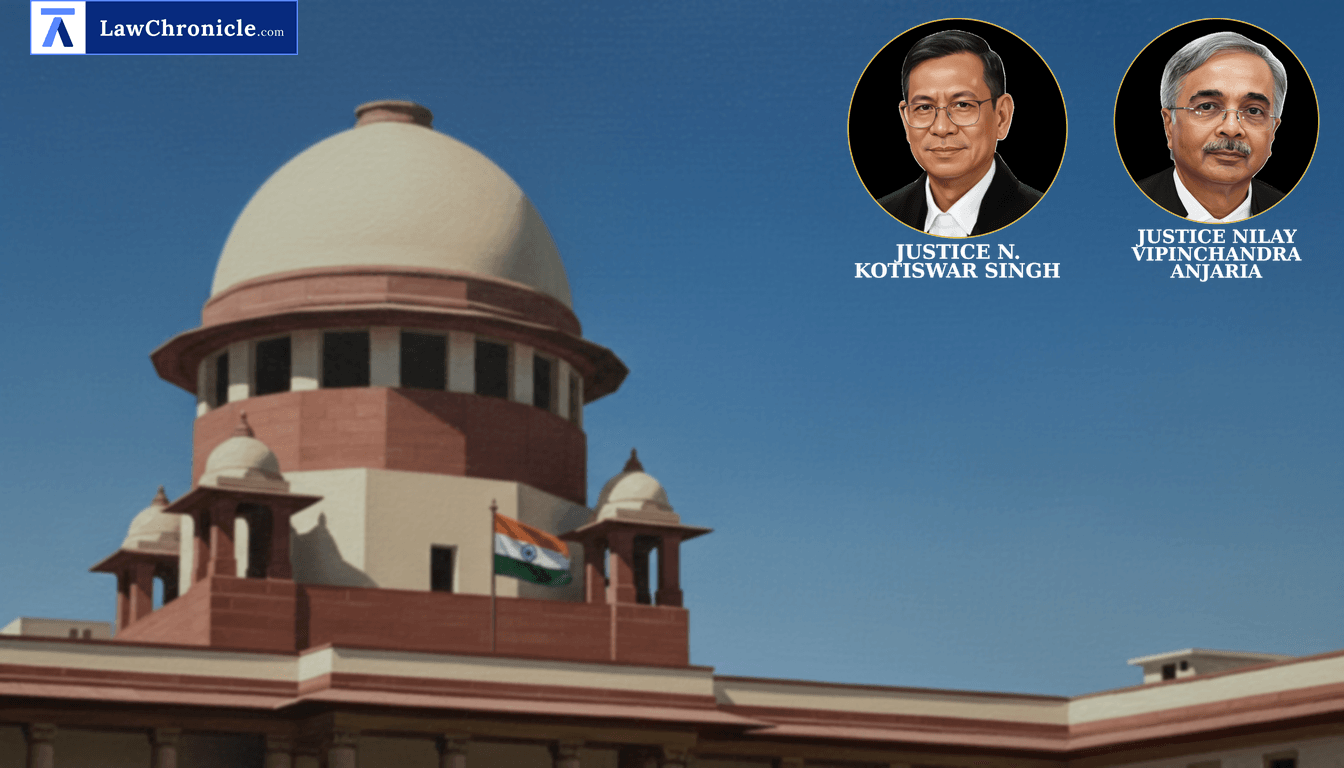
The Supreme Court quashed criminal proceedings initiated against in-laws under vague charges, while cautioning against the indiscriminate extension of criminal law to every family member during matrimonial discord, the
A Bench comprising Justice Nongmeikapam Kotiswar Singh and Justice N.V. Anjaria set aside a Calcutta High Court order that had declined to quash charges under Sections 498A, 406, and 506 of the Indian Penal Code, 1860 alongside the Dowry Prohibition Act, 1961 against a husband's parents.
Key Takeaways
- Protection for In-laws: Relatives of a husband cannot be indiscriminately subjected to criminal trials based on general and omnibus allegations of dowry harassment.
- Need for Specificity: Prosecution of family members in matrimonial disputes requires clear, specific, and distinct factual foundations showing active involvement in alleged offences.
- Evidentiary Threshold at Quashing Stage: Merely filing a chargesheet does not bar higher courts from quashing proceedings under Section 482 of the Code of Criminal Procedure, 1973 if the investigation lacks primary independent material.
Matrimonial Disputes and Inherent Powers
While evaluating the boundaries of quashing criminal proceedings arising out of domestic discord, the Apex Court revisited established legal principles. The Bench referred to the illustrative categories laid down in State of Harayana v. Bhajan Lal, emphasizing that criminal proceedings manifestly attended with mala fide or private grudges warrant judicial intervention.
Furthermore, the Supreme Court relied on Arti Mehta v. State of Madhya Pradesh ( "2026 SCC OnLine SC 933": 2026 CaseBase(SC) 457) to stress that while safeguarding victims of domestic violence remains paramount, courts must ensure criminal law rigours are not applied indiscriminately. The Apex Court also highlighted the societal implications of criminalizing domestic disputes by referring to Geddam Jhansi v. State of Telangana ( "2025 SCC OnLine SC 263": 2025 CaseBase(SC) 222), reiterating that invoking penal processes without credible supporting material ruptures family bonds and leads to disastrous consequences.
While discussing frequently occurring vague allegations in matrimonial disputes, the Supreme Court expressed that "Invoking criminal process is a serious matter with penal consequences involving coercive measures, which can be permitted only when specific act(s) which constitute offences punishable under the penal code or any other penal statute are alleged or attributed to the accused and a prima facie case is made out. It applies with equal force when criminal laws are invoked in domestic disputes. Criminalising domestic disputes without specific allegations and credible materials to support the same may have disastrous consequences for the institution of family, which is built on the premise of love, affection, cordiality and mutual trust."
Addressing the specific criminal charges under the Indian Penal Code, 1860 and the Dowry Prohibition Act, 1961, the Supreme Court found that neither the initial complaint nor the police investigation revealed independent evidence of physical or mental cruelty under Section 498A, criminal breach of trust under Section 406, or criminal intimidation under Section 506. Observing that oral allegations were devoid of supporting material or independent witnesses, the Bench noted that subjecting the in-laws to a trial was legally unsustainable.
Ratio
To prosecute relatives of a husband in criminal proceedings arising out of matrimonial acrimony, allegations must be genuine, specific, and supported by foundational materials demonstrating active participation in the alleged offences; vague and omnibus allegations unsupported by investigative material warrant quashing under Section 482 of the Code of Criminal Procedure, 1973 to prevent abuse of the process of law.
Background
The case originated from a complaint filed by a woman against her husband and his parents alleging dowry demand, verbal harassment, and non-support during her pregnancy. Following investigation, a chargesheet was submitted under Sections 498A, 406, 506, and 323 of the Indian Penal Code, 1860 read with Sections 3 and 4 of the Dowry Prohibition Act, 1961. The parents-in-law approached the High Court of Calcutta under Section 482 of the Code of Criminal Procedure, 1973 seeking to quash the proceedings.
The High Court partially allowed the petition by quashing the charge under Section 323 of the Indian Penal Code, 1860, but directed that remaining charges be examined during trial. Aggrieved by the partial refusal, the in-laws appealed before the Supreme Court.
Allowing the appeal, the Supreme Court quashed the criminal proceedings qua the parents-in-law, clarifying that its observations are strictly confined to the maintainability of proceedings against the in-laws and do not reflect any opinion on the merits of the case against the husband.
Case Details:
Case No.: Criminal Appeal No. of 2026 (@ Special Leave Petition (Crl.) No. 16908 of 2024)
Neutral Citation: 2026 INSC 1087
Case Title: Prasanta Kumar Dhar & Anr. v. The State of West Bengal & Anr.
Source: 2026 CaseBase(SC) 8235
Similar Articles




 Breaking News


