Supreme Court holds Order II Rule 2 CPC not attracted where earlier injunction suit arose during registration ban; second suit for specific performance may proceed
 Copy Link
 Share
Share Save
Save
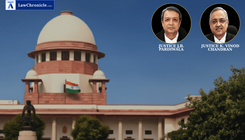
A Bench of Justices J.B. Pardiwala and R. Mahadevan heard appeals by Cuddalore Powergen Corporation Ltd. challenging the Madras High Court’s restoration of the plaint in O.S. No. 122 of 2008 filed by M/s Chemplast Cuddalore Vinyls Ltd. The narrow issue related to whether a second suit for specific performance and cancellation of a subsequent sale deed was barred by Order II Rule 2 CPC where an earlier suit for permanent injunction had been filed.
The Court dismissed the appeals and held that the bar under Order II Rule 2 CPC did not operate in the facts of the case because the reliefs claimed in the second suit were not “available” to the plaintiff at the time of the first suit. The Court emphasised that the question was whether the plaintiff was both “entitled to” and, crucially, “able to obtain” the omitted relief when the earlier suit was instituted. The Court, in its reasoning, observed: “The object of both the Rules 1 and 2 of Order II is to prevent the multiplicity of suits. Order II Rule 2 is founded on the principle that a person should not be vexed twice for the same cause. It is a rule which is directed against two evils i.e., the splitting up of claims and the splitting up of remedies. What Order II Rule 2 requires is the inclusion of the whole claim arising in respect of one and the same cause of action, in one suit. However, this must not be misunderstood to mean that every suit shall include every claim or every cause of action which the plaintiff may have against the defendant. Therefore, where there are different causes of action, Order II Rule 2 would have no application.” The Court quoted the relief-ordering conclusion in the judgment: “the bar under the provisions of Order II Rule 2 CPC would not stand in the way of the institution of the second suit.” The Court added that it did not express any view on the merits of the claim.
Background M/s Chemplast Cuddalore Vinyls Ltd. entered into an agreement to purchase one acre at Thiyagavalli from Mrs. Senthamizh Selvi on 24 January 2007; an irrevocable power of attorney followed on 26 March 2007 and the agreement was registered on 7 September 2007. Chemplast alleged payment in full and possession. Mrs. Selvi purportedly revoked the power of attorney and, by early February 2008, returned a demand draft which Chemplast characterised as a repudiatory act. Chemplast filed O.S. No. 28 of 2008 on 16 February 2008 for permanent injunction to protect possession.
Unknown to Chemplast initially, registration authorities had declined certain registrations because of a Government Order dated 8 August 1986 and a TNEB letter of 23 October 2006 reserving lands in Thiyagavalli for power-project purposes; Cuddalore Powergen was the only entity authorised in practice to register. Chemplast also litigated by writ; a Division Bench of the Madras High Court in a public interest petition quashed the 1986 Government Order on 5 March 2008 and directed revenue authorities to accept registrable documents. Chemplast then filed O.S. No. 122 of 2008 (the second suit) seeking specific performance of the 2007 agreement, a declaration that the 24 January 2008 sale deed in favour of Cuddalore Powergen was null and void, and permanent injunction.
The trial court rejected the second plaint on 30 April 2009 under Order II Rule 2 r/w Order VII Rule 11(d) CPC; the first appellate court affirmed. The Madras High Court allowed the second appeal and restored the plaint on 30 June 2016; a subsequent civil miscellaneous petition was dismissed on 1 September 2016. Cuddalore Powergen appealed to the Supreme Court.
The Supreme Court reviewed authorities including Gurbux Singh, Mohammad Khalil Khan, Virgo Industries, Vurimi Pullarao, Inbasagaran and Rathnavathi, and analysed whether the cause of action and the availability of reliefs at the time of the earlier suit would attract Order II Rule 2. The Court held that because the State-imposed ban on registrations was in force when the first suit was filed, specific performance and cancellation of the later-registered deed were not remedies actually available then; the High Court’s decision restoring the plaint therefore stood. The Court remitted the parties to trial on merits and observed that it did not express any view on substantive rights or title.
Case Details: Case No.: CIVIL APPEAL NOS. 372-373 OF 2025 (@SLP (C) NOS. 1297-1298 OF 2025) (@ SLP(C) D. No.13548 of 2017) Case Title: Cuddalore Powergen Corporation Ltd. v. M/s Chemplast Cuddalore Vinyls Limited and Anr. Appearances: For the Petitioner(s): V. Prabhakar, Senior Counsel For the Respondent(s): V. Chitambaresh, Senior Counsel
Date of Supreme Court Judgment: 15 January 2025.
 Breaking News