Supreme Court Invokes Article 142 To Protect Retiral Benefits After Caste Claim Fails
 Copy Link
 Share
Share Save
Save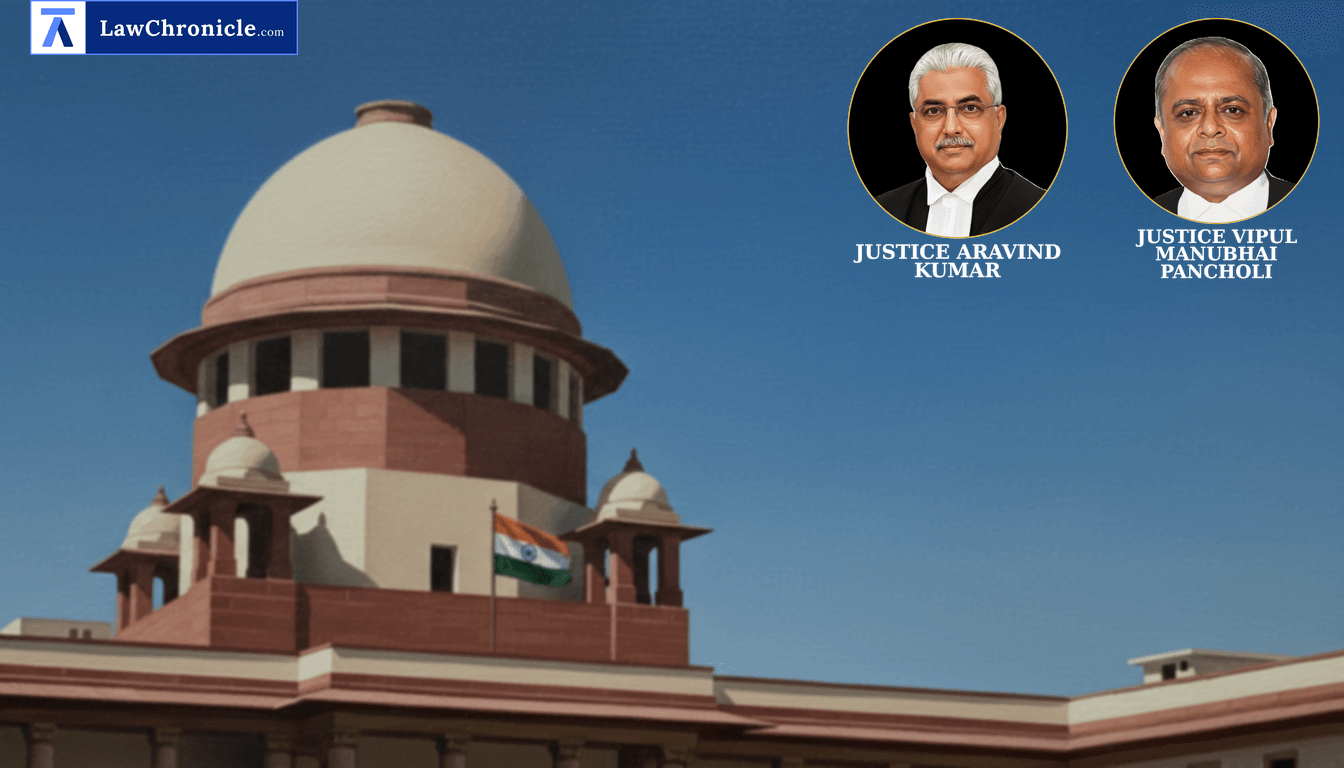
Exercising its extraordinary constitutional powers, the Supreme Court protected the retiral and pensionary benefits of a municipal employee whose Scheduled Tribe caste certificate was invalidated after three decades of service. The judgment highlights that even when a caste claim is rightfully rejected, equity can warrant the safeguarding of earned post-retirement benefits to do complete justice.
A bench comprising Justice Aravind Kumar and Justice Vipul M. Pancholi heard the appeal challenging the Bombay High Court's dismissal of a writ petition that affirmed the cancellation and confiscation of the appellant's 'Tokre Koli' Scheduled Tribe certificate.
Key Takeaways
Equitable Relief Under Article 142: The Supreme Court can shield long-serving employees from the forfeiture of pensionary benefits even if their underlying caste certificate is invalidated.
No Validation of Caste Status: Granting pensionary protection does not validate the invalid caste certificate or confer tribal status on the individual or their family members.
Prohibition on Future Claims: Litigants or their dependents cannot claim any future public employment, educational, or statutory benefits based on an annulled caste certificate.
Court Observations and Directions
The Supreme Court affirmed the findings of the Caste Scrutiny Committee and the High Court on merits, confirming that the pre-constitutional family records possessed high probative value and defeated the appellant's tribe claim. However, considering that the appellant served for over 30 years and retired on superannuation without any family member deriving benefits from the certificate, the Court found it fit to grant limited protection.
The Court, in its reasoning, observed: "Generally, invalidation of a caste or tribe claim upon verification would have consequences in law. However, this Court has consistently recognized that, in exceptional circumstances where equities of the case so warrant, the power under Article 142 of the Constitution of India may be exercised to do complete justice."
The Court issued the following directions:
"In view of the facts and circumstances of the present case, we are inclined to exercise our power under Article 142 of the Constitution of India, and accordingly, the service rendered by the appellant with respondent No. 3 from 21.10.1994 until his date of retirement on 30.06.2025 shall be protected for the limited purpose of computation and release of his retiral and pensionary benefits, in accordance with the applicable service rules.
It is clarified that the protection granted hereinabove shall not amount to validation or recognition of the claim of the appellant of belonging to the “Tokre Koli” Scheduled Tribe. Neither the appellant nor any member of his family shall be entitled to claim any future benefit on the basis of the invalidated caste certificate.
In view of the aforesaid discussion, we allow the appeal to the extent stated hereinabove. We are of the view that the order dated 27.07.2020 passed by the Scrutiny Committee, insofar as it invalidates the claim of the appellant of belonging to the “Tokre Koli” Scheduled Tribe, and the impugned judgment dated 15.09.2020 passed by the High Court affirming the same, do not warrant interference. The appellant will be entitled to the retiral and pensionary benefits, which shall be processed and released within a period of six months from the date of this judgment."
Ratio
Where an employee has rendered long and uninterrupted service until superannuation, the Supreme Court may exercise its power under Article 142 of the Constitution of India to protect earned retiral and pensionary benefits despite the invalidation of their caste certificate, provided no family members have derived benefits and equity strongly warrants such relief without validating the invalid caste status.
Background
The appellant secured a caste certificate in 1984 as belonging to the 'Tokre Koli' Scheduled Tribe and was appointed as a Junior Engineer (Civil) with the Municipal Corporation of Greater Mumbai in 1994. Upon misplacing the original, he obtained a fresh certificate in 2000. In 2008, his employer referred the caste claim to the Scrutiny Committee. The Vigilance Cell reported that old family records marked his paternal ancestors as 'Koli', 'Hindu Koli', and 'Hindu Suryawanshi Koli'. On July 27, 2020, the Scrutiny Committee invalidated and confiscated his caste certificate.
The High Court of Judicature at Bombay dismissed the appellant's writ petition on September 15, 2020, relying on pre-constitutional records of high probative value. During the pendency of the appeal before the Supreme Court under an interim protection order, the appellant superannuated on June 30, 2025. Relying on Chairman and Managing Director, Food Corporation of India & Ors. v. Jagdish Balaram Bahira & Ors., R. Sundaram v. Tamil Nadu State Level Scrutiny Committee ( "2023 SCC OnLine SC 287": 2023 CaseBase(SC) 193), and Surekha Baljorsingh Thakur v. Caste Scrutiny Committee & Anr., the Supreme Court held that while the invalidation of the caste claim was unassailable, equitable protection of pensionary benefits was warranted under Article 142 of the Constitution of India.
Case Details:
Case No.: Civil Appeal No. of 2026 (@ SLP (C) No. 12938 of 2020)
Neutral Citation: 2026 INSC 949
Case Title: Shirish Pandharinath Patil v. The State of Maharashtra & Ors.
Source: 2026 CaseBase(SC) 1806
 Breaking News