Supreme Court Judgment on Repossession of Vehicle Holds Midnight Force Illegal; Awards Compensation
 Copy Link
 Share
Share Save
Save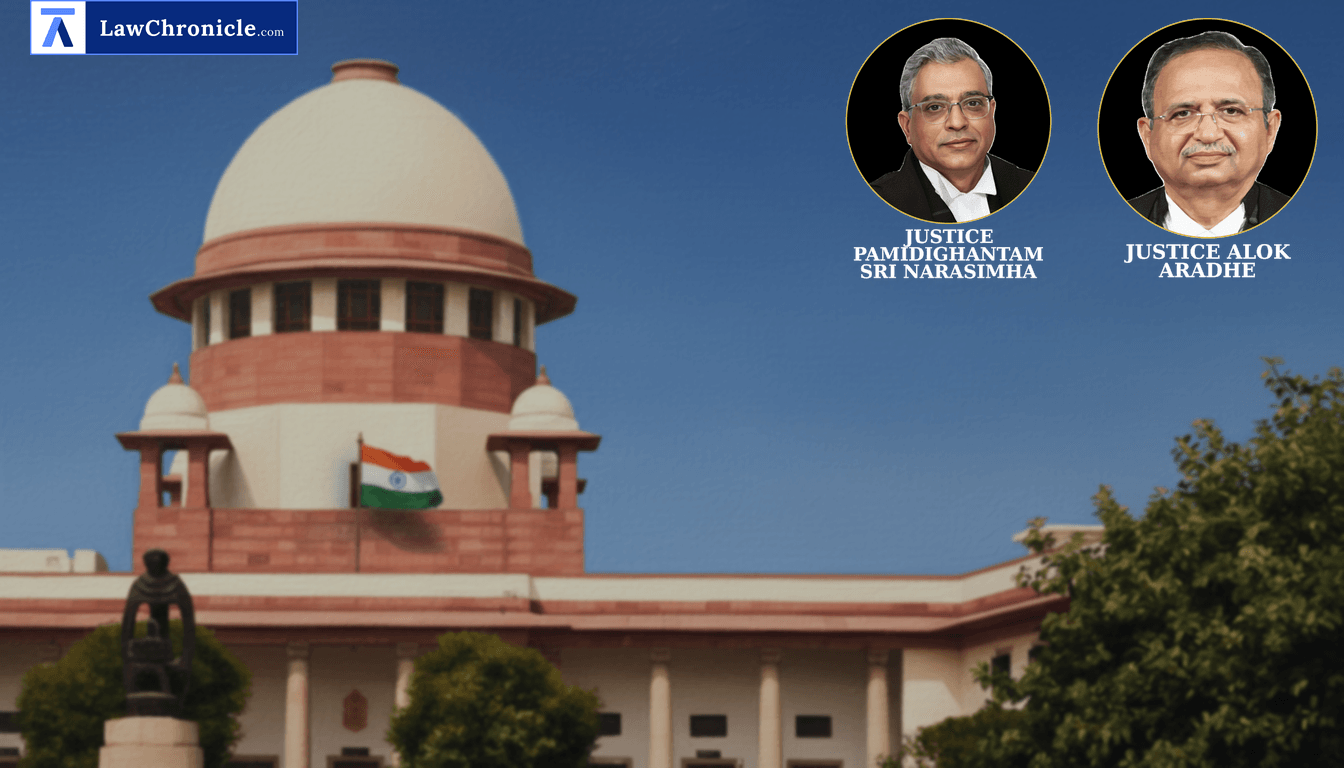
The Supreme Court has clamped down on non-banking financial companies and banks employing illegal self-help repossessions without notice, directing strict compliance with regulatory safeguards.
An appellate bench comprising Justice Pamidighantam Sri Narasimha and Justice Alok Aradhe delivered Supreme Court judgment on repossession of vehicle in an appeal challenging an order of the Allahabad High Court, which had dismissed a borrower's writ petition against the forcible seizure and sale of his commercial vehicle by a private financier.
Key Takeaways
End of Midnight Seizures: Lenders cannot deploy recovery agents to seize assets by stealth or force without mandatory notice, as such actions forfeit legal and contractual protections.
Contractual Clauses Subject to Law: Unilateral repossession terms allowing lenders to dispense with notice or enter premises without consent violate basic contractual fairness and regulatory standards.
Mandatory RBI Enforcement: Financial regulators are mandated to actively enforce recovery guidelines rather than leaving customer protection policies merely on paper.
Restitution for Loss of Livelihood: Arbitrary deprivation of an asset used for earning a livelihood triggers heavy compensation and constitutional remedies under Articles 14 and 21.
Invalidation of Arbitrary Repossession Clauses
The Supreme Court scrutinized self-help repossession clauses under loan agreements, emphasizing that while such rights commercially enable credit extension, they must operate within lawful boundaries. Examining Section 35-A of the Banking Regulation Act, 1949 and Fair Practices Codes, the bench underscored that circulars issued by the Reserve Bank of India carry statutory force, as settled in Internet and Mobile Association of India v. Reserve Bank of India ( "(2020) 10 SCC 274": 2020 CaseBase(SC) 691). Terms Repossession of Vehicle must conform in letter and spirit to the Indian Contract Act, 1872.
Reflecting on ICICI Bank Ltd. v. Prakash Kaur and Ors., the Apex Court reiterated that financial institutions cannot deploy force or muscle power to seize vehicles. Prior precedents like Orix Auto Finance (India) Ltd., v. Jagmander Singh and Anr. and Sundaram Finance Limited and Anr. v. T. Thankam establish that contractual self-help repossession rights are subject to public policy and fairness.
The Apex Court, in its reasoning, observed that "A contractual term which permits one party unilaterally to dispense with the procedural safeguards designed to protect the other cannot be regarded as being in conformity with either the RBI Guidelines or the general contractual requirement of fairness; to that extent, Article 11 does not meet the standard the law requires of a valid repossession clause."
The Court has following directions:
"(i) The company shall close both the loan accounts of the appellant.
(ii) The Company shall refund the sum of Rs. 4,50,000/- (Rupees Four Lakh Fifty Thousand only) that is the sale price for which the vehicle of the appellant was sold. The said amount shall carry interest at the rate of 6% per annum from the date of sale till the payment is made to the appellant.
(iii) The appellant is held entitled to a sum of Rs.10,00,000/- (Rupees Ten Lakhs only) as compensation in lieu of mental agony caused to him and loss of his livelihood for a considerable period."
Ratio
A financier's contractual right to repossess a hypothecated asset without judicial intervention is conditional upon strict adherence to procedural safeguards, including mandatory prior notice and peaceful possession. Any exercise of self-help repossession through stealth, force, or unconscionable contractual waivers renders the seizure unlawful and violates Articles 14 and 21 of the Constitution of India.
Background
The appellant had secured a commercial vehicle loan from a financial company for a Tata truck, secured via hypothecation. Following defaults in repayment, the financier issued demand notices and subsequently repossessed the vehicle in the dead of night at 1:00 a.m. by breaking its steering lock without giving the contractually mandated 7-day prior notice.
After discovering the vehicle missing, the appellant filed an e-FIR and later approached the magistrate under Section 156(3) of the Code of Criminal Procedure, 1973. Meanwhile, the lender sold the vehicle and demanded a further balance amount. The High Court dismissed the appellant's writ petition primarily on the ground of delay.
Reversing the High Court's order, the Supreme Court held that the writ petition could not have been dismissed on delay alone when the appellant was actively pursuing criminal remedies. Observing that the forced seizure violated fundamental rights guaranteed under Article 14 and Article 21 of the Constitution of India, the Supreme Court judgment on repossession of vehicle allowed the appeal with Rs. 50,000 in costs, awarding Rs. 10 Lakhs in compensation and ordering the refund of the sale proceeds.
Case Details:
Case No.: Civil Appeal No(s). OF 2026 (@ S.L.P. (C) NO(S). OF 2026) (@ DIARY NO. 10952 OF 2026)
Neutral Citation: 2026 INSC 998
Case Title: HARI DUTTA SHARMA v. STATE OF U.P. & ORS.
Source: 2026 CaseBase(SC) 6999
 Breaking News