


Supreme Court Quashes Arbitrary 60% Disability Ceiling for Law Officers
 Copy Link
 Share
 Save
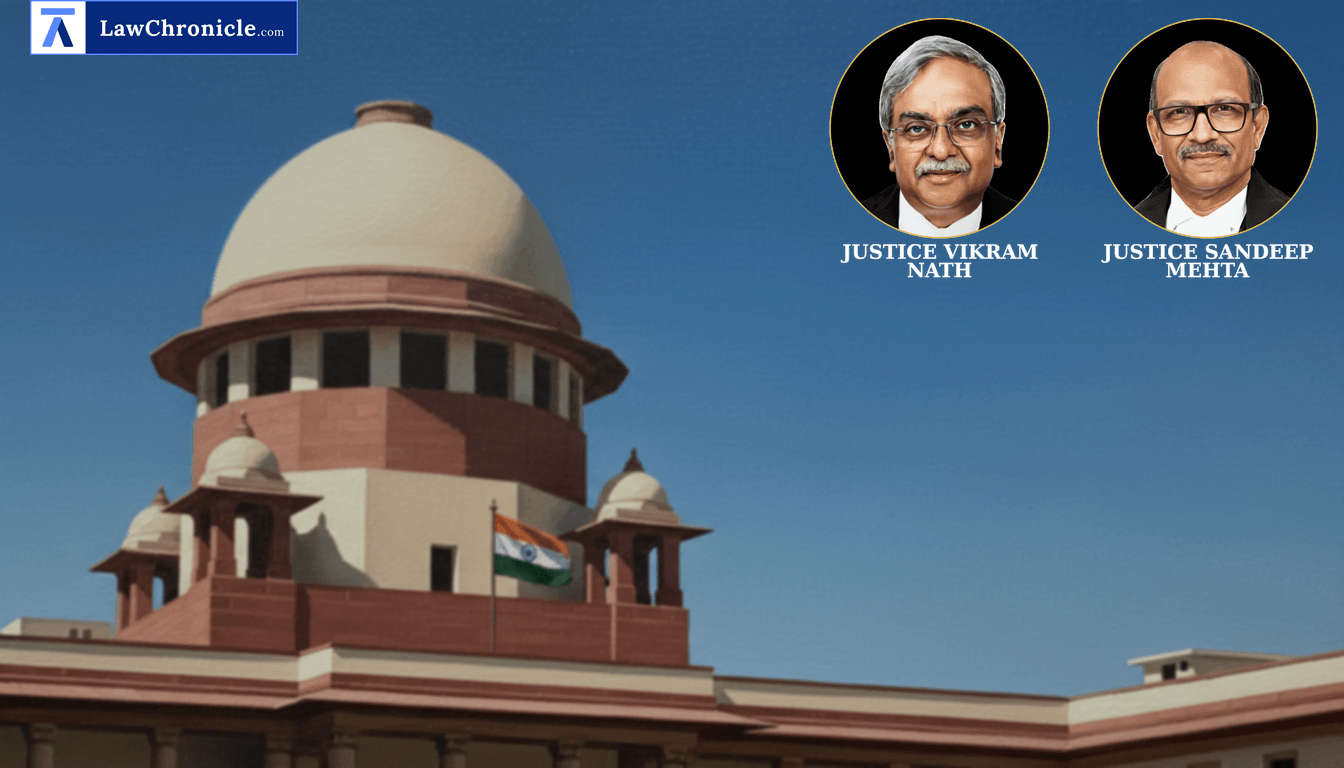
In Prabhu Kumar v. State of Himachal Pradesh & Others, the Supreme Court of India, championing the rights of specially-abled professionals, ruled that imposing an upper limit on disability for public employment without a rational basis violates constitutional guarantees and the mandate of the Rights of Persons with Disabilities Act, 2016. The Court emphasized that professional capability must be assessed based on actual functional competence rather than stereotypical assumptions or abstract disability percentages.
A bench comprising Justice Vikram Nath and Justice Sandeep Mehta heard the appeal of a law graduate with 90% permanent locomotor disability who was denied appointment as an Assistant District Attorney (ADA) despite topping the merit list in his category. The Court observed that the job of a law officer primarily requires mental alacrity and legal acumen, where physical disability in an arm or leg does not serve as an impediment.
The Court, in its reasoning, observed: "The RPwD Act, 2016 defines the 'floor' for reservation eligibility but does not empower the State to create an arbitrary 'ceiling' that excludes those with higher degrees of disability, provided they are otherwise capable of performing the functional requirements of the role through reasonable accommodation."
The Court has the following directions:
"(i) The respondent No.1-State of Himachal Pradesh shall forthwith, and not later than within a period of two weeks from today, issue the appointment letter to the appellant for the post of ADA in the subject recruitment process.
(ii) In the event that the designated vacant post is unavailable for any technical reason, respondent No.1-State shall create a supernumerary post to accommodate the appellant.
(iii) The appointment of the appellant shall relate back to 19th September, 2019, and the appellant shall be entitled to all notional benefits from the said date.
(iv) Considering the fact that the appellant, despite standing in merit was unjustly denied appointment and compelled to pursue prolonged litigation, we deem it appropriate to impose costs of Rs. 5 lakhs on respondent No.1-State of Himachal Pradesh, which shall be paid to the appellant within a period of four weeks from today."
Background:
The dispute arose when the Himachal Pradesh Public Service Commission issued an advertisement for 24 posts of Assistant District Attorney, keeping two posts reserved for persons with disability. However, the advertisement restricted eligibility to those having between 40% and 60% disability. The appellant, a practicing advocate since 2015 with 90% disability due to left shoulder disarticulation, qualified the written test and interview but was denied appointment based on this ceiling.
The High Court of Himachal Pradesh had previously dismissed the appellant's writ petition by relying on V Surendra Mohan v. State of Tamil Nadu ( "2019 4 SCC 237": 2019 CaseBase(SC) 1298). However, the Supreme Court noted that this precedent was expressly overruled by a three-judge bench in Vikash Kumar v. U.P.S.C., which established the principle of "reasonable accommodation."
Court's Rationale on Reasonable Accommodation
The Bench highlighted that Rights of Persons with Disabilities Act, 2016 mandates the State to make necessary modifications to ensure persons with disabilities enjoy rights on an equal basis. The Court referred to recent precedents including Om Rathod v. Director General of Health Sciences ( "2024 SCC OnLine SC 3130": 2024 CaseBase(SC) 753), Anmol v. Union of India & Ors ( "2025 SCC OnLine SC 387": 2025 CaseBase(SC) 71), and Kabir Pahariya v. National Medical Commission & Ors ( "2025 SCC OnLine SC 1025": 2025 CaseBase(SC) 730) to reiterate that arbitrary medical percentages cannot create insurmountable barriers to professional entry.
Inconsistency with Constitutional Mandates
The Court found that the 60% cap had no nexus with the duties of an ADA and was fixed without any expert consultation or objective evaluation required under Section 33 of Rights of Persons with Disabilities Act, 2016. Such exclusion was held to be "manifestly arbitrary" and inconsistent with Articles 14 and 16 of the Constitution of India.
Case Details:
Case No.: CIVIL APPEAL NO(S). 868 OF 2024
NeutralCitation: 2026 INSC 253
Case Title: PRABHU KUMAR v. STATE OF HIMACHAL PRADESH & OTHERS
Appearances:
For the Petitioner(s): Shri P.V. Dinesh, Senior Counsel
Source: 2026 CaseBase(SC) 533
Similar Articles
 Breaking News


