Supreme Court Quashes Mahant's Removal Over Breach of Natural Justice
 Copy Link
 Share
Share Save
Save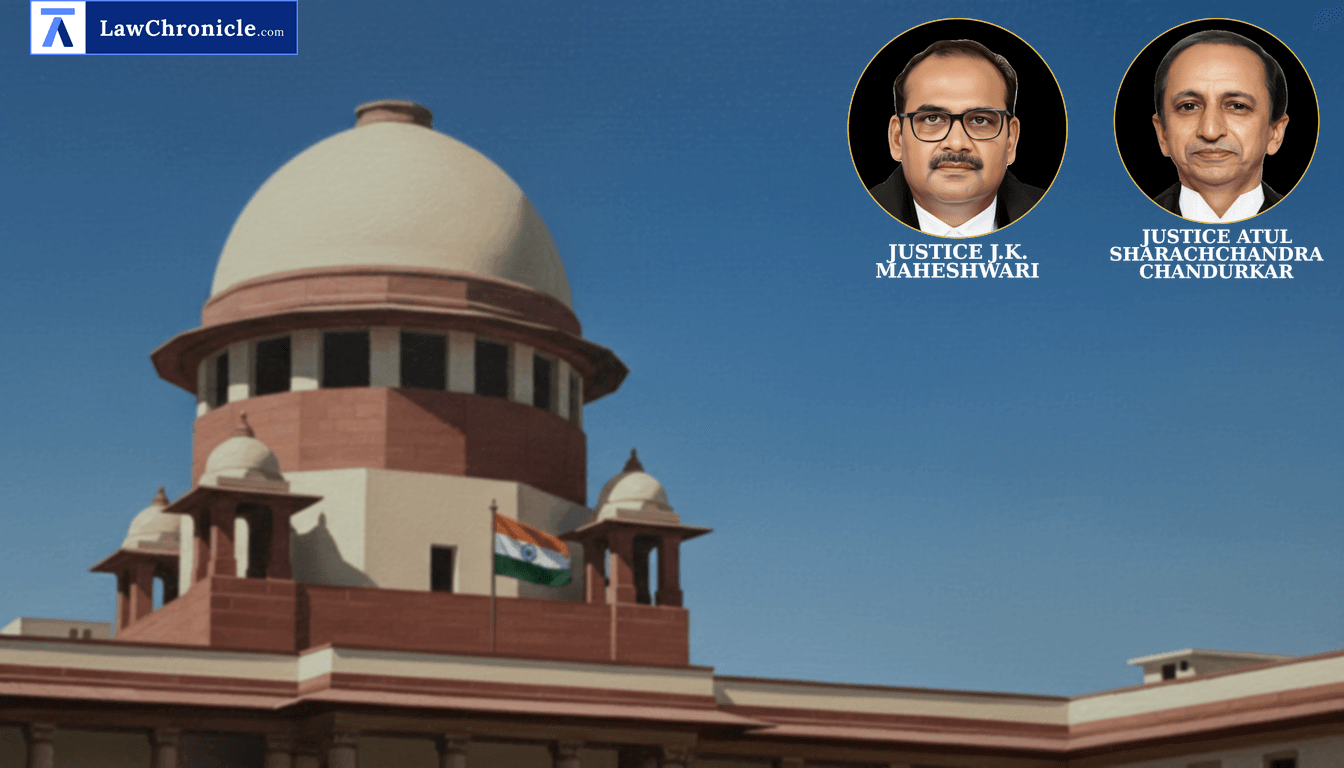
Protecting the procedural rights of religious heads, the Supreme Court set aside the removal of a Mathadhipati, emphasizing that the right to hold a religious office entails substantive civil rights that cannot be curtailed through a tainted or biased inquiry. The Court underscored that any process leading to the removal of a spiritual leader must be demonstrably fair, neutral, and minimally invasive, strictly adhering to the constitutional guarantee of fairness.
Justice J.K. Maheshwari and Justice Atul S. Chandurkar heard the appeal challenging the High Court of Andhra Pradesh's decision which had upheld the removal of the appellant from his position at Sri Swamy Hathiramji Mutt. The apex court found that the entire disciplinary proceeding, from the non-supply of documents to the pre-determined nature of the suspension, violated the core tenets of Constitution of India, 1950.
Fundamental Breach of Natural Justice and Procedural Fairness
The Court observed that the removal proceedings were vitiated by multiple violations. It was noted that a charge memo of 27 pages and over 600 pages of supporting documents were never properly served. The Court rejected the state's claim of service by affixation on the Mutt's gate, pointing out that the state had already taken physical possession of the premises, making such service a "legal absurdity." Furthermore, the appellant's requests for time and documents were ignored, and the enquiry was conducted ex-parte.
The Court, in its reasoning, observed: "The removal of a Mathadhipati from the office of the head of a religious institution is not an administrative act of ordinary character. It involves substantive civil rights involving the right to religious office and to carry on one’s spiritual vocation. The constitutional guarantee of fairness in procedure, enshrined in the principle of audi alteram partem and evinced from Constitution of India, 1950, applies with full force to such quasi-judicial proceedings."
On the Role of the Dharmika Parishad and Apparent Bias
The Bench expressed concern over the structural composition of the enquiry, noting that the members who resolved to charge the appellant were the same ones conducting the investigation. Invoking the principle of nemo judex in causa sua, the Court found a reasonable apprehension of bias. It further noted that the Dharmika Parishad, composed entirely of State nominees, had repeatedly attempted to control the Mutt's administration despite prior judicial findings vesting management in the appellant.
To ensure a fair process, the Court invoked its plenary powers under Constitution of India, 1950 to bypass the standard statutory remand, appointing an independent one-man committee and a separate administrative committee to oversee the Mutt's affairs during a fresh enquiry.
Directions Issued by the Court
The Court has the following directions:
"(i) An appropriate venue for conducting the said enquiry proceedings shall be provided by the Principal District Judge, Chittoor within the premises of the Court Complex, Tirupati.
(ii) For purposes of the said enquiry, the concerned Principal District Judge shall depute two court staff to assist the Enquiry Committee on each day of sitting.
(iii) The documents forming part of the record of the Enquiry Committee shall be kept in the custody of the court as directed by Principal District Judge.
(iv) The State Government of Andhra Pradesh and the Endowments Department/Dharmika Parishad shall, within two weeks, handover the charge memo dated 08.06.2023 and copies of all relevant documents and material referred in the charge memo to the Enquiry Committee.
(v) On receiving the said material, the Enquiry Committee shall immediately supply those relevant documents and material which they want to rely upon, to the Appellant.
(vi) Upon receipt of the above documents, the Appellant shall be afforded a minimum period of four weeks for submitting his statement of defence extendable further by the Enquiry Committee on reasonable cause shown by the Appellant.
(vii) The Enquiry Committee is at liberty to ask for an officer of Endowment Department to represent the department and be permitted to participate in the enquiry representing the department.
(viii) The Enquiry Committee is at liberty to provide assistance for defence and thereafter, conduct a formal hearing in which the Appellant shall be afforded full opportunity to examine documents, cross-examine witnesses produced in support of the charges, and adduce evidence, oral and documentary, if any.
(ix) The Enquiry Committee may regulate its own procedure, subject to the requirements of Section 51(2) of the Act and the directions of this Court and shall record reasons for all procedural decisions.
(x) The Enquiry Committee shall submit its report within one year from the date of supply of documents, to the Endowments Department.
(xi) The Enquiry Committee shall be provided with all necessary infrastructure and support through the concerned Principal District Judge, for which the State Government shall co-operate till completion of enquiry. Enquiry committee at liberty to provide defence assistance.
(xii) The expenses of the Enquiry Committee shall be borne from the funds of the Mutt.
(xiii) The Enquiry Committee would be entitled for to and fro travel expenses equivalent to first class railway ticket or equivalent airfare and in addition, Rupees Twenty Thousand per sitting.
(xiv) The Enquiry Committee shall submit its report to the Endowment Department after conclusion of the enquiry, whereupon the department shall take final decision in accordance with law.”
Background:
The dispute originated from allegations of financial misappropriation, violation of monastic customs (celibacy), and mismanagement of Mutt properties. The Dharmika Parishad, constituted under Section 152 of the Andhra Pradesh Charitable And Hindu Religious Institutions And Endowments Act, 1987, had removed the appellant following an enquiry report dated August 1, 2023. This removal was confirmed by the State Government and subsequently upheld by the High Court in a Civil Miscellaneous Appeal.
The appellant argued that he was never given the 29 relied-upon documents and was unceremoniously expelled while on a pilgrimage. He relied on precedents such as Canara Bank Vs. V. K. Awasthy ( "(2005) 6 SCC 321": 2005 CaseBase(SC) 928) to argue that copies of statements are essential for a fair defense. The Supreme Court agreed, noting that the High Court failed to exercise its full appellate jurisdiction by not independently examining the evidence and procedural lapses. While the Court refrained from ruling on the vires of Section 152 of the Andhra Pradesh Charitable And Hindu Religious Institutions And Endowments Act, 1987 (currently pending elsewhere), it held that the current proceedings could not stand. The Court referred to The Commissioner, Hindu Religious Endowments, Madras v. Sri Lakshmindra Thirtha Swamiar of Sri Shirur Mutt ( "AIR 1954 SC 282": 1954 CaseBase(SC) 168) and Ratilal Panachand Gandhi v. State of Bombay ( "AIR 1954 SC 388": 1954 CaseBase(SC) 83) to emphasize that a Mahant's office blends both property rights and spiritual duties, which cannot be easily severed by administrative fiat.
Case Details:
Case No.: Civil Appeal No. OF 2026 (Arising out of SLP (Civil) No. 38500 OF 2025)
NeutralCitation: 2026 INSC 592
Case Title: ARJUN DASS VERSUS THE STATE OF ANDHRA PRADESH AND ORS.
Appearances:
For the Petitioner(s): Mr. Puneet Jain, Senior Counsel
For the Respondent(s): Mr. Sidharth Luthra, Senior Counsel
Source: 2026 CaseBase(SC) 519
 Breaking News