


Supreme Court Refers Scope of IBC Moratorium in NI Act Cases to Larger Bench
 Copy Link
 Share
 Save
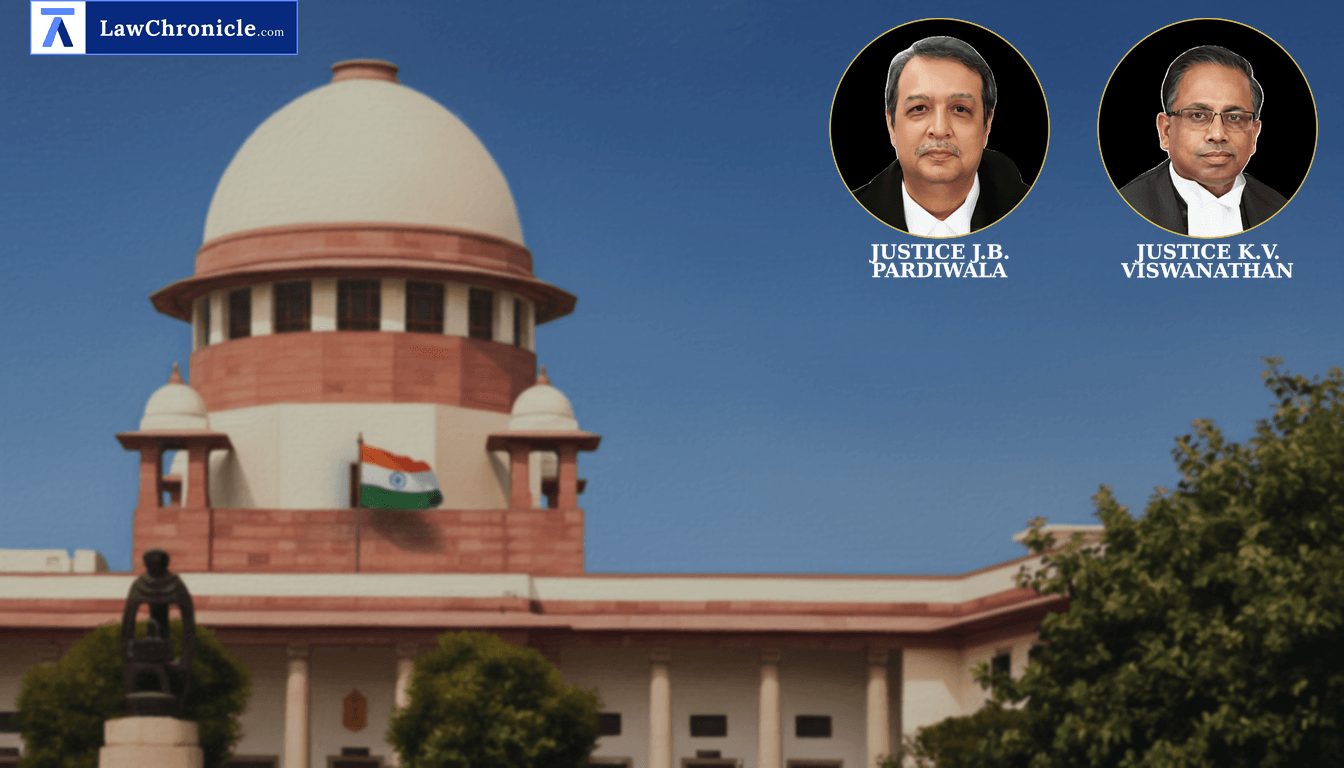
The Supreme Court has clarified that proceedings under Section 138 of the Negotiable Instruments Act, 1881 are predominantly criminal in nature and cannot be categorized merely as debt recovery actions, thereby holding that the interim moratorium under the Insolvency and Bankruptcy Code, 2016 does not stall the criminal aspect of such prosecutions.
A bench of Justice J.B. Pardiwala and Justice K.V. Viswanathan heard the appeal challenging a Madras High Court order that refused to stay a cheque bounce complaint despite the petitioner undergoing personal insolvency. The Court engaged in a deep analysis of the nature of the offence and its interaction with the moratorium provisions under Part III of the Insolvency and Bankruptcy Code, 2016.
The Predominantly Criminal Character of Cheque Dishonour
The Court observed that while the origin of the dispute may be a civil debt, the 'deeming fiction' created by the legislature under Section 138 of the Negotiable Instruments Act, 1881 transforms the act of dishonour into a criminal offence aimed at ensuring commercial discipline. The Court noted that the primary objective is deterrence, ensuring faith in negotiable instruments.
The Court, in its reasoning, observed: "The enactment of Section 138 makes the wrongful act of breach of trust placed in cheque as a negotiable instrument, a criminal offence and provides for penal consequences therefor. In such a scenario, where the injury continues to remain civil but the act causing it has intentionally been made criminal by way of a statutory provision, we find it difficult to accept that the offence is a ‘civil sheep in criminal wolf’s clothing’."
Bifurcation of Section 138: Tier I and Tier II Objectives
In a landmark analytical shift, the Court proposed a 'tiered' understanding of Section 138. Tier I represents the mandatory criminal aspect (imprisonment and fine), while Tier II represents the discretionary compensatory aspect under Section 395 of the Bhartiya Nyaya Suraksha Sanhita, 2023.
Interaction with IBC Moratorium
Referring to P. Mohanraj v. Shah Bros. Ispat (P) Ltd. ( "(2021) 6 SCC 258": 2021 CaseBase(SC) 891), Ajay Kumar Radheshyam Goenka v. Tourism Finance Corporation of India Ltd. ( "(2023) 10 SCC 545": 2023 CaseBase(SC) 514), and Rakesh Bhanot v. Gurdas Agro Private Limited, the Court held that while the criminal aspect (Tier I) remains unaffected by a moratorium, the recovery of compensation (Tier II) must be stayed. The Court reasoned that since 'fine' is an 'excluded debt' under Section 79(15) of the Insolvency and Bankruptcy Code, 2016, criminal liability persists. However, compensation, being in the nature of a civil claim, would lead to depletion of the debtor's assets, thus falling under the moratorium's protective umbrella.
Directives Issued to the Registry
Given the divergence of views and the significant impact on commercial law, the Court referred the matter to a larger bench. The Court has the following directions:
"The three-Judge Bench constituted may refer to the following questions:
(i) Whether the provisions of Section 138 of the NI Act and the objective underlying the enactment thereof indicate that it is quasi-criminal in nature with a tilt towards the criminal side?
(ii) Whether the moratorium provisions under Part III of the IBC should be made applicable on the entire proceedings under Section 138 of the NI Act or only to the compensatory aspect thereof?"
Background:
The appellant, former Managing Director of M/s. Surana Power Ltd., was prosecuted for a dishonoured cheque of Rs. 5,03,21,250 issued to the respondent bank. During the pendency of the trial, personal insolvency proceedings were initiated against him under Section 95 of the Insolvency and Bankruptcy Code, 2016, followed by a bankruptcy order. The appellant sought a stay of the Negotiable Instruments Act, 1881 proceedings, arguing that Sections 96 and 101 of the Insolvency and Bankruptcy Code, 2016 provided a blanket stay on all legal actions 'in respect of any debt'.
The High Court dismissed the plea, holding that Section 138 is not a proceeding for recovery of money. The Supreme Court upheld the continuity of the criminal prosecution but emphasized that the compensatory element of the judgment cannot be enforced against the debtor's estate while the moratorium is in place. To settle the 'quasi-criminal' versus 'predominantly criminal' debate initiated in P. Mohanraj v. Shah Bros. Ispat (P) Ltd. ( "(2021) 6 SCC 258": 2021 CaseBase(SC) 891), the matter now stands referred to a three-judge bench.
Case Details:
Case No.: Criminal Appeal No. 2026 (Arising out of SLP (Crl.) No. 12135 of 2024)
NeutralCitation: 2026 INSC 579
Case Title: Dineshchand Surana v. UCO Bank
Appearances:
For the Petitioner(s): Mr. Shreeyash Lalit, Advocate
For the Respondent(s): Mr. Briijesh Kumar Tamber, Advocate
Source: 2026 CaseBase(SC) 496
Similar Articles

 Breaking News


