


Supreme Court Restored Trial Court Acquittal, Holding Confession and Circumstances Insufficient for Conviction
 Copy Link
 Share
 Save
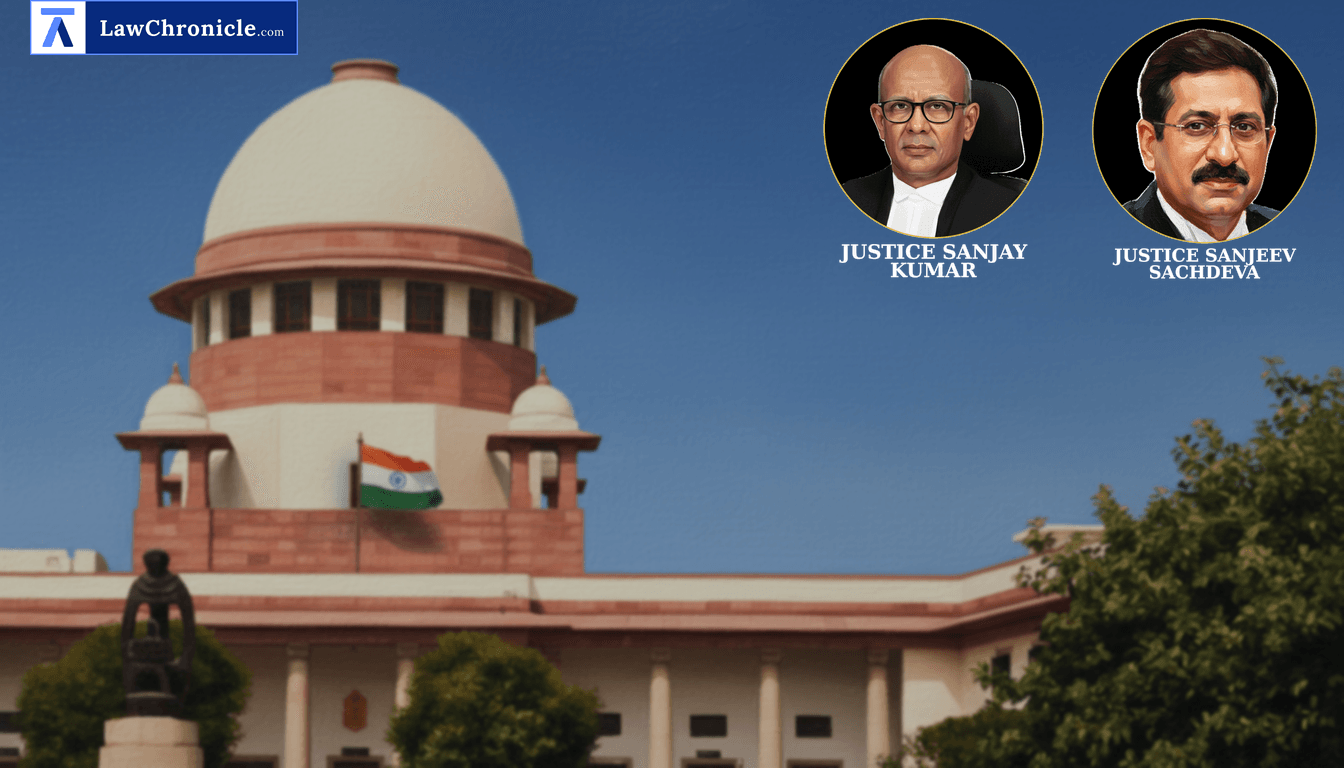
A bench of Justices Sanjay Kumar and K. Vinod Chandran heard appeals challenging the Meghalaya High Court's reversal of a trial acquittal and conviction for murder and disappearance of evidence. The appeals arose from conflicting findings between the Trial Court, which acquitted the accused, and the High Court, which convicted them under Sections 302 and 201 of the Indian Penal Code after finding the "five golden principles" of circumstantial evidence satisfied.
The Court allowed the appeals, set aside the High Court's conviction and restored the Trial Court's order of acquittal. The Bench found that the chain of circumstances, as led by the prosecution, was incomplete and that the confessional statements were unreliable and uncorroborated. The Court noted weaknesses in the prosecution's case on the last-seen theory, timing of death, identification procedures, recoveries and forensic links. The Court, in its reasoning, observed: “The confession allegedly made by the appellants is of no use in bringing home a conviction, especially when there was no corroboration available, of the statements made, from other valid evidence. There was thus no single circumstance available, incriminating the accused in the death of their friend.” The Bench directed that the accused be released forthwith if not required in any other case, and ordered that bail bonds stand cancelled where applicable.
Background
The case originated from a missing-person complaint after a college student disappeared on 18.02.2006. Investigation led to arrests, discovery and exhumation of a body from a graveyard, recovery of a rope alleged to have been used for strangulation, alleged ransom calls to the deceased's father, and seizure of certain belongings said to belong to the victim. At trial the Trial Court examined 34 prosecution witnesses, accepted forensic and medical evidence with reservations, and ultimately acquitted the accused citing insufficiency of proof. On State appeal the High Court reversed the acquittal, applying the principles in Sharad Birdhichand Sarda v. State of Maharashtra and concluding that the circumstantial case excluded all reasonable hypotheses of innocence.
On appeal to the Supreme Court, defence counsel argued that the High Court substituted its own inferences, failed to treat the Trial Court's view as a possible one, and ignored reasonable doubt arising from lacunae in investigation and inconsistencies in confessional statements. The State relied on last-seen testimony, recoveries, and confessions, citing precedents that a voluntary confession, even if retracted, can be used for conviction.
The Supreme Court examined the medical evidence that recorded ligature marks and ruptured spleen but also acknowledged opinions that hanging could not be excluded, and found the post-mortem timing left the last-seen theory unproven. The Court recorded defects in identification evidence — including in‑station identification without a test parade and absence of ownership records of an alleged autorickshaw — and found the discovery of the body and rope unreliable under Section 27 of the Evidence Act because of gaps in disclosure statements and seizure procedure. Forensic analysis did not show human tissue or blood on the rope. Several seized personal items were not identified by the victim's father and some seizure witnesses turned hostile. The Court also highlighted procedural infirmities in recording confessions: discrepancies in dates, language inconsistencies, absence of recorded offer of legal assistance and the exculpatory nature of one confession that incriminated the co‑accused. Relying on settled authorities including Chandrappa v. State of Karnataka and Manoharan v. State, the Court said a confession required satisfactory corroboration and voluntary recording; finding neither, it held the confessions could not sustain conviction. The Supreme Court concluded there was “no circumstance having been found... to arrive at a hypothesis of guilt,” reversed the High Court and restored the Trial Court’s acquittal, granting directions for release.
Case Details: Case No.: 2026 INSC 85; Criminal Appeal No. 3738 of 2023 Case Title: Bernard Lyngdoh Phawa v. The State of Meghalaya Appearances: For the Petitioner(s): Sh. Subhro Sanyal, Advocate‑on‑Record; Sh. Ajay Sabharwal, Advocate For the Respondent(s): Sh. Avijit Mani Tripathi, Advocate‑on‑Record
Similar Articles
 Breaking News


