


Supreme Court Restores Conviction in Dr. Subbiah Murder Case
 Copy Link
 Share
 Save
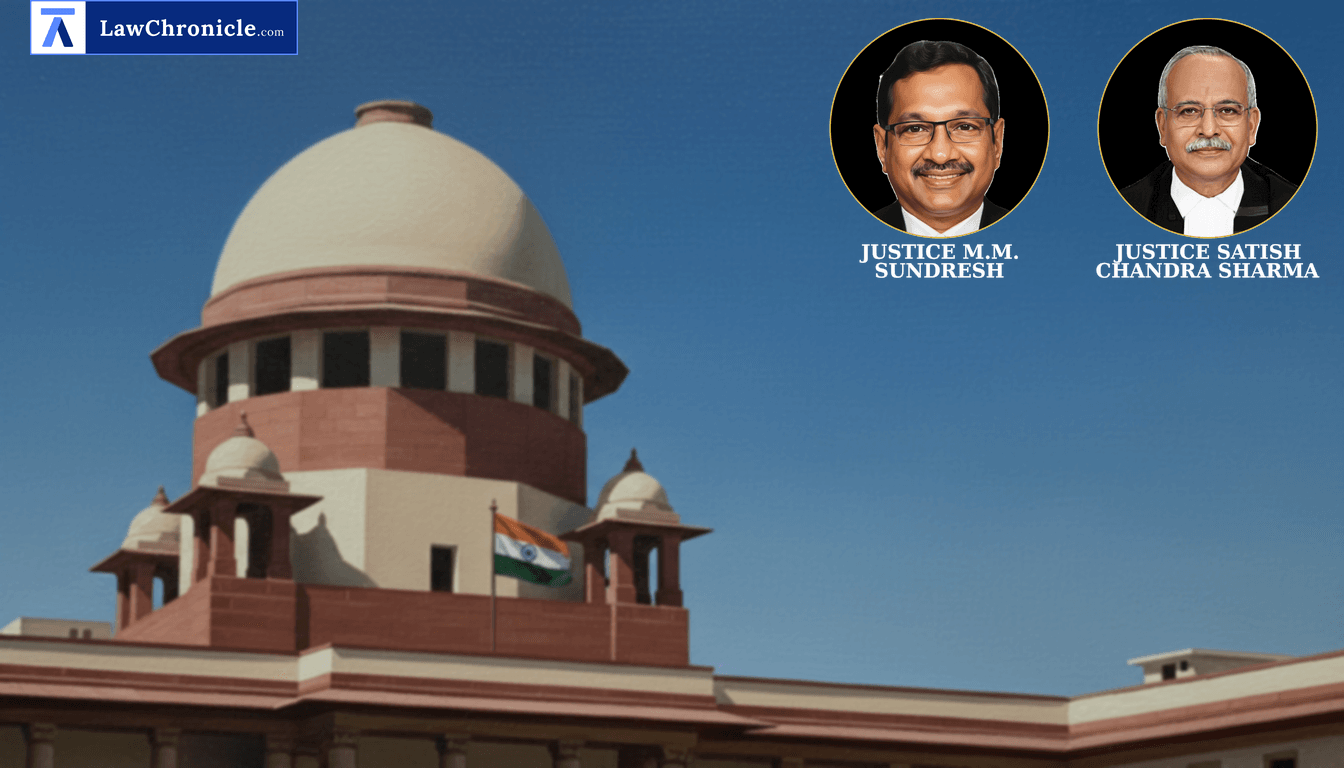
The Supreme Court has set aside a Madras High Court judgment of acquittal, restoring the conviction of multiple individuals in the sensational 2013 broad daylight murder of Dr. Subbiah in Chennai. The Court emphasized that a High Court, while sitting in appeal, should not replace a legally plausible view of the Trial Court with its own subjective assessment of evidence.
A bench of Justice M. M. Sundresh and Justice Satish Chandra Sharma heard the appeals filed by the State of Tamil Nadu against the acquittal of the accused persons. The Court noted that the case was a classic illustration of how human greed can surpass all limits of sound behavior, leading to the crushing of human lives.
Legal Validity of Gait Analysis and Re-enactment
One of the central legal issues was whether compelling an accused to re-enact a crime scene violates the protection against self-incrimination under Article 20(3) of the Constitution of India, 1950. The High Court had previously held such re-enactments to be inadmissible. However, the Supreme Court clarified that if a re-enactment is merely a directed demonstration to analyze physical attributes like gait, it does not amount to personal testimony.
The Court, in its reasoning, observed: "...it cannot be held as a general proposition that every re-enactment or demonstration of a crime scene per se amounts to personal testimony of the accused. If the re-enactment is merely based on a direction to walk or to act a certain way or to imitate a visual sequence, it does not necessarily involve any physical manifestation or disclosure of the personal knowledge of the accused. In that sense, it does not amount to any personal testimony."
Court Observations on Evidence and Standard of Proof
The Court highlighted that the prosecution had established the guilt of the accused through a consistent chain of direct and circumstantial evidence, including testimonies from eye-witnesses and an approver. While the Court rejected the Indian Evidence Act, 1872 Section 65-B certification for Call Detail Records and the Gait Analysis report due to chain-of-custody issues, it held that the remaining evidence was sufficient for conviction.
Background:
The dispute originated from a 2-acre land parcel in Kanyakumari District. Dr. Subbiah had filed multiple criminal complaints and applications for cancellation of anticipatory bail against the family of A1. Driven by the motive to eliminate the hindrance to disposing of the property, the accused hatched a conspiracy. The execution involved hiring henchmen (A8, A9, and PW12) who attacked the doctor with a sickle outside Billroth Hospital.
The Court relied on principles established in Vaibhav v. State of Maharashtra ( "2025 INSC 800": 2025 CaseBase(SC) 598) regarding the relevance of motive and referred to Subha @ Shubhashankar vs. State of Karnataka and another concerning the constitutional power of pardon under Article 161. While restoring the life sentences, the Court showed leniency to the elderly parents (A1 and A2) by allowing them to seek pardon from the Governor of Tamil Nadu.
Case Details:
Case No.: CRIMINAL APPEAL NO(S). 2493-2502 OF 2025
NeutralCitation: 2026 INSC 507
Case Title: THE STATE OF TAMIL NADU VERSUS PONNUSAMY & ORS.
Source: 2026 CaseBase(SC) 436
Similar Articles

 Breaking News


