Supreme Court Restores Conviction In Suspicious Nighttime Cremation, Applies Section 106 To Husband's Silence
 Copy Link
 Share
Share Save
Save
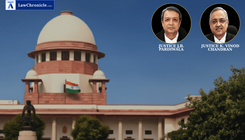
A bench of Justice J.B. Pardiwala and Justice Manoj Misra heard an appeal by the State of Madhya Pradesh challenging the High Court of Madhya Pradesh, Gwalior’s acquittal of an accused husband who had been convicted by the trial court for the murder of his wife and destruction of evidence. The principal issues before the Court were the reliability of a seven‑year‑old child eyewitness, alleged tutoring and delay in recording her police statement, and the applicability of Section 106 of the Evidence Act where key facts lay peculiarly within the accused’s knowledge.
The Court allowed the State’s appeal, set aside the High Court’s acquittal and restored the trial court’s conviction under Sections 302 and 201 read with Section 34 IPC. The Court held that the child witness (PW6) was competent and her testimony, properly scrutinised, inspired confidence; supplementary circumstantial facts established a prima facie case that called for explanation by the accused under Section 106. The Court remarked that in clandestine offences within the four walls of a home the prosecution was not required to lead evidence that was “almost impossible” to produce, and that an accused who remained silent and failed to explain incriminating circumstances could not benefit from that silence. The Court, in its reasoning, observed: “It is useful to quote the following observation ... that this section is not intended to relieve the prosecution of its burden to prove the guilt of the accused beyond reasonable doubt, but it would apply to cases where the prosecution has succeeded in proving facts from which a reasonable inference can be drawn regarding the existence of certain other facts, unless the accused by virtue of his special knowledge regarding such facts, failed to offer any explanation which might drive the court to draw a different inference.” The Supreme Court directed the convicted accused to surrender within four weeks to undergo the sentence imposed by the trial court.
Background The deceased, Birendra Kumari, was the wife of the respondent accused and mother of a seven‑year‑old daughter, Rani. On the night of 15 July 2003 villagers heard the deceased screaming; the screams later ceased and the body was found cremated in the accused’s field the following morning. The complainant and other relatives lodged an unnatural death report and police inquest; the investigating officer seized ashes, bones, burnt bangles and a diesel can. The trial court accepted the child’s in‑court testimony that the accused had grabbed his wife, hit her with a stick, and “put his leg on the neck of her mother,” causing death; the court treated clandestine night cremation, the accused’s flight and prior harassment/dowry demands as corroborative circumstantial evidence and convicted.
The High Court reversed, finding the child witness’s statement recorded under Section 161 CrPC was delayed by 18 days, observing a real possibility of tutoring because the child stayed with an uncle who was hostile to the accused, and noting perceived contradictions and distance between houses which, it held, made hearing nocturnal cries unlikely. It held the child’s evidence was “shaky” and declined to apply Section 106.
Before the Supreme Court, the State argued the High Court erred in rejecting the child’s demeanour and in failing to apply settled law on child witnesses and circumstantial evidence; the accused relied on alleged delays and perceived inconsistencies. The Supreme Court analysed authorities on competency and corroboration of child witnesses, principles for assessing tutoring and for appreciation of circumstantial evidence, and the scope of Section 106. It found foundational facts — death inside a house, clandestine night cremation, the accused’s unexplained flight and silence, strained marital relations and absence of any medical cause — together formed a prima facie case that required explanation from the accused. The Court restored the trial court’s finding that “the accused Balvir pressed the neck of his wife with his leg due to which she died,” and ordered surrender.
Case Details: Case No.: Criminal Appeal No. 1669 of 2012 (2025 INSC 261) Case Title: The State of Madhya Pradesh v. Balveer Singh Appearances: For the Petitioner(s): Not available For the Respondent(s): Not available
 Breaking News