


Supreme Court: Premature Quashing of FIR Unjustified When Expert Report Was Pending
 Copy Link
 Share
 Save
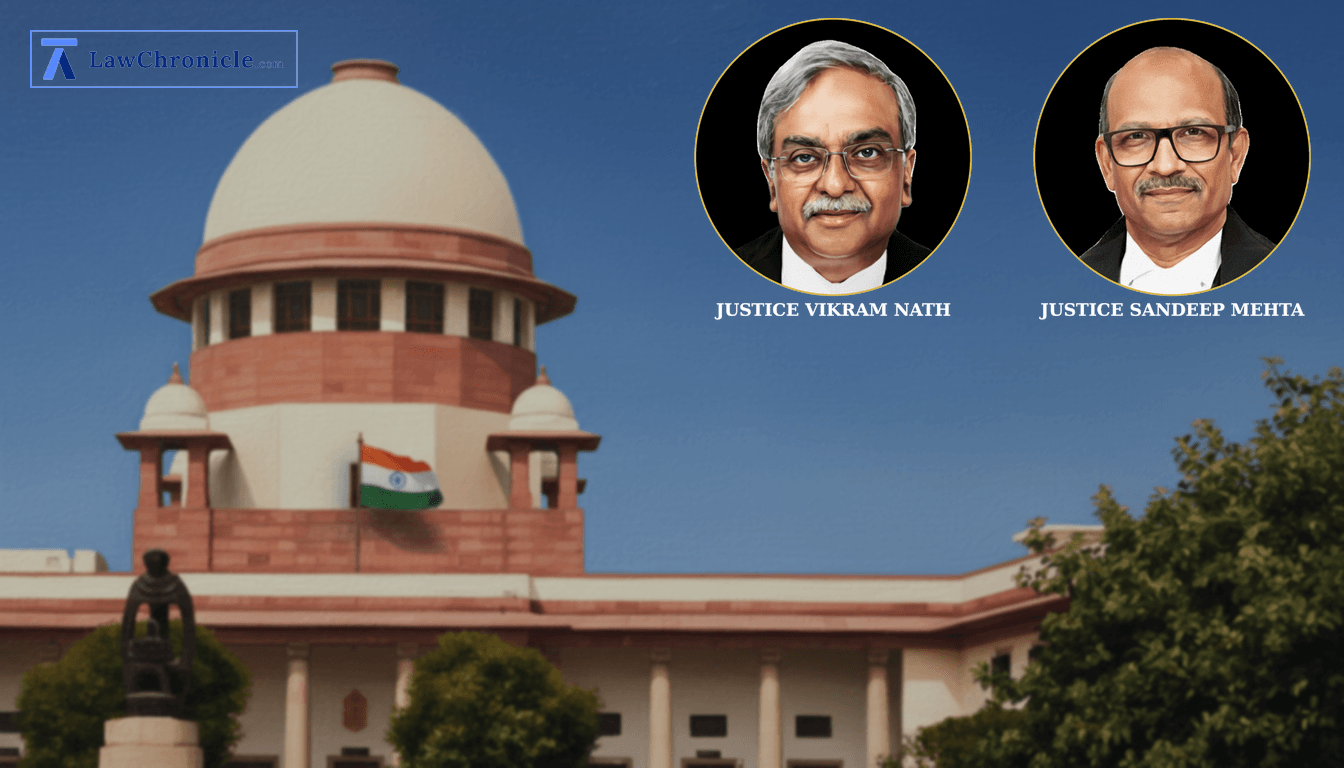
A bench of Justices Vikram Nath and Sandeep Mehta heard appeals by the original complainant and the State of Himachal Pradesh against a High Court order that quashed an FIR registered at State CID, Shimla. The appeals arose from petitions under Section 482 CrPC in which the Single Judge of the Himachal Pradesh High Court had terminated criminal proceedings at the threshold in a matter involving alleged forgery, fraud and conspiracy to grab ancestral property.
The Supreme Court allowed the appeals, set aside the High Court’s order dated 8 January 2024 and directed the Investigating Officer to conclude the investigation and file the result at the earliest. The Court held that the High Court had “prematurely quashed and terminated” the proceedings while vital investigation was still underway and while disputed documents had been sent to the State Forensic Science Laboratory (SFSL) for examination. The Court emphasised that where forgery allegations were made and the agency had referred disputed documents for expert analysis, quashing before receipt of the expert’s report would be unjustified. The Court, in its reasoning, observed: “where allegations of forgery are set out in the FIR and Investigating Agency has undertaken the exercise of getting the disputed documents examined through the handwriting expert, an order quashing the FIR without awaiting the outcome of the handwriting expert’s report would be totally unjustified.” The judgment further recorded that “there was no reason whatsoever for the High Court to have proceeded to quash the FIR” once investigation into genuineness of signatures was in progress, and clarified that its observations were “restricted only to the decision of the present appeal(s) and shall have no bearing on the rights and defences available to the parties at the appropriate stage of the case.”
Background
The dispute arose from an FIR dated 26 August 2022 filed by Sharla Bazliel, who described herself as the adopted daughter and legal heir of the late Dr. G.B. Bazliel. She alleged that three respondents conspired to grab family movable and immovable property agricultural land measuring over 49 bighas in Village Katli and other assets by influencing her father, forging signatures, fabricating sale deeds and misappropriating bank funds. The complaint recorded transfers totalling over Rs. 1.23 crore from the father’s bank accounts, a registered sale at a purportedly undervalued consideration of Rs. 3.90 crores, alleged false NOCs and the father’s subsequent death in a hotel owned by one of the accused. The FIR named offences under Sections 420, 465, 467, 468, 471 and 120-B IPC.
During investigation the police noted discrepancies between sale deed values and Government circle rates and forwarded questioned documents to the SFSL for forensic examination. The investigating agency’s material and SFSL reports (placed on record before the Supreme Court) indicated that certain nominated documents and closure documents bore forged signatures; the SFSL later concluded that signatures on the questioned documents were facsimile stamps and not handwritten signatures of the deceased. The Investigating Officer also reported short payment of stamp duty and registration charges, causing loss to the exchequer.
The High Court, while quashing the FIR under its inherent powers, held that the allegations did not disclose necessary ingredients of forgery or fraud and characterised the complaint as speculative; it relied on this Court’s decision in Mir Nagvi Askari v. CBI. The Supreme Court found that reliance misplaced, noting the investigation had already sought expert opinion and that the proof of forgery depended on outcome of that comparison. The Court observed that, in these circumstances, prosecution could not be stifled at the threshold by exercise of Section 482 CrPC or Article 226 powers.
The appeals were allowed. The Investigating Officer was directed to complete the investigation and file the report; if a report under Section 173(2) CrPC (corresponding to Section 193(3) of the Bharatiya Nagarik Suraksha Sanhita, 2023 had already been filed, the trial Court was to proceed in accordance with law. The Court clarified that its ruling would not prejudice the parties’ rights and defences at the appropriate forum.
Case Details:
Case No.: Criminal Appeal Nos. of 2026 (Arising out of SLP(Crl.) Nos. 3533 of 2024 and 2498 of 2025)
NeutralCitation: 2026 INSC 252
Case Title: Sharla Bazliel v. Baldev Thakur and Others
Source: 2026 CaseBase(SC) 219
Similar Articles


 Breaking News


