Supreme Court Restores Multiplier Method for Loss of Earning Capacity
 Copy Link
 Share
Share Save
Save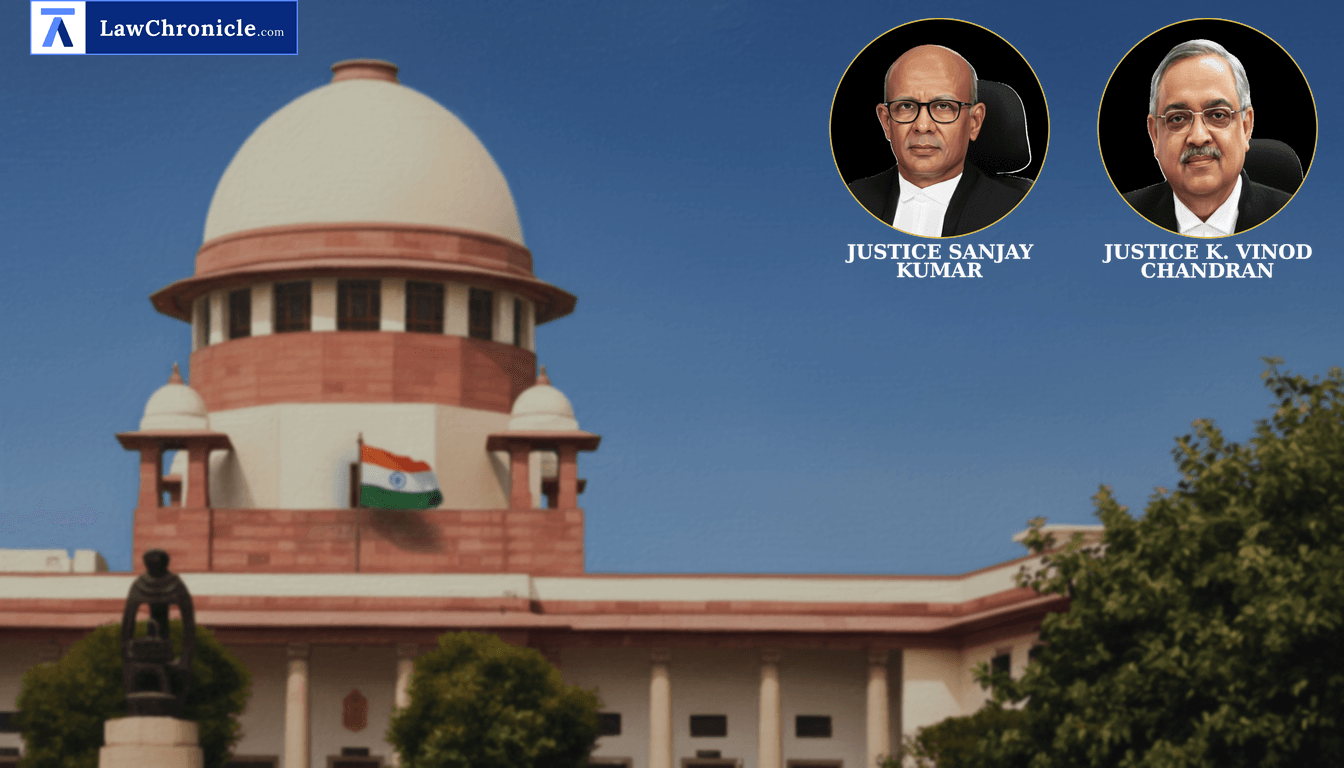
The Supreme Court has clarified that the multiplier method is the standard for assessing loss of earning capacity in motor accident claims, setting aside a High Court decision that used an arbitrary per-percentage disability calculation.
A bench of Justice Sanjay Kumar and Justice K. Vinod Chandran heard an appeal challenging a significant reduction in compensation awarded to a motorcycle rider who suffered permanent disability. The Court scrutinized the High Court's approach to calculating compensation for professional coaches and restored the more robust multiplier-based assessment originally conducted by the Motor Accident Claims Tribunal.
Invalidity of the Per-Percentage Disability Award
The Supreme Court expressed strong disapproval of the High Court's departure from established legal principles regarding disability compensation. The Court noted that while the Tribunal had correctly applied the multiplier method, the High Court had reduced the award based on an erroneous reasoning that the multiplier method was inappropriate for the specific disability level.
The Court, in its reasoning, observed: "We cannot but find that the loss of earning capacity as assessed by the High Court is unheard of. As we found the measure adopted by the High Court is totally erroneous and the Tribunal correctly assessed the loss of earning capacity and granted compensation based on the salary, the age and the future prospects applicable to a self-employed person..."
Assessment of Disability and Income
The appellant, a squash coach, was assessed with 20% permanent disability by two separate Regional Medical Boards. Despite evidence of his earnings and appointment at an institute of national importance, the High Court had drastically cut his compensation for loss of earning capacity from over Rs. 17 lakhs to just Rs. 80,000. The Supreme Court found the Tribunal's original assessment to be more aligned with the principle of awarding 'just compensation.'
The Court has following directions:
"The compensation awarded as above shall be paid after deducting what is already paid with interest @ 7.5% as awarded by the Tribunal. The same shall be disbursed to the appellant within a period of three months from the receipt of this order."
Background:
The dispute originated from a motorcycle accident on August 16, 2019, caused by a rashly driven offending vehicle. The appellant sustained injuries leading to a 20% permanent disability. The Tribunal awarded total compensation of Rs. 19,58,513, including a substantial amount for loss of earning capacity using the multiplier 18, considering the appellant's age and income as a squash coach.
On appeal by the insurance company, the High Court drastically reduced the 'loss of earning capacity' component by discarding the multiplier method and instead awarding a flat sum of Rs. 4,000 per percentage of disability. However, the High Court did add compensation for 'loss of amenities.'
The Supreme Court, while allowing the appeal, restored the Tribunal's multiplier-based calculation but removed the Rs. 50,000 granted by the High Court for 'loss of amenities,' ruling that loss of earning capacity already encompasses such loss. The final compensation was recalculated at Rs. 19,81,513.
Case Details: Case No.: Civil Appeal No. OF 2026 (@ SLP (C) No. 22089/2023) NeutralCitation: 2026 INSC 500 Case Title: Santhosh v. United India Insurance Company Ltd. and Anr.
Source: 2026 CaseBase(SC) 585
 Breaking News