


Supreme Court Sets Aside Allahabad HC Bail Order, Holds Parity Misapplied in Face of Fake IDs and Fugitive Conduct
 Copy Link
 Share
 Save
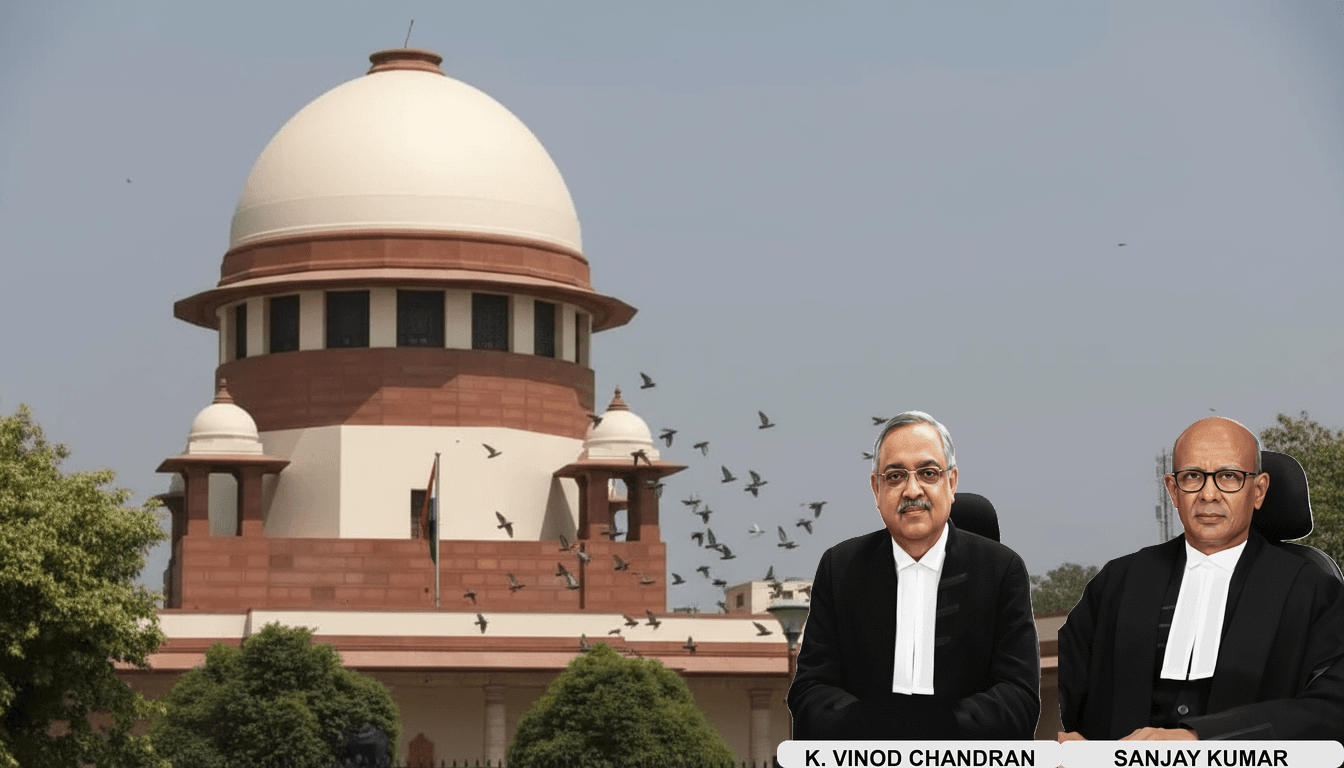
A bench of Justices Sanjay Kumar and K. Vinod Chandran heard the criminal appeal filed by Rakesh Mittal challenging the Allahabad High Court’s order dated 12.11.2025 which granted bail to accused Ajay Pal Gupta @ Sonu Chaudhary in connection with FIR No. 0568 of 2023. The appeal arose from the complainant’s grievance against the High Court’s reliance on parity with co-accused while respondent No.1 faced multiple FIRs and serious allegations of fraud, forgery and use of fictitious identities.
The Supreme Court allowed the appeal and set aside the impugned bail order. The Court held that the High Court had “blindly extended the parity principle” without taking into account respondent No.1’s criminal antecedents, long period of absconsion, use of multiple aliases and recovery of forged identity documents. The Court noted that offences under Sections 409 and 467 IPC were also attracted and that it was premature to assume the matter was triable only by a Magistrate. The Court, in its reasoning, observed: "In such circumstances, the High Court ought not to have blindly extended the parity principle to him without considering the particular and distinctive features of his individual case." The Court further recorded that "the impugned order dated 12.11.2025 passed by the Allahabad High Court, Lucknow Bench, granting bail to respondent No.1, therefore, cannot be sustained either on facts or in law." The appeal was allowed and the State was directed to expedite the trial.
Background
The dispute arose from a complaint by Rakesh Mittal that he had supplied foodgrains to four accused, including Ajay Pal Gupta, but received only ₹5,02,57,000 out of ₹11,52,38,156 due. The complainant alleged issuance of dishonoured cheques and a conspiracy involving forged documents and fabricated addresses, including false Aadhaar cards. The FIR registered on 29.12.2023 initially charged offences under Sections 406, 419, 420, 467, 468, 471 and 506 IPC; investigation later added Section 409 IPC after discovery of ingredients of criminal breach of trust.
Investigation by the Crime Branch revealed that respondent No.1 had used a multiplicity of names and aliases and produced several Aadhaar cards and a PAN card with inconsistent names and addresses; some documents replaced his father’s name. He remained a fugitive for over 20 months before his arrest on 08.08.2025, after which three Aadhaar cards and incriminating documents were recovered. The chargesheet was filed on 23.10.2025. The State pointed to earlier FIRs in Delhi and Uttar Pradesh, a history of absconding, issuance of a reward for capture, and the conclusion that respondent No.1 was the mastermind.
The Sessions Judge rejected respondent No.1’s bail on 29.08.2025 noting suppression of previous FIRs and false statements. The High Court, relying on parity with co-accused who had secured bail and the fact that a chargesheet had been filed, granted bail on 12.11.2025 subject to conditions. This Court noted, however, that the High Court had not adequately considered the gravity of offences (including Sections 409 and 467 IPC), the accused’s antecedents, repeated commission of similar offences after earlier grants of bail, absconsion and the fictitious nature of addresses and surety. The Court relied on precedents emphasising that parity could not override consideration of criminal antecedents and risk to society, and observed that superior courts could set aside bail orders founded on irrelevant considerations. The Supreme Court set aside the High Court order, left respondent No.1 in custody pending trial and directed the State to take necessary measures to expedite proceedings. Earlier directions on the effect of the High Court order resulted in respondent No.1 remaining incarcerated.
Case No.: Special Leave to Appeal (Crl.) No. 19708 of 2025; 2026 INSC 161
Case Title: Rakesh Mittal v. Ajay Pal Gupta @ Sonu Chaudhary and another
Appearances:
For the Petitioner(s): Not indicated in the judgment
For the Respondent(s): Not indicated in the judgment
Source: 2026 CaseBase(SC) 133
Similar Articles
 Breaking News


