


Supreme Court Sets Aside High Court Order Directing Demolition in Santiniketan Area; Allows Appeals and Imposes Costs on PIL Petitioners
 Copy Link
 Share
 Save
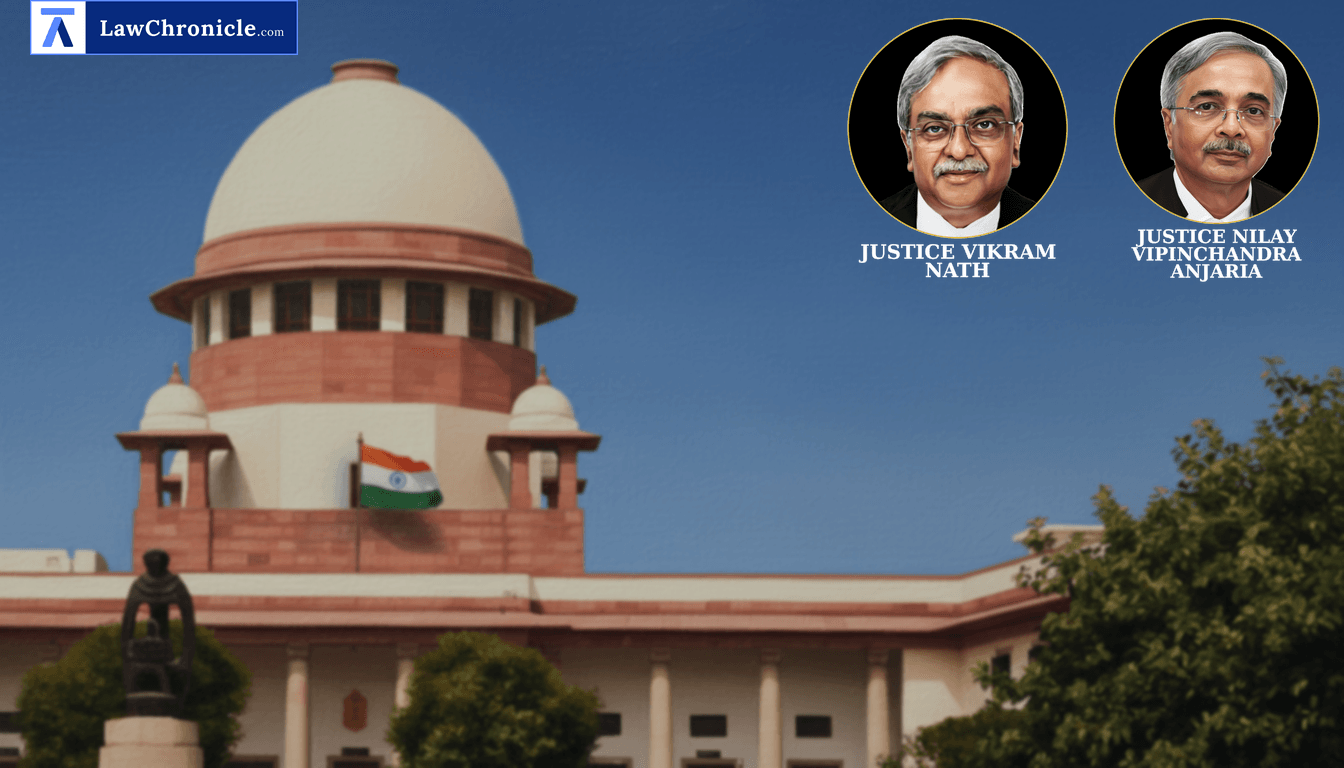
A bench of Justices Vikram Nath and Sandeep Mehta heard appeals against a Division Bench judgment of the Calcutta High Court that had directed demolition of a building raised near Visva-Bharati, ordered payment of compensation and initiated proceedings against local authorities. The appeals, filed by the developer, the Sriniketan‑Santiniketan Development Authority (SSDA) and subsequent flat purchasers, challenged the High Court’s finding that the construction stood on protected “khoai” land and was unauthorised.
The Court allowed the appeals, set aside the High Court’s demolition and ancillary directions, and expunged adverse observations against the SSDA and its officers. The bench held that the record did not support a conclusive finding that the particular plot was of “khoai” character and that the writ petitioners had failed to place unambiguous, contemporaneous scientific or documentary evidence to justify extraordinary relief. The Court emphasised the need for clear material before invoking public interest jurisdiction to deprive owners of property, noting that “no person shall be deprived of his property save by authority of law.” The Court, in its reasoning, observed: “Viewed cumulatively, the material placed on record does not support the foundational assumptions on which the writ petition proceeded. In the absence of clear, specific, and contemporaneous scientific evidence establishing that the subject plot was of ‘khoai’ nature, the invocation of public interest jurisdiction to assail the construction undertaken by Aarsuday Projects cannot be sustained, particularly where similarly situated constructions within the same tract of land were left unchallenged.” The bench also found that the public interest litigation lacked bona fides in that several petitioners had existing residential structures within the same tract which were not challenged.
Background The dispute arose from a public interest petition before the Calcutta High Court alleging that a multi‑storeyed residential and commercial building raised by a private developer on a 0.39 acre plot in Mouza Ballavpur (near Visva‑Bharati) violated this Court’s earlier directions in Sushanta Tagore v. Union of India (2005) and harmed the unique “khoai” landscape. The High Court accepted inspection reports and directed demolition, awarded compensation of Rs.10 lakh to be used for restoration, imposed Rs.25,000 costs on the developer and directed initiation of proceedings against SSDA and local officers for alleged violation of the apex‑court mandate.
On appeal the Supreme Court reviewed the documentary record and statutory framework. The development plan of 2002 had earmarked the subject plot for residential use; the plot was privately owned and was recorded as “danga” in revenue records. Building plans were vetted by the Zilla Parishad and treated as approved by the Ruppur Gram Panchayat; SSDA’s Sub‑Committee inspected and issued a No Objection Certificate for conversion (danga to bastu) and the DL&LRO later approved conversion. The WBPCB and District Magistrate filed reports at the High Court’s request; the WBPCB noted “khoai” formations adjacent to the site but recorded that land‑classification records did not contain the category “khoai” and that the project did not require prior environmental clearance as its built‑up area was below the statutory threshold. The Supreme Court found neither report to supply conclusive, site‑specific scientific proof that the subject plot itself was “khoai” land.
The Court proceeded on settled principles that extraordinary writ relief in PILs required clear and cogent material, and that procedural irregularities in local permissions, if not demonstrably fraudulent or resulting in substantive illegality, were generally curable and did not automatically justify demolition. Applying those principles, the Court allowed the appeals, set aside the High Court order, and observed that the SSDA’s subsequent compliance and planning steps also weighed against upholding punitive directions. Finding lack of bona fides on the part of some writ petitioners, the Court imposed costs of Rs.1,00,000 on respondent Nos.1‑7, to be deposited with the West Bengal Legal Services Authority within two months.
Case Details: Case No.: 2026 INSC 93 (Civil Appeal Nos. 2920‑2923 of 2018) Case Title: M/S AARSUDAY PROJECTS & INFRASTRUCTURE (P) LTD v. JOGEN CHOWDHURY & ORS. Appearances: For the Petitioner(s): Mr. Siddharth Bhatnagar, Senior Counsel (for Aarsuday Projects & Infrastructure (P) Ltd.) For the Respondent(s): Mr. Jaideep Gupta, Senior Counsel (for Respondent Nos.1‑7); Mr. Abhrotosh Majumdar, Senior Counsel (for SSDA); Mr. Rana Mukherjee, Senior Counsel (for Visva‑Bharati University); Mr. Saktinath Mukherjee, Senior Advocate (for Respondent No.6).
Similar Articles
 Breaking News


