Supreme Court Strikes Down Maharashtra Poisons Rules Provisions Mandating Additives to Methanol
 Copy Link
 Share
Share Save
Save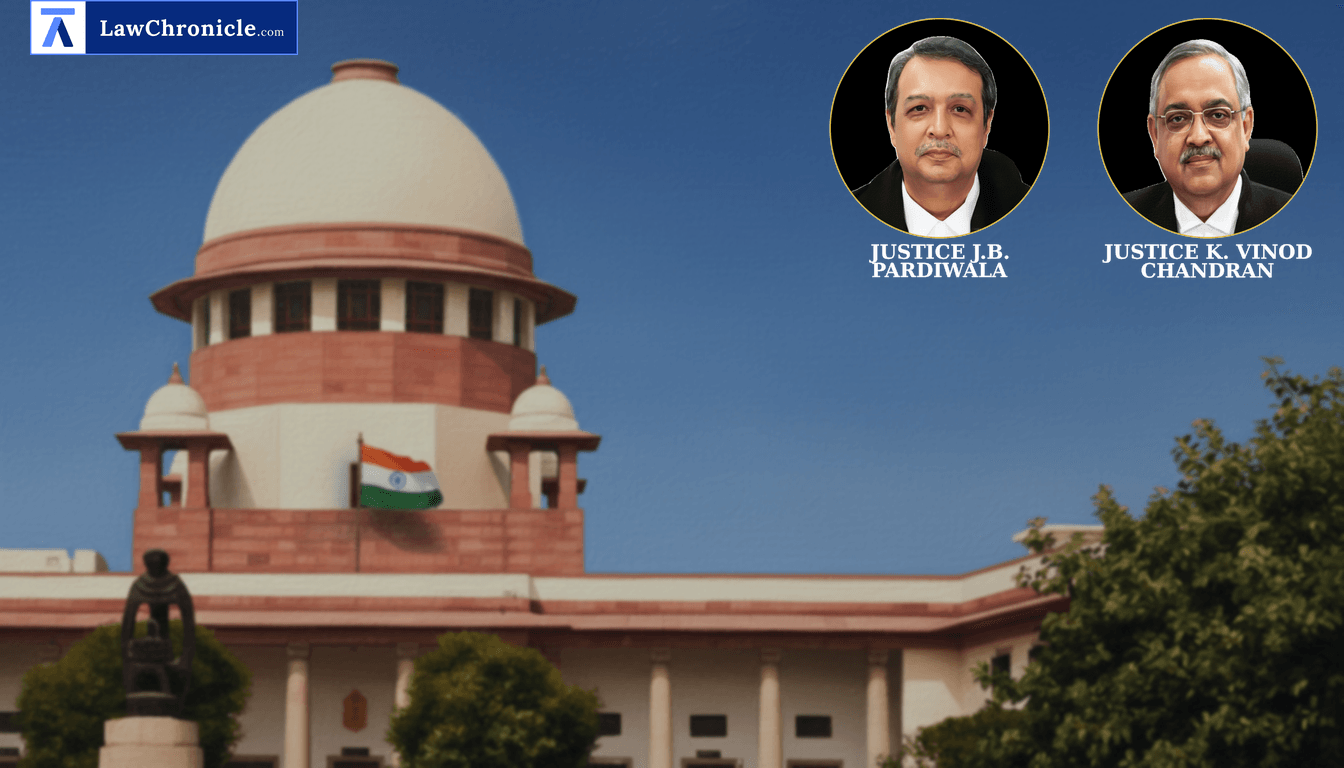
A Bench comprising Justice J.B. Pardiwala and Justice K. Vinod Chandran struck down Rules 18A and 18B of the Maharashtra Poisons Rules, 1972, inserted via a 2011 notification following the 1991 Chhaya Bar tragedy. The Supreme Court held that forced adulteration to curb hooch tragedies fails the test of proportionality and violates fundamental business rights. It was observed that forcing non-drug industrial consumers to mix bitterants and colourants into industrial methanol crippled downstream manufacturing without stopping the illicit diversion occurring in unregulated channels.
Key Takeaways
Industrial Protection Priority: Over-broad state regulations imposing unreasonable burdens on legitimate chemical industries to stop criminal adulteration are constitutionally untenable.
Proportionality Test Applied: Regulatory measures must demonstrate a rational, direct nexus to the target objective rather than serving as mere surface-level visual identification tools.
Rejection of Forced Temperance: State policies forcing additives onto industrial raw materials threaten industrial growth while failing to curb underground hooch networks.
Strict Process Supervision Mandated: The Court advocated for strict physical and digital tracking, tamper-evident seals, and dedicated transport units over chemical modification of raw materials.
Validity of Maharashtra Poisons Rules
While striking down specific provisions, the Supreme Court held that the impugned rules suffered from manifest arbitrariness and failed to satisfy the four-pronged proportionality test laid down in K.S. Puttaswamy (Privacy-9 J.) v. Union of India ( "(2017) 10 SCC 1": 2015 CaseBase(SC) 636).
The Apex Court in its reasoning observed that "Forced temperance, it is learned from experience, is no solution for alcoholism. Neither the taste or colour matters, for the one craving and in making such a measure, the fallout is the death knell of an industry. To adulterate methanol with a bitterant and colourant would not quell the craving and to achieve unavailability, there should be stricter regulatory measures for transportation and storage as put forth in the excise laws. The present exercise puts to jeopardy an industry itself and would result in ‘missing the woods for the trees’."
Addressing the failure of the State's approach, the Supreme Court further noted:
"This aspect of identification works like rearranging the deck chairs on the Titanic, to say that the measure addresses a surface level aspect and does not address the core issues of diversion and pilferage... The sub-rule even in the best case of full compliance cannot prevent the misuse it aims to prevent. Thus, it cannot be said to bear a reasonable and proximate nexus with the object it seeks to achieve."
Ratio
Subordinate legislation that restricts the fundamental right to carry on trade or business under Article 19(1)(g) of the Constitution of India, 1950 must be reasonable, proportionate, and bear a direct, rational nexus to the intended public purpose. A regulatory rule that inflicts severe, continuous industrial disruption while failing to remedy the underlying mischief of illegal diversion is manifestly arbitrary under Article 14 of the Constitution of India, 1950 and cannot be sustained under Article 19(6).
Background
Following a deadly hooch incident in 1991 at Andheri, Mumbai, which claimed 93 lives, the Maharashtra government accepted recommendations from the P.R. Parthasarthy Committee and issued a notification in 2011 amending the Maharashtra Poisons Rules, 1972 framed under the Poisons Act, 1919. The new Rules 18A and 18B required methanol sellers to ascertain purchaser identity via Form A licenses, mandated the addition of methylene carmine (a colourant) and denatonium saccharide (a bitterant) to methanol sold to non-drug manufacturers, and subjected unlicensed possession of methanol to confiscation.
Industrial users of methanol, producing downstream chemicals like formaldehyde, resins, and laminates, challenged the rules before the High Court of Bombay. The High Court dismissed the challenge, holding that Rule 18A(2) lacked extra-territorial operation. Upon appeal, the petitioners argued that the additives destroyed the chemical utility of methanol, ruined catalysts, and rendered end-products unacceptable for pharmaceutical, paint, and research industries. They pointed out that statutory powers under the Poisons Act, 1919 must be tested against Articles 14 and 19(1)(g) of the Constitution of India, 1950.
The State defended the notification by relying on Goodwill Paint & Chemical Industry v. Union of India ( "1992 Supp (1) SCC 16": 1991 CaseBase(SC) 176), contending that inherently dangerous substances like poisons justify strict trade restrictions to protect public health.
Evaluating the legal framework, the Supreme Court referred to precedents on subordinate legislation including State of Tamil Nadu v. P. Krishnamoorthy ( "(2006) 4 SCC 517": 2006 CaseBase(SC) 877), Mahalakshmi Sugar Mills Co. Ltd. v. Union of India, and Vasu Dev Singh v. Union of India ( "(2006) 12 SCC 753": 2006 CaseBase(SC) 31). Applying the test of reasonableness established in Mohd. Faruk v. State of M.P. ( "(1969) 1 SCC 853": 1969 CaseBase(SC) 94), the Supreme Court found that the State failed to show that less restrictive measures could not achieve the goal. The Bench issued a series of comprehensive recommendations to all States and Union Territories, focusing on inter-departmental cooperation, tamper-evident transport sealing, strict licensing scrutiny, and de-addiction initiatives.
Case Details:
Case No.: Civil Appeal No. 13008 of 2026 (@ Special Leave Petition (C) No. 16236 of 2019) with Writ Petition (C) No. 893 of 2019 and Writ Petition (C) No. 1059 of 2019
Neutral Citation: 2026 INSC 1009
Case Title: M/s Balaji Formalin Pvt. Ltd. & Anr. v. Union of India & Anr.
Appearances:
For the Petitioner(s): Mr. Balbir Singh, Senior Counsel
For the Respondent(s): Mr. Anand Dilip Landge, Counsel
Source: 2026 CaseBase(SC) 7009
 Breaking News