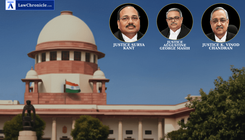
Supreme Court Upholds Conviction Under Section 304 Part II And 120B, Dismisses SLP
 Copy Link
 Share
Share Save
Save
A bench of Justices Sudhanshu Dhulia and K. Vinod Chandran heard the Special Leave Petition filed by R. Baiju challenging his conviction by the Kerala High Court arising from a violent group attack that resulted in a death and multiple injuries. The appeal contested the High Court's confirmation of criminal culpability under Section 304 Part II read with Section 120B IPC and related offences, and urged acquittal on grounds of faulty investigation, parity with an acquitted co-accused and absence of proof of common intention.
The Court upheld the High Court's findings and dismissed the Special Leave Petition. It accepted the prosecution case that the appellant (accused No.6) had motive, was present near the scene before the nocturnal attack, and exhorted the attackers from outside the house to "kill them". The Court found that, while a deliberate intention to cause death could not be conclusively attributed to the appellant, his "knowledge that the attack ... is likely to cause death" was established and he was culpable for conspiracy and abetment. The Court noted that even where an investigation's probity was suspect, "the rest of the evidence must be scrutinised meticulously to ensure that criminal justice is not rendered a causality." The Court, in its reasoning, observed: "As has been held in State of Tamil Nadu v. Nalini, by the very nature of the offence of conspiracy, being hatched in secrecy, no evidence of the common intention of the conspirators can be normally produced before Court. The offence can be proved largely by inferences from the acts committed or words spoken by the conspirators in pursuance of a common intention. That an altercation occurred between A6 and the deceased in the afternoon and another wordy duel in public, on the same evening, with PW2, the son of the deceased has been established by the prosecution. The reaction of A6 in the afternoon, to the refusal of the deceased to purchase a coir mat and in the evening, when the question of compulsory sale of coir mats was raised by PW2, was abrasive and violent. On the same day evening, A6 was found with the other accused near the house of the deceased, a few minutes before the crime occurred in the house of the deceased. The accused had called out PW2 from the outside the house when PW2, unsuspectingly invited them inside. The accused belonged to a political party, whose leader was A6. Accused 1 to 4 entered the house and unleashed a frontal attack on the family members with wooden logs. Construction work was going on in the house of the deceased and there were wooden logs lying in the premises. Even if it is found that the accused did not come with deadly weapons, before entering the house they picked up the wooden logs, within the eye-sight of A6. They entered the house of PW2 on his invitation and unleashed an attack without any provocation from the inmates of the house. Obviously, in retaliation of the incidents that happened earlier, on the same day A6 had seen the accused picking up the wooden logs and entering the house and also had exhorted them from outside the house. A6 definitely had the knowledge that the attack perpetrated on the accused could lead to death and the attack was carried out under his watchful eyes. As rightly held by the High Court, though the heightened intention to cause death cannot be attributed in the incident, the knowledge that the attack, as established in the trial, is likely to cause death can definitely be pinned down on A6, at whose instance and connivance as also active instigation, the attack was carried out."
Background The dispute arose after an afternoon altercation when the appellant, a municipal councillor and influential local political leader, attempted to sell coir mats and reacted angrily when the deceased declined to buy. A subsequent Ward Council meeting escalated tensions when the deceased's son raised a query about the alleged coercive sale. Later that night, four accused entered the deceased's house and assaulted the family with wooden logs; the deceased sustained fatal head injuries and others were injured. The trial court convicted all accused for an array of offences including murder and conspiracy; it sentenced the sixth accused to death. On appeal the High Court acquitted one co-accused, altered other convictions from Section 302 to Section 304 Part II read with Section 34, and convicted the appellant (A6) under Sections 323, 324, 427, 450 and 304 Part II IPC read with Section 120B, sentencing him to terms of rigorous imprisonment and fines. The appellant argued that he had not joined the frontal attack, that initial statements under Section 161 CrPC did not name him, and that one witness (PW7) was partisan. The High Court and this Court found the motive, presence near the scene, corroborative eyewitness evidence, medical and post-mortem reports, and the sequence of investigative steps (including later 164 CrPC statements) collectively proved conspiracy and culpable knowledge. The Supreme Court observed inconsistencies in investigation but held they did not vitiate the cumulative evidence and therefore dismissed the SLP. No interim directions were issued; the petition was dismissed and pending applications stood disposed of.
Case No.: SLP (Crl.) No. 12926 of 2024 (2025 INSC 488) Case Title: R. Baiju v. The State of Kerala Appearances: For the Petitioner(s): Sh. Abhilash M.R., Counsel for appellant For the Respondent(s): Standing Counsel, State of Kerala
 Breaking News