Supreme Court upholds High Court order quashing SC/ST Act prosecution where mala fide and caste animus were not made out
 Copy Link
 Share
Share Save
Save
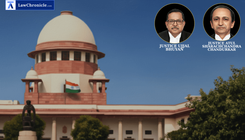
A bench of Chief Justice B. R. Gavai and Justice Augustine George Masih heard an appeal against a Telangana and Andhra Pradesh High Court order which had quashed criminal proceedings under the Scheduled Castes and Scheduled Tribes (Prevention of Atrocities) Act, 1989. The appeal challenged the Single Judge’s use of Section 482 CrPC to set aside a complaint and subsequent criminal proceedings arising from an allegation of wrongful allotment of land and a related group clash.
The Court dismissed the appeal and upheld the High Court’s order quashing proceedings against the private respondents (the then Mandal Revenue Officer and another officer). The Supreme Court agreed that the allegations did not disclose malafide conduct or caste-based animus required to sustain prosecution under the SC/ST Act and that the High Court had correctly applied legal principles to prevent misuse of the statute. The Court noted that the dispute was intra-caste and that the allotment challenged by the appellant had been made in accordance with government instructions and was subsequently cancelled. The Court, in its reasoning, observed: "In Masumsha Hasanasha Musalman v. State of Maharashtra this Court has emphasized that merely because the complainant belongs to the Scheduled Castes or Scheduled Tribes cannot be the sole ground for prosecution. The offences alleged must have been committed solely on the basis of the victim’s caste status. Misuse of the statute to settle personal scores or to harass individuals cannot be permitted. The Court should in such situation be not hesitant to step in and stop the said misuse. Prosecution needs to be quashed at an early stage to prevent undue harassment of the accused where there is clear legal infirmity in the prosecution case, such as the allegations, even if taken at their face value, do not disclose an offence or the entire case is a bad faith exercise weaponized to settle personal scores, rather than seeking justice." The judgment also reiterated that "there has been an alarming increase in false complaints under the SC/ST Act" and endorsed the High Court’s approach to curb such misuse.
Background The dispute arose from allotment of two house-site pattas in Duvva village reserved for SC/ST beneficiaries. The appellant, a Junior Accountant, alleged that the MRO and others manipulated allotments in favour of relatives of a local proprietor and, after complaining, was allegedly maliciously implicated in an earlier 1995 group clash case. The appellant’s prosecution arising from the clash led to his suspension; prosecution was later withdrawn against him. He then filed a complaint alleging wrongful prosecution motivated by caste animus and personal vendetta, which—after investigation and sanction—led to proceedings against the MRO and another officer under Sections 3(1)(viii), (ix) & (3)(2)(vii) of the SC/ST Act.
Respondents sought quashing under Section 482 CrPC; the High Court allowed the petition on 15.10.2014, finding absence of mala fide, noting that the allotment complied with government instructions and that the dispute was intra-caste rather than caste-targeted. The appellant and the State challenged that order before the Supreme Court, urging that the High Court had impermissibly performed a roving inquiry into merits and had exceeded its extraordinary jurisdiction. The Supreme Court reviewed the pleadings, the investigation record and precedent, including Masumsha Hasanasha Musalman and Dr. Subhash Kashinath Mahajan, and agreed that the prosecution showed legal infirmity and risked misuse of the SC/ST Act to settle personal scores. The Court also recorded that one of the accused (Respondent No.1) had died and his name was deleted from the array. The appeal was dismissed and the High Court order was affirmed; pending applications stood disposed of.
Case Details: Case No.: CRIMINAL APPEAL NO. 555 OF 2018 (2025 INSC 886) Case Title: Konde Nageshwar Rao v. A. Srirama Chandra Murty & Anr. Appearances: For the Petitioner(s): [Not recorded in the extract] For the Respondent(s): [Not recorded in the extract]
 Breaking News