Supreme Court Upholds Minimum Interview Cut-offs for Judicial Recruitment
 Copy Link
 Share
Share Save
Save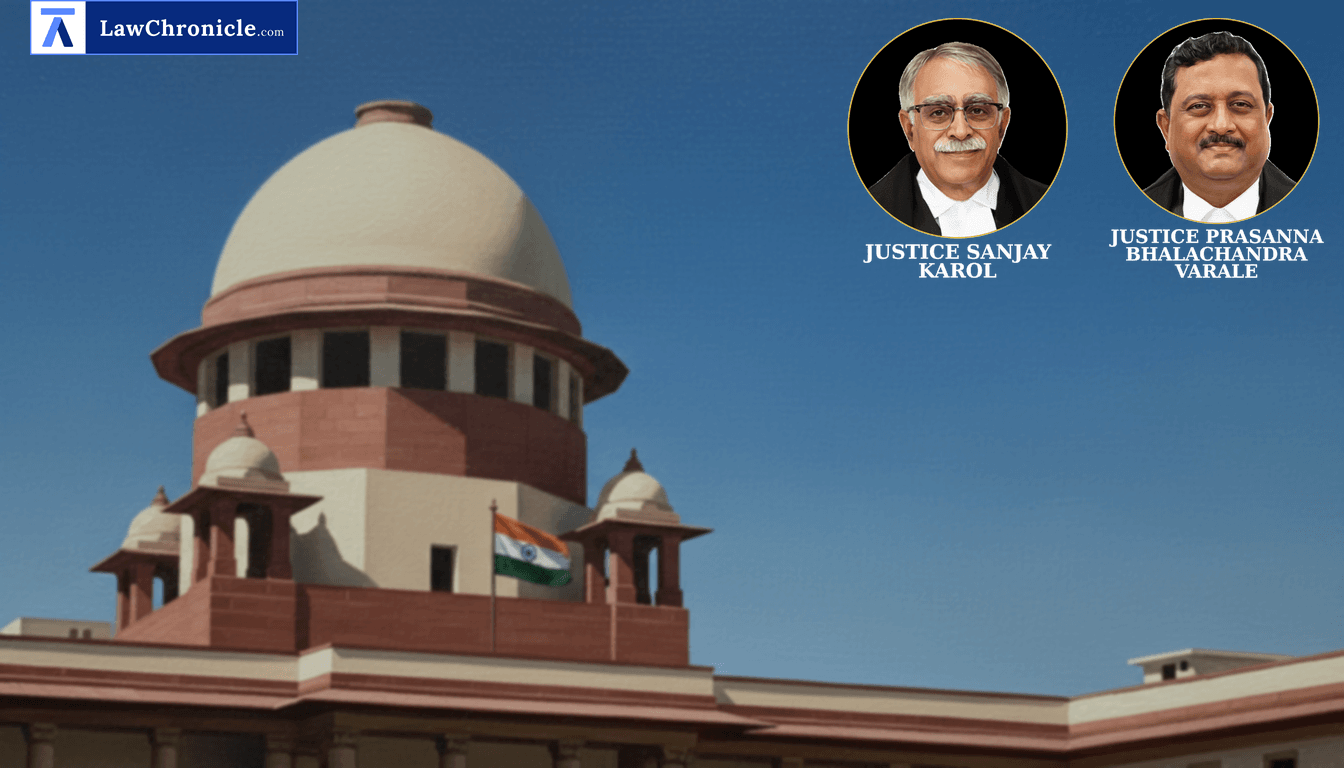
Aspiring judicial officers cannot challenge recruitment rules after being declared unsuccessful, as the Supreme Court shuts the door on retroactive litigation against selection benchmarks. The ruling reinforces the sanctity of interview thresholds as a rational mechanism to preserve the integrity of the higher judiciary against claims of merit based solely on written scores.
In a decisive verdict, a bench comprising Justice Sanjay Karol and Justice Prasanna B. Varale affirmed the Rajasthan High Court's refusal to interfere with a decade-old recruitment process for Additional District Judges. The Court addressed an appeal by a candidate who, despite a high aggregate score, was disqualified for falling short of the 25% minimum qualifying mark in the viva-voce examination prescribed by a 2011 amendment to the state's judicial rules.
The Doctrine of Estoppel in Selection Processes
Justice Varale, writing for the bench, emphasized that candidates who participate in a selection process with full knowledge of the prevailing rules are barred by the doctrine of estoppel from later challenging those very rules. The Court noted that the appellant had appeared for the written examination and interview under the Rajasthan Judicial Service Rules, 2010 as amended in 2011 with his "eyes wide open."
Refuting the argument that the Constitution of India, 1950 and the recommendations of the Shetty Commission forbade interview cut-offs, the Court clarified that such recommendations are guidelines and must yield to formal statutory rules. The bench relied on Mahinder Kumar vs. High Court of Madhya Pradesh to establish that once a competent authority frames statutory rules, the selection must strictly follow them.
Rationale for Minimum Viva-Voce Benchmarks
Preserving the Calibre of the Higher Judiciary
The Court defended the administrative necessity of interview benchmarks for high judicial offices. The bench observed that while written tests assess academic legal knowledge, the viva-voce is essential to judge traits like alertness, resourcefulness, and the ability to take decisive action.
The Court, in its reasoning, observed: "To suggest that a candidate who fails to demonstrate these minimum essential traits in an interview must nonetheless be appointed merely because of a high aggregate score would severely compromise the calibre of the higher judiciary. The 25% cut-off was a rational, considered benchmark prescribed to preserve the integrity and quality of judicial administration."
The Impossibility of Granting Relief
Addressing the request for retrospective appointment, the Supreme Court warned against opening a "Pandora's box." Granting relief after ten years would disrupt the established seniority of the entire judicial cadre and be unfair to other unsuccessful candidates who did not approach the court.
The Court has following directions:
"Accordingly, the Civil Appeal is devoid of merit and is hereby dismissed. The impugned judgment and order dated 08.02.2018 passed by the High Court of Judicature for Rajasthan is affirmed. Pending applications, if any, shall stand disposed of. There shall be no order as to costs."
Key Takeaways:
Finality of Selection Rules
Candidates who take a calculated chance in a recruitment process cannot turn around and assail the criteria after failing.
Statutory Rules Trump Guidelines
Recommendations like those of the Shetty Commission are advisory and do not override formally enacted judicial service rules.
Interview Benchmarks Are Rational
Minimum marks in viva-voce for judicial posts are legally valid to ensure intellectual and personal suitability for the office.
Protection of Settled Seniority
Courts will not grant retrospective seniority if it causes administrative chaos or violates the vested rights of long-serving officers.
Ratio Decidendi:
A candidate who participates in a selection process without protest is estopped from challenging the validity of the recruitment rules or criteria upon being declared unsuccessful. Furthermore, a recruiting authority is competent to prescribe minimum qualifying marks for a viva-voce to maintain the efficiency and integrity of the service, and such statutory provisions prevail over general policy guidelines.
Background:
The dispute originated from a 2011 recruitment for 39 vacancies in the Rajasthan Additional District Judge cadre. The appellant secured the 11th rank in aggregate marks (168/280) but obtained only 7 out of 30 marks in the interview, failing the 7.5 mark (25%) threshold introduced via an amendment to Rule 41 of the Rajasthan Judicial Service Rules, 2010. The High Court had dismissed the appellant's writ in 2018, noting that the contentious proviso was deleted in 2017, making the challenge academic. The Supreme Court, referencing All India Judges Association vs. Union of India ( "(2002) 4 SCC 247": 2001 CaseBase(SC) 1233), Mehmood Alam Tariq vs. State of Rajasthan, Syed T.A. Naqshbandi vs. State of J&K, Malik Mazhar Sultan vs. UP Public Services Commission ( "(2008) 17 SCC 703": 2006 CaseBase(SC) 272), Om Prakash Shukla vs. Akhilesh Kumar Shukla and Ors. ( "(1986) Supp SCC 285": 1986 CaseBase(SC) 178), and Madan Lal and Others vs. State of J & K and Ors ( "(1995) 3 SCC 486": 1995 CaseBase(SC) 452), found no merit in the appeal, upholding the High Court’s judgment.
Case Details:
Case No.: CIVIL APPEAL NO(s). 8142 OF 2018
NeutralCitation: 2026 INSC 699
Case Title: MANOJ GOYAL Versus RAJASTHAN HIGH COURT & ORS.
Source: 2026 CaseBase(SC) 651
 Breaking News