Supreme Court Upholds Oraon Customary Law, Denies Daughters Inheritance Rights
 Copy Link
 Share
Share Save
Save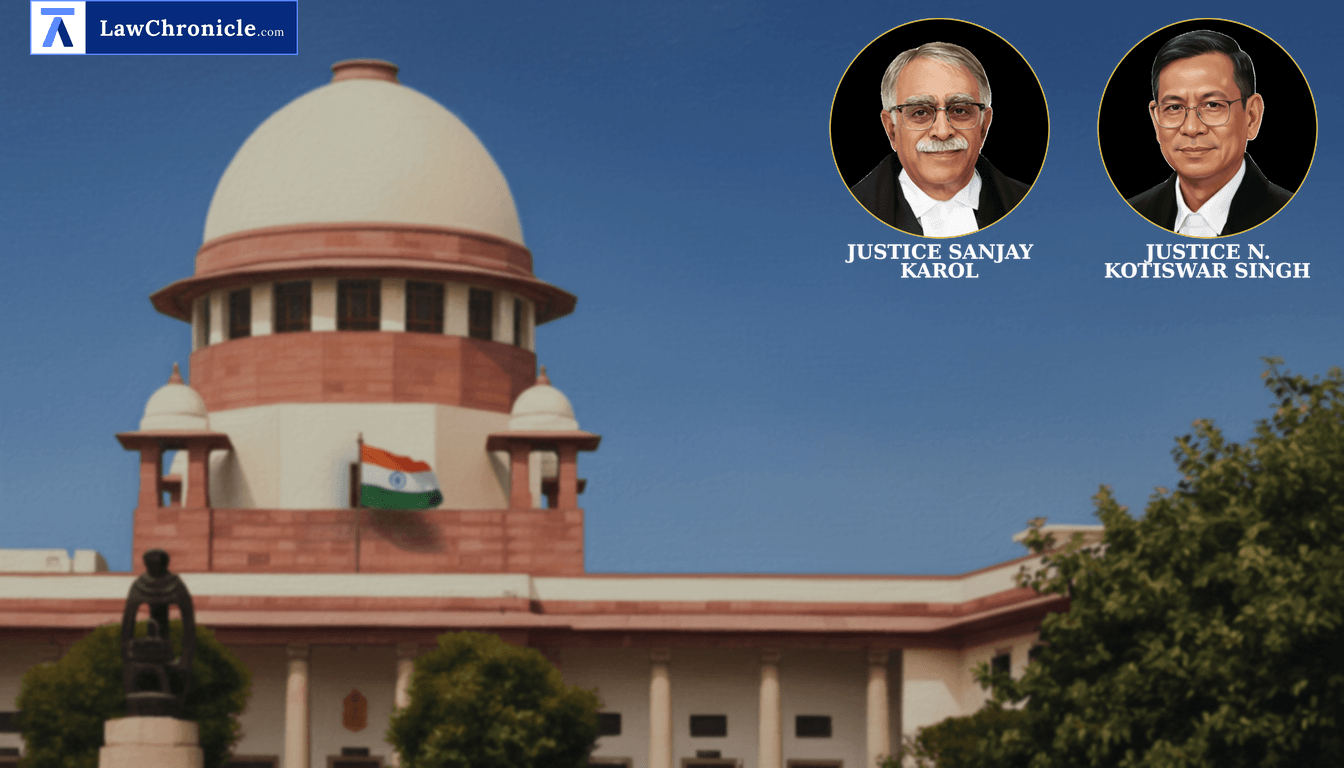
In a decisive reinforcement of tribal customary laws, the Supreme Court has set aside concurrent findings of three lower courts, ruling that among the Oraon community, daughters possess no inherent right of inheritance and property must devolve to the nearest male agnate in the absence of a validly adopted ghardamad.
Justice Sanjay Karol and Justice Nongmeikapam Kotiswar Singh, presiding over a bench that scrutinized the traditional lineage systems of Jharkhand, overturned a long-standing dispute regarding the estate of Sukhu Oraon. The Court clarified that while local customs do permit a son-in-law to acquire rights through the 'ghardamad' status, such an adoption must strictly follow the customary protocols involving the immediate father or widow, rather than being orchestrated by an uncle-in-law.
Establishing the Legal Requirements for Customary Proof
The Bench elaborated on the rigorous evidentiary standards required to establish a custom in Indian courts. Drawing from previous jurisprudence, the Court noted that a party relying on a custom must prove its existence through long, continuous usage and consistent testimony from the community.
The Court, in its reasoning, observed: "A custom possible in law, being reasonable and otherwise fulfilling the requisites of a good custom, may be established by very slender evidence. ... To be valid, a custom must have four essential attributes: (1) it must be immemorial; (2) it must be reasonable; (3) it must be certain in its terms... and (4) it must have continued as of right and without interruption since its immemorial origin."
The Intersection of Customary Adoption and Property Title
The dispute centered on whether Punai Oraon was validly adopted as a ghardamad by his uncle-in-law, Ledura. The Court found that the lower courts had misdirected themselves by accepting this relationship without clear evidence that the specific custom allowed an uncle-in-law to adopt a niece's husband for succession purposes. Under Section 48 of the Evidence Act, 1872, the court is bound to consider the opinions of those likely to know such customs, and in this case, the defense's witnesses were found to be internally inconsistent.
Judicial Interference with Concurrent Findings
While the High Court had declined to interfere due to the concurrent nature of the findings by the Trial Court and First Appellate Court, the Supreme Court invoked its plenary powers under Article 136 of the Constitution of India. Referring to Srinivas Ram Kumar v. Mahabir Prasad ( "1951 SCC 136": 1951 CaseBase(SC) 8) and Ramachandran v. Vijayan ( "2024 SCC OnLine SC 3384": 2024 CaseBase(SC) 786), the Bench emphasized that even concurrent findings can be set aside if they are reached on the basis of irrelevant evidence or if they run contrary to provisions of law. The Court noted that the High Court's failure to answer a framed substantial question of law merely because of concurrent findings was an error.
The Court has following directions:
"The judgments of the courts below are set aside. Plaintiff's suit is decreed. All necessary consequences to follow. The appeal is allowed."
Key Takeaways:
Strict Proof of Customary Adoption
Establishing the status of a 'ghardamad' (resident son-in-law) requires proof of specific adoption by the father or widow of the deceased, not merely a collateral relative.
Male Agnate Supremacy in Oraon Custom
In the absence of a son or a validly adopted resident son-in-law, the property of an Oraon male devolves to the nearest male agnate, excluding daughters from inheritance.
Scope of Article 136 Interference
Concurrent findings of fact are not sacrosanct and will be set aside by the Supreme Court if they are based on a misapplication of legal principles or historical texts.
Inconsistency Vitiates Evidence of Usage
When community witnesses provide contradictory versions of a tribal custom, the court cannot hold the custom as 'proven' or 'certain'.
Ratio Decidendi:
Among the Oraon community, daughters do not possess a right of inheritance. A son-in-law only acquires property rights if he is 'duly adopted' as a ghardamad into the household by the last male owner or his widow. In the absence of such a specific adoption or a male issue, the estate must necessarily devolve to the nearest male agnate, and no title can be conferred via a 'lease' or 'partition' deed executed by a relative lacking the authority to adopt.
Case Details:
Case No.: Civil Appeal No. ______ of 2026
NeutralCitation: 2026 INSC 672
Case Title: Bejla Oraon v. Kali Das Oraon & Ors.
Source: 2026 CaseBase(SC) 632
 Breaking News