Supreme Court Upholds Validity of Sale Deeds Executed via Power of Attorney
 Copy Link
 Share
Share Save
Save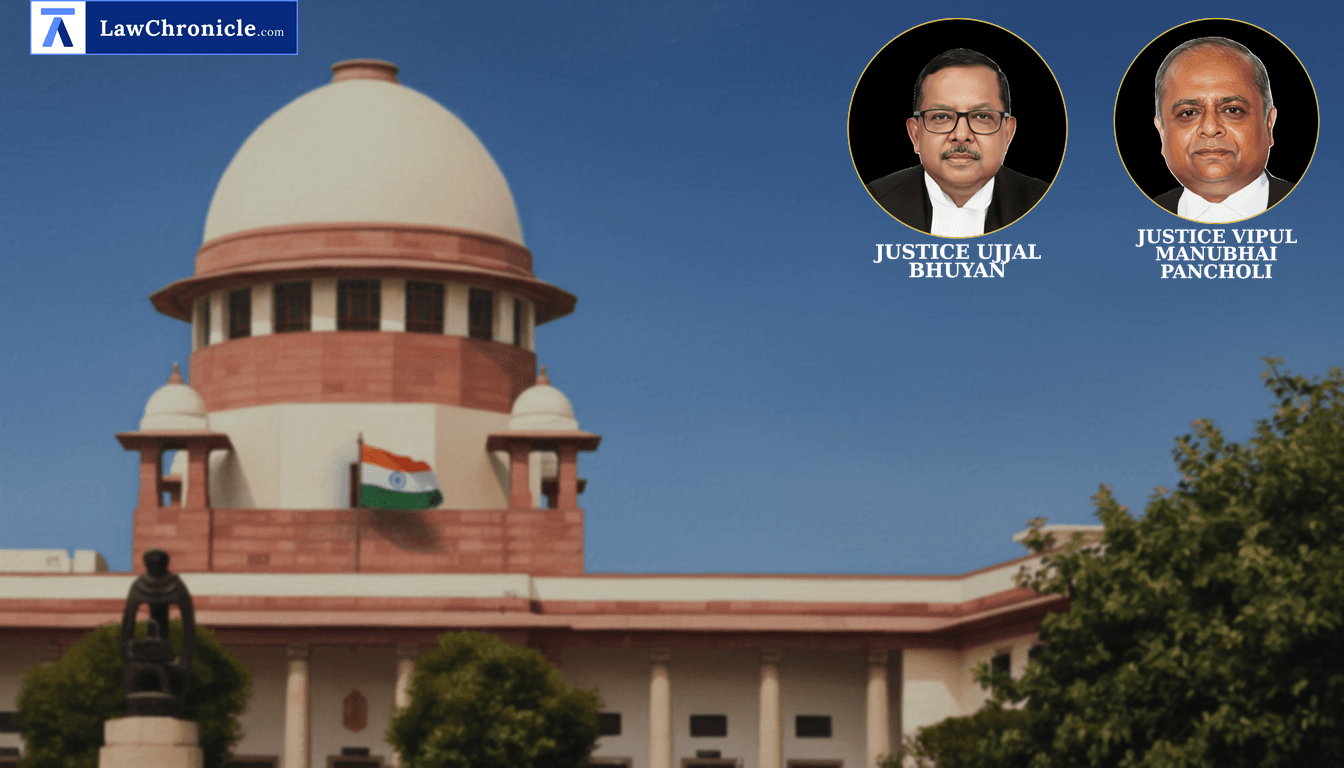
The Supreme Court has clarified that the burden of proving that a registered General Power of Attorney (GPA) was merely security for a loan rests heavily on the party alleging fraud, especially when that party fails to personally testify in court. The Court emphasized that prolonged silence and failure to enter the witness box are fatal to claims seeking to void registered sale transactions.
A bench comprising Justice Ujjal Bhuyan and Justice Vipul M. Pancholi heard the appeal challenging a Madras High Court decision which had affirmed the reversal of a trial court decree in favor of the appellant. The dispute centered on whether GPAs executed by a landowner were genuine authorizations for sale or merely collateral security for loans.
Adverse Inference for Avoiding the Witness Box
The Court observed that the appellant’s failure to personally testify was a critical flaw in her case. Despite making serious allegations of fraud, forgery of receipts, and misuse of signed blank papers, she chose not to enter the witness box. In its reasoning, the Court observed: "In the facts of the present case, the adverse inference drawn by the First Appellate Court and the High Court cannot be said to be unjustified... where a party possessing special knowledge of facts fails to enter the witness box, an adverse inference may legitimately be drawn against such party." The Court relied on the principle established in Vidhyadhar v. Manikrao ( "(1999) 3 SCC 573": 1999 CaseBase(SC) 205) to justify this stance.
Compliance with Order XLI Rule 31 CPC
A major procedural challenge was raised regarding the First Appellate Court's judgment. The appellant argued that the appellate court failed to frame proper points for determination as mandated by Order 41 Rule 31 of the Code of Civil Procedure, 1908. Referring to H. Siddiqui (dead) by LRs v. A. Ramalingam ( "2011 (4) SCC 240": 2011 CaseBase(SC) 484), the appellant contended the judgment was vitiated. However, the Supreme Court clarified: "...the requirement of Order XLI Rule 31 of the CPC is one of substantial compliance and not one of mere technical formality. The substance of the judgment and the manner in which the appellate court has dealt with the controversy are of greater significance than the form in which points are framed."
Background: The Dispute Over Decadelong Silence
The appellant had purchased agricultural land in 1996 and subsequently executed GPAs in favor of two brothers (Respondent Nos. 1 and 2) in 1997-98. She claimed these were security for loans totaling Rs. 7 lakhs. The respondents, however, used these GPAs to execute sale deeds in favor of their relatives. The appellant moved the court only in 2008, a decade later, seeking to declare the sale deeds null and void.
While the Trial Court initially ruled in her favor, the First Appellate Court reversed the decree, noting she failed to prove loan repayment or continued possession. The High Court dismissed her second appeal under Section 100 of the Code of Civil Procedure, 1908. The Supreme Court highlighted that the appellant, being involved in real estate, could not plead ignorance of the transactions for ten years. Furthermore, the Court noted that while revenue records do not create title, they are relevant for determining possession when supported by registered deeds. The Court also referred to Subhra Mukerjee v. Bharat Coking Coal Ltd. regarding the burden of proof in fiduciary relationships, but concluded the appellant failed to establish the foundational facts of fraud.
Case Details:
Case No.: CIVIL APPEAL NO. 9837 OF 2017
NeutralCitation: 2026 INSC 529
Case Title: MALLIKA v. R. NALLATHAMBI & ORS.
Appearances:
For the Petitioner(s): Mr. Sivagnanam Karthikeyan, Advocate
For the Respondent(s): Mr. V. Chitambaresh, Senior Advocate; Mr. Jayanth Muth Raj, Senior Advocate
Source: 2026 CaseBase(SC) 454
 Breaking News