The Law Behind Special Intensive Revision (SIR) of Electoral Rolls
 Copy Link
 Share
 Save
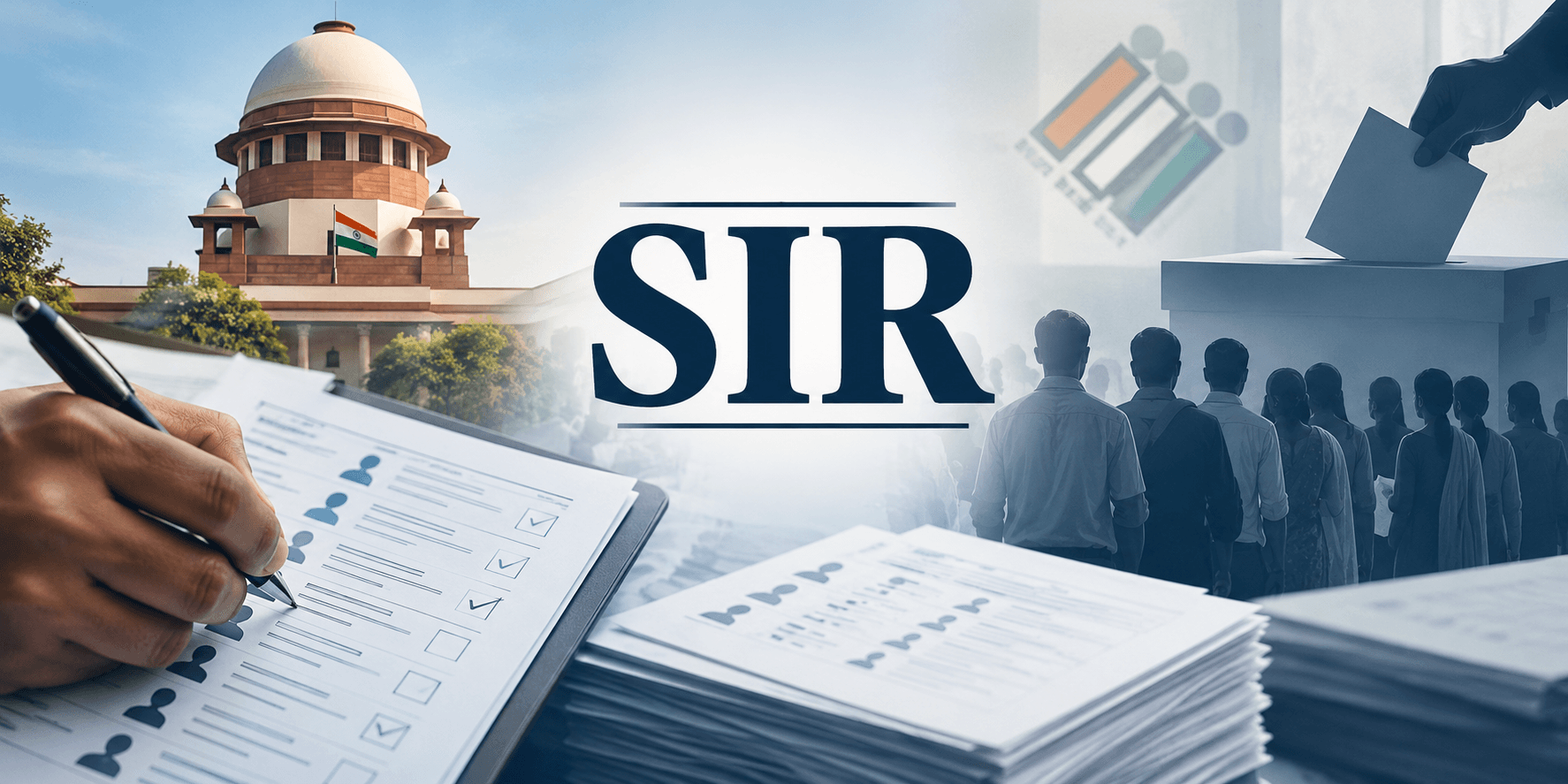
In India, debates around validity of the ongoing process of Special Intensive Revision (SIR) of Electoral Rolls have been tremendous. The matter even reached the Supreme Court of India, and the street protests against the Chief Election Commissioner, all discussing the legality of the SIR process. Since there is a lot noise around the ongoing process, here is a discussion of the law that governs the Special Intensive Revision of electoral rolls in India. First, let us understand what it means and covers.
Special Intensive Revision (SIR)
The Special Intensive Revision (SIR) for the Electoral Rolls is a voter-list verification exercise conducted by the Election Commission of India (ECI). It is intended to verify electoral rolls, identify eligible voters, and correct entries such as duplicate, shifted, deceased or otherwise ineligible electors.
Given below is an answer to what empowers the ECI to conduct SIR, and what safeguards govern the inclusion or deletion of a person's name from the electoral roll.
The legal framework behind SIR
SIR is not a separate law enacted by Parliament. Its legal foundation lies in the Constitution of India, the Representation of the People Act, 1950, and the Registration of Electors Rules, 1960.
| Legal provision | What it establishes |
| Article 324, Constitution | Vests the ECI with superintendence, direction and control over the preparation of electoral rolls and the conduct of elections. |
| Article 325 | Provides for one general electoral roll for every territorial constituency and prohibits exclusion from electoral rolls on grounds only of religion, race, caste or sex. |
| Article 326 | Establishes adult suffrage, subject to constitutional and statutory qualifications, including citizenship and the prescribed minimum age. |
| Section 21(3), Representation of the People Act, 1950 | Expressly empowers the ECI to direct a special revision of electoral rolls at any time, for reasons to be recorded, in such manner as it considers appropriate. |
| Sections 22 and 23, RPA 1950 | Govern correction or deletion of entries and inclusion of names in electoral rolls. |
| Registration of Electors Rules, 1960 | Prescribe the procedural framework for preparing, revising, verifying and finalizing electoral rolls. |
Section 21(3) of Representation of People Act, 1950
The most important provision backing the Special Intensive Revision (SIR) of Electoral Rolls is Section 21(3) of the Representation of the People Act, 1950. It authorizes the ECI, notwithstanding the ordinary revision framework under Section 21(2), to direct a special revision:
- At any time, rather than only during the ordinary revision cycle.
- For reasons to be recorded, requiring the Commission to record its reasons for directing the exercise.
- In such manner as it may think fit, giving the Commission flexibility in determining the revision procedure, subject to the governing legal framework.
The provision also states that the existing electoral roll ordinarily continues to operate until the special revision is completed. This is important because the ECI's authority to conduct SIR does not rest solely on its general constitutional powers. Section 21(3) expressly provides for special revision in the statute enacted by Parliament.
Rules governing Verification and Deletion of Voters
The Registration of Electors Rules, 1960, govern the practical procedure of SIR pertaining to deletion of names from voter lists. Some of the relevant provisions are:
- Rule 21A: Addresses deletion of names from electoral rolls in specified circumstances, including where an entry is found to be erroneous or the person is dead, has ceased to be ordinarily resident, or is otherwise not entitled to registration.
- Rule 25: Deals with revision of electoral rolls, including the ordinary revision framework.
- Sections 22 and 23 of the RPA 1950: Provide the statutory basis for correcting or deleting existing entries and including eligible persons who are missing from the roll.
The distinction between conducting a verification exercise and deleting an individual's name is crucial. The authority to undertake SIR does not mean that an individual entry can be deleted arbitrarily. The applicable procedure and safeguards must be followed.
Supreme Court Verdict on SIR
Association for Democratic Reforms v. Election Commission of India (2026 CaseBase(SC) 483)
In its judgment concerning the Bihar SIR exercise, the Supreme Court upheld the ECI's authority to conduct the revision under Article 324 of the Constitution read with Section 21(3) of the RPA 1950.
The key findings of the Apex Court included:
- Section 21(3) independently authorizes a special revision, subject to the applicable legal framework.
- Ensuring that eligible citizens are included and ineligible persons are excluded from electoral rolls is consistent with the constitutional scheme of elections.
- The ECI may undertake a limited inquiry into citizenship for determining eligibility for electoral registration.
- The SIR process remains subject to the applicable statutory safeguards, including notice, scrutiny and an opportunity to be heard where required.
The Supreme Court also considered the legality of the documentation framework and the use of the 2003 electoral roll as a reference point in the Bihar exercise. Its ruling concerned the SIR process challenged before it; the legality of particular administrative actions must still be assessed against the applicable rules and facts.
SIR Process: Can ECI Remove Names from Voter List?
The power to conduct a comprehensive revision is not an unrestricted power to disenfranchise voters. The legal framework requires compliance with the following:
- Eligibility: Whether the person satisfies the constitutional and statutory conditions for registration.
- Verification: Whether the relevant facts and documents support continued inclusion in the roll.
- Deletion: Whether the legal grounds and prescribed procedure for removing the entry have been established.
- Remedies: Whether the affected person can submit a claim, objection or appeal under the applicable procedure.
A person whose name is missing from the draft roll may seek inclusion through the prescribed process. Where deletion is proposed, the relevant statutory protections and opportunities to contest the action must be observed. The Supreme Court's 2026 judgment upheld the SIR framework in the Bihar case, but it should not be read as giving election officials an unconditional power to remove names without following the applicable safeguards.
Why is SIR at the center of Controversy?
The central debate is not simply whether the ECI has the power to conduct SIR. Section 21(3) of RPA 1950 expressly provides that power. The more difficult questions concern how the power is exercised, including:
- Whether the reasons for initiating SIR adequately justify the scale and method of verification.
- Whether the documents demanded are reasonable and legally relevant.
- Whether the burden of proving eligibility falls disproportionately on existing electors.
- Whether adequate notice, hearings and appeal mechanisms prevent wrongful exclusion.
- Whether the process sufficiently protects the constitutional principle of adult suffrage under Article 326.
Answers to these questions are subject to statutory interpretation, constitutional safeguards, administrative fairness and electoral integrity. They need to be examined separately from the ECI's basic authority to initiate a special revision.
 Breaking News