[Third Party Motor Vehicle Insurance] Supreme Court proposes No Insurance, No Fuel Policy
 Copy Link
 Share
Share Save
Save![[Third Party Motor Vehicle Insurance] Supreme Court proposes No Insurance, No Fuel Policy](https://cms-image.lawchronicle.com/77fd2151547d25e38daa44ecf6ea985b_1b497a11c5.png)
Supreme Court has issued sweeping nationwide directions for digital enforcement, technology integration, and policy restructuring under motor vehicle laws. The judgment seeks to address the alarming crisis of uninsured vehicles causing severe prejudice to motor accident victims.
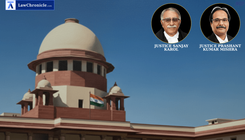
A bench comprising Justice Sanjay Karol and Justice Prashant Kumar Mishra dealt with the pressing systemic issues arising from non-compliance with statutory insurance requirements under Section 146 of Motor Vehicles Act, 1988. The Apex Court emphasized that road safety and financial protection for commuters are intrinsic to constitutional guarantees. Proposing a No Insurance No Fuel Policy, the Bench suggested to evolve a pilot-project whereby fuel for vehicles to be linked with valid insurance status. In case on non-compliance, the vehicle concerned would be refused fuel at petrol pumps, until such time that valid insurance is obtained.
Key Takeaways
- Automated E-Challans via ANPR Integration: State law enforcement agencies must integrate highway ANPR cameras with VAHAN and Insurance Information Bureau portals to automatically penalize uninsured vehicles.
- Extended Mandatory Cover Period: Mandated third-party motor vehicle insurance tenures for new vehicles stand enhanced to four years for cars and six years for two-wheelers.
- No Insurance-No Fuel: Authorities must execute pilot projects linking petrol pump fuel dispatch with real-time verification of valid vehicle insurance.
- Standardised Four-Layered Policy Scheme: Introduction of a mandatory 'Customer Option Form' allowing buyers to explicitly choose optional covers like personal accident and own damage alongside mandatory third-party cover.
Supreme Court Judgment on Road Safety
Evaluating the broader constitutional nexus of road safety, the Apex Court highlighted that the right to safe travel forms an integral part of personal liberty. The Bench observed that "Recognizing the safety of the commuter as an integral facet of the right to live with dignity as a constitutional obligation under Article 21 of Constitution of India, it is necessary in the interest to address the systematic root causes that these interim directions are issued in exercise of powers under Article 142 of the Constitution of India. We reiterate that no pecuniary or administrative constraint can outweigh the sanctity of human life..."
Supreme Court Directions on Motor Vehicle Insurance
The Court issued the following specific directions:
"23.1. Currently, ANPR Cameras deployed on highways and roads are equipped with a mechanism to catch and penalize road safety violations such as high speed, red light jumping, driving on the wrong side of the road, etc. Carrying this forward and as already deployed by the MoRTH in certain states, ANPR Cameras are to be integrated with data from the Insurance Information Bureau (established under IRDA) and the VAHAN portal for issuance of automatic e-challans to uninsured vehicles, in furtherance of the SOP for Electronic Monitoring and Enforcement of Road Safety.
23.2. This Court is informed that as on date, there is no uniform mechanism in place with State Police to verify insurance status on the ground. It is directed that State Police be provided with handheld devices or downloadable apps, linked with the data from Insurance Information Bureau (established under IRDA) and VAHAN portal be supplied to the State Police. This is to monitor real-time insurance status of vehicles and impose challans for violations, ensuring compliance with mandatory insurance on the ground.
23.3. Upon notification of the amendment to Section 196 of the MVA, strict compliance thereof is to be ensured.
23.4. As submitted by the IRDA, for private vehicles, a broad four-layer structure is to be implemented for private vehicles. This would bring clarity to various policy options for the vehicle-owner so as to allow them to make an informed choice... Consequently, every customer, at the time of purchase of insurance, will be issued a ‘customer option form', whether offline or online, whereby they may ‘opt in’ via check box to the add-on options...
23.5. The IRDA in consultation with GIC and insurance companies, shall formulate uniform policy wordings for the above optional covers...
23.6. The suggestion of the IRDA for a consumer-friendly customer information sheet will also have to be given to the prospective customers outlining the above four-layered structure, i.e., who is covered under mandatory and optional covers, is made mandatory for the sale of motor-vehicle insurance, whether offline or online.
23.7. ...Therefore, it is directed that henceforth, third-party insurance for four years for new cars and six years for new two wheelers be required to be purchased. IRDA to immediately issue necessary directions.
23.8. The benefits of obtaining comprehensive motor-vehicle insurance policies to be displayed in easy-to-read format on the websites of the insurance companies.
23.9. Based upon the deliberations in Court, a pilot-project be implemented allowing citizens to verify insurance status, and ultimately assist with the implementation of the statutory mandate under the MV Act...
23.10. As deliberated upon in Court, the IRDA in consultation with the MoRTH, to deliberate and evolve a pilot-project whereby fuel for vehicles to be linked with valid insurance status. In the absence thereof, the vehicle concerned would be refused fuel at petrol pumps, until such time that valid insurance is obtained...
23.11. ...the MoRTH is to implement the said pilot projects as submitted above on certain corridors, substituting the process of stopping at toll plazas with automatic detection of vehicles passing through toll points.
24.1. The State Police to promptly file DAR along with relevant documents such as FIR, MLC, post-mortem report, insurance policy, permit, etc. before the concerned MACT, in pending cases relating to accidents prior to 31.03.2022.
24.2. The State Police to assist with prompt service and production of relevant witnesses before the concerned MACT, to ensure speedy disposal of cases relating to accidents prior to 31.03.2022."
Ratio
Enforcement of mandatory third-party motor vehicle insurance under Section 146 of the Motor Vehicles Act, 1988 directly enforces the constitutional right to safe travel and dignity under Article 21. Regulatory bodies and law enforcement authorities are obligated to utilize integrated digital infrastructures to eliminate uninsured vehicles from public roads and streamline accident claim mechanisms.
Background
The proceeding stemmed from an appeal challenging a judgment of Telangana High Court, which had awarded compensation to the legal representatives of a deceased vehicle owner under a comprehensive policy. The insurer contended that no extra premium was paid to cover personal risk. Dismissing the insurer's appeal, the Apex Court affirmed the decision relying on Surekha and Ors. v. Santosh and Ors. ( "[(2021) 16 SCC 467]": 2020 CaseBase(SC) 1026), noting that courts must not adopt a hyper-technical approach in motor accident claims and that IRDA circulars mandate coverage for occupants under comprehensive policies.
Expanding the scope due to massive non-compliance of Section 146 of the Motor Vehicles Act, 1988, the Supreme Court impleaded regulatory bodies, the Ministry of Road Transport and Highways, and multiple insurance companies. The Court scrutinized provisions under the IRDA Act, 1999, the Insurance Act, 1938, and the Central Motor Vehicles Rules, 1989, noting that nearly 56% of vehicles in India run uninsured. Referencing legal frameworks and rulings including S. Rajaseekaran v. Union of India ( "(2018) 8 SCC 447": 2018 CaseBase(SC) 669), General Insurance Council v. State of Andhra Pradesh ( "(2007) 12 SCC 354": 2007 CaseBase(SC) 419), M.R. Krishna Murthi v. New India Assurance Company Limited ( "(2020) 15 SCC 493": 2019 CaseBase(SC) 2758), Shishu Pal @ Shish Ram & Ors v. Surjeet & Ors ( "2026 INSC 634": 2026 CaseBase(SC) 566), In Re: Phalodi Accident v. National Highways Authority of India and Ors. ( "2026 SCC OnLine SC 646": 2026 CaseBase(SC) 338), and Abhijeet Kumar Pandey v. State of Bihar, the Court passed wide-ranging directions to enforce statutory mandates, streamline claim filings before MACTs, and ensure ground-level digital monitoring.
Case Details:
Case No.: Civil Appeal No. 14369 of 2025
Neutral Citation: 2026 INSC 793
Case Title: National Insurance Co. Ltd. v. Smt. Thungala Dhana Laxmi & Ors.
Source: 2026 CaseBase(SC) 730
 Breaking News