


Trial Court Cannot Treat Issue As Preliminary Once General Trial Commences: SC
 Copy Link
 Share
 Save
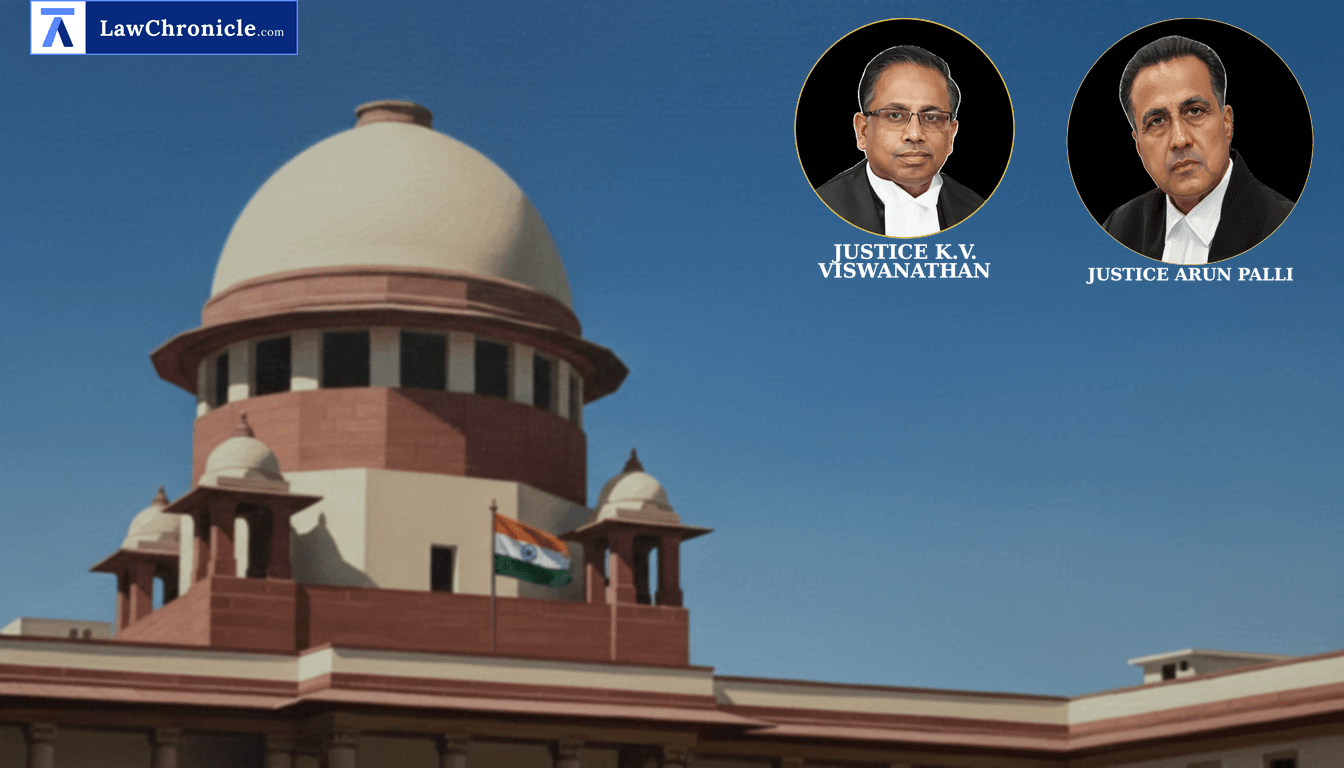
The Supreme Court clarified that the statutory power to try an issue first expires the moment a composite trial gets underway. The Bench emphasized that Trial Courts cannot retrospectively sever a single issue to decide it as a preliminary point under Order XIV Rule 2 of the Code of Civil Procedure, 1908 once evidence on issues generally has already commenced.
A bench comprising Justice K.V. Viswanathan and Justice Arun Palli held that while framing all issues together does not automatically bar the court from deciding a qualifying issue of law first, embarking upon full trial on all issues permanently closes that procedural window.
Key Takeaways
No Retrospective Severance: Once trial commences on all issues, courts cannot detach a single issue mid-way to try it as a preliminary point.
Framing vs. Embarking on Trial: The mere framing of all issues does not exhaust Order XIV Rule 2(2) powers; actually embarking upon evidence does.
Discretionary Preliminary Issues: Only pure questions of law relating to jurisdiction or statutory bars can be tried first, provided no factual inquiry is required.
Harmonious Trial Procedure: Prevents procedural loop-holes where a suit gets remanded back and forth after piecemeal preliminary adjudications.
Piecemeal Trials
Evaluating the legislative intent behind the 1976 Amendment to Order XIV Rule 2 of the Code of Civil Procedure, 1908 alongside Order XX Rule 5, the Supreme Court stressed that trial courts must avoid piecemeal trials after composite proceedings begin. The Bench elaborated the Trial Court's role as per applicable laws as “What the Court is empowered to do is to 'try that issue first', not merely to decide, or pronounce judgment upon, that issue first. 'First' is relational: it describes the position of the trial of the selected issue in relation to the trial of the others. Once the issues have entered a common trial, that relation can no longer be brought about. It is no longer possible, either temporally or conceptually, for one of them thereafter to be tried first. A Court may, of course consider, or decide, one issue before another while composing its judgment, but that is not the power conferred by sub-rule (2). The provision authorises a prospective ordering of trial; it does not authorise a retrospective reordering of a trial already underway.”
Ratio
An issue may be tried first as a preliminary issue under Order XIV Rule 2(2) of the Code of Civil Procedure, 1908 only if it is a pure issue of law relating to jurisdiction or a statutory bar that disposes of the suit without requiring determination of disputed facts. The procedural option to try an issue first remains available after all issues are framed, but stands completely exhausted the moment the trial court embarks upon the trial of issues generally.
Background
The dispute stemmed from a civil suit filed in 2013 seeking to declare a 2005 sale deed void and recover possession. The plaintiff alleged that his power of attorney holder fraudulently conveyed property without authority. The trial court framed issues in 2015, including whether the suit was barred under the Limitation Act, 1963.
After full evidence was led by the plaintiff and defence evidence commenced, Defendant No. 2 filed an application in 2018 seeking trial of the limitation issue as a preliminary issue. The trial court allowed the application and dismissed the suit under Article 59 of the Limitation Act, 1963. On appeal, the First Appellate Court modified the order to a rejection of plaint under Order VII Rule 11(d) of the Code of Civil Procedure, 1908. The Kerala High Court subsequently set aside the dismissal, holding limitation to be a mixed question of fact and law under Article 65 of the Limitation Act, 1963, and remitted the suit.
In analyzing the scope of preliminary issues, the Supreme Court examined several precedents. Relying on Ramesh B. Desai v. Bipin Vadilal Mehta ( "(2006) 5 SCC 638": 2006 CaseBase(SC) 996) and Major S.S. Khanna v. Brig. F.J. Dillon ( "AIR 1964 SC 497": 1963 CaseBase(SC) 200), the Court noted that pure legal issues disassociable from facts alone can be tried preliminarily. The Bench highlighted Nusli Neville Wadia v. Ivory Properties ( "(2020) 6 SCC 557": 2019 CaseBase(SC) 3629), where a three-judge bench held that CPC does not contemplate two full-fledged trials. The decision in Sukhbiri Devi v. Union of India ( "2022 SCC OnLine SC 1322": 2022 CaseBase(SC) 621) demonstrated that limitation can shedding its mixed character only when foundational facts are undisputed on plaint averments. The Court further referred to Manjula v. D.A. Srinivas ( "2026 INSC 465": 2026 CaseBase(SC) 419) to explain the stage-wise application of Order XIV Rule 2, and cited Nuthalapati Munaswamy Naidu v. N.A. Chengama Naidu to reinforce that once evidence on all issues is allowed, findings must be given on all issues under Order XX Rule 5.
The Supreme Court also distinguished and clarified prior decisions in Prithvi Raj Jhingta v. Gopal Singh and Sathyanath v. Sarojamani ( "(2022) 7 SCC 644": 2022 CaseBase(SC) 861), holding that while Prithvi Raj Jhingta correctly barred severing issues after joint trial, its wider observation that all other issues must remain unframed for Rule 2(2) to apply was incorrect. Finding that the trial court in this case had impermissibly severed an issue after general trial commenced, the Supreme Court set aside all lower court orders, restored the suit, and directed disposal within three months.
Case Details:
Case No.: Civil Appeal No. OF 2026 (Arising out of SLP (C) No. 34086 of 2025)
Neutral Citation: 2026 INSC 1020
Case Title: John Mathew v. Santha Paul & Ors.
Source: 2026 CaseBase(SC) 7016
Similar Articles
 Breaking News


