Typographical Errors Not Grounds For Criminal Prosecution: SC
 Copy Link
 Share
Share Save
Save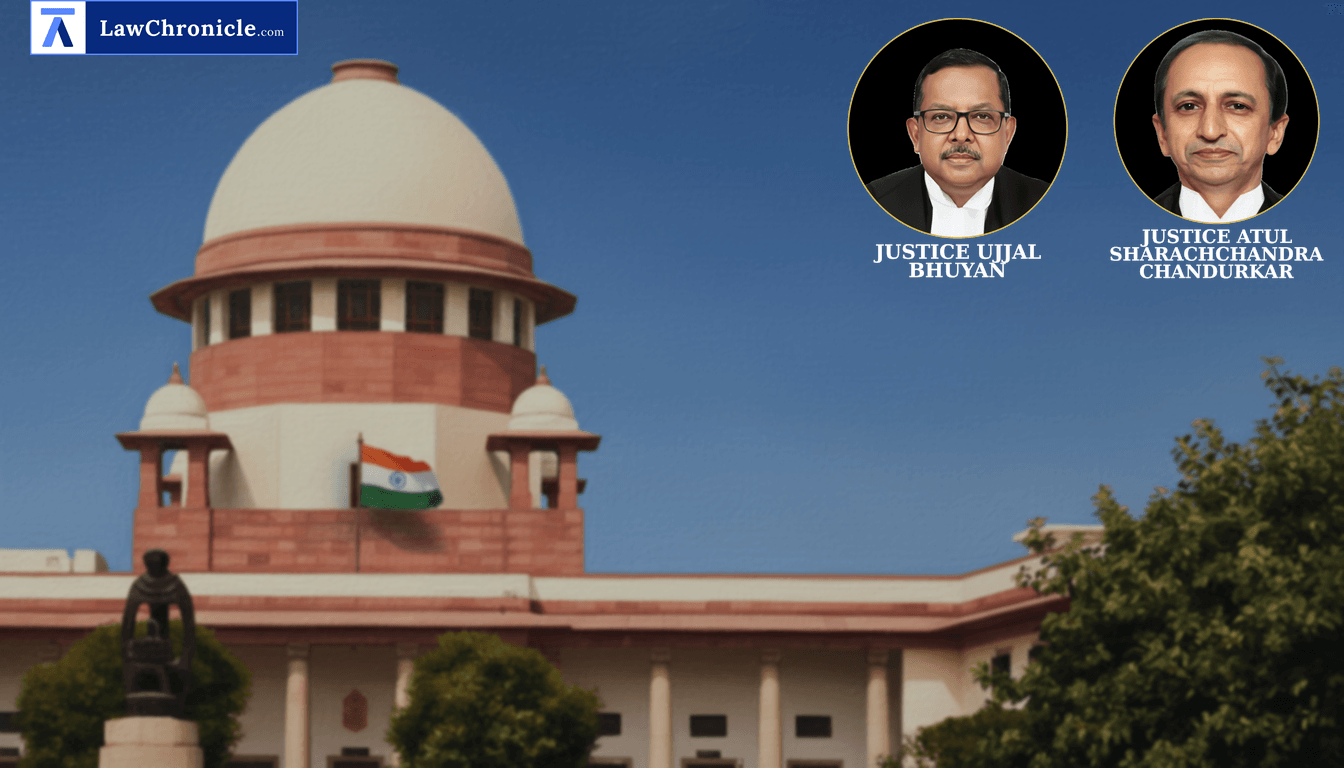
The Supreme Court has decisively shielded litigants and their counsel from malicious prosecution, ruling that mere 'wrong statements' or typographical errors in pleadings do not constitute 'false evidence' required to trigger criminal proceedings. This landmark intervention prevents the weaponization of procedural lapses under Section 340 of the Code of Criminal Procedure, 1973, emphasizing that judicial discretion must prioritize the interests of justice over personal vendettas.
A bench of Justice Ujjal Bhuyan and Justice Atul S. Chandurkar heard an appeal against a High Court judgment that had upheld the initiation of criminal proceedings against a defendant and his lawyer for alleged inaccuracies in a miscellaneous appeal and stay application.
Distinction Between 'Wrong' and 'False' Statements
The apex court clarified that the threshold for initiating action under Sections 193, 199, and 200 of the Indian Penal Code, 1860 is the deliberate making of a 'false statement' with an intent to deceive, rather than a mere 'wrong statement'. The Court, in its reasoning, observed: "There is a material difference between making a ‘wrong statement’ and ‘false statement’ in the context of Sections 199 and 200 of the Penal Code. A ‘wrong statement’ of fact may not always have the character of a ‘false statement’. While making of a ‘wrong statement’ may not fall within the ambit of Sections 199 and 200 of the Penal Code, a ‘false statement’ would qualify as relevant material for being considered as an offence under the said provisions. The threshold for initiating action... is the making of a ‘false statement’ and not the making of a ‘wrong statement’. It is so because a ‘false statement’ denotes a deliberate intention in making such statement; in other words, it is a wrongful or erroneous statement made intentionally to gain an undue advantage."
Mandate of Expediency in the Interest of Justice
The Court noted that the trial court and High Court failed to record whether it was "expedient in the interest of justice" to lodge a complaint. Citing Santokh Singh Vs. Izhar Hussain and another ( "1973 INSC 96": 1973 CaseBase(SC) 2), the bench reiterated that prosecution should only be directed in glaring cases of deliberate falsehood where conviction is highly likely. It further observed that the High Court erred by improving upon the trial court's order in an appeal filed by the aggrieved parties themselves, a course it termed impermissible.
Referring to Iqbal Singh Marwah and another Vs. Meenakshi Marwah and another ( "2005 INSC 129": 2005 CaseBase(SC) 720), the Court highlighted that the material produced must make out a prima facie case for an inquiry and that the impact on the administration of justice must be significant enough to warrant such a step.
Protections for Counsel and Timing of Section 340 Applications
Addressing the impleadment of the second appellant, a learned counsel, the Court found the typographical errors were duly explained as inadvertent mistakes by a steno-typist. Reliance was placed on James Kunjwal Vs. State of Uttarakhand and another ( "2024 INSC 601": 2024 CaseBase(SC) 224) to underscore that proceedings should only be initiated in exceptional circumstances where a party has perjured themselves for beneficial orders.
The Court has following directions: "The order dated 19.01.2006 passed by the 7th Additional District Judge, Nagpur below Exhibit 24 in M.C.A. No.28 of 2004 as well as the judgment dated 14.08.2012 passed in Criminal Appeal No.125 of 2006 by the learned Single Judge of the High Court is quashed and set aside. The application preferred by the plaintiffs under Section 340 of the Cr.P.C. stands dismissed. The Criminal Appeal is, accordingly, allowed."
Key Takeaways
Curbing Vexatious Litigation: The ruling prevents parties from using Section 340 as a tool to delay substantive proceedings or settle personal scores.
Protection for Legal Professionals: Lawyers cannot be held criminally liable for bona fide typographical or clerical errors in pleadings drafted by their offices.
Defined Threshold for Perjury: Establishes that only 'deliberate falsehood on a matter of substance' justifies criminal prosecution, not innocent inaccuracies.
Timing of Inquiry: Reaffirms that Section 340 inquiries should generally conclude after the final judgment to avoid distracting from the main dispute.
Ratio
The law declared by the Court is that the power under Section 340 of the Code of Criminal Procedure, 1973 cannot be invoked for 'wrong statements' resulting from inadvertent errors or typographical mistakes. An inquiry is only warranted when there is prima facie evidence of a 'false statement' made with deliberate intent to deceive, and where the Court explicitly forms an opinion that such an inquiry is 'expedient in the interest of justice'.
Background:
The dispute originated from a civil suit regarding property obstruction and water meter access. During the litigation, the plaintiffs alleged that the defendant and his counsel made false statements in a miscellaneous appeal by using the word 'dismissed' instead of 'disposed of' and omitting the word 'no' in a sentence. While the appellants had moved to correct these typographical errors under Section 151 and Order VI Rule 17 of the Code of Civil Procedure, 1908 before any inquiry, the lower courts ordered criminal prosecution. The Supreme Court found these errors to be minor and inadvertent, lacking the 'intent to deceive' necessary for criminal charges.
Case Details:
Case No.: CRIMINAL APPEAL NO.1365 OF 2015
NeutralCitation: 2026 INSC 724
Case Title: Prabhakar Yeshwant Masram And Another Versus Sou Tula Namdeorao Jaipurkar And Another
Appearances:
For the Petitioner(s): Mr. Satyajit A. Desai, Advocate
Source: 2026 CaseBase(SC) 674
 Breaking News