Uncertain Dying Declaration Entitles Accused To Benefit Of Doubt: Himachal Pradesh HC
 Copy Link
 Share
Share Save
Save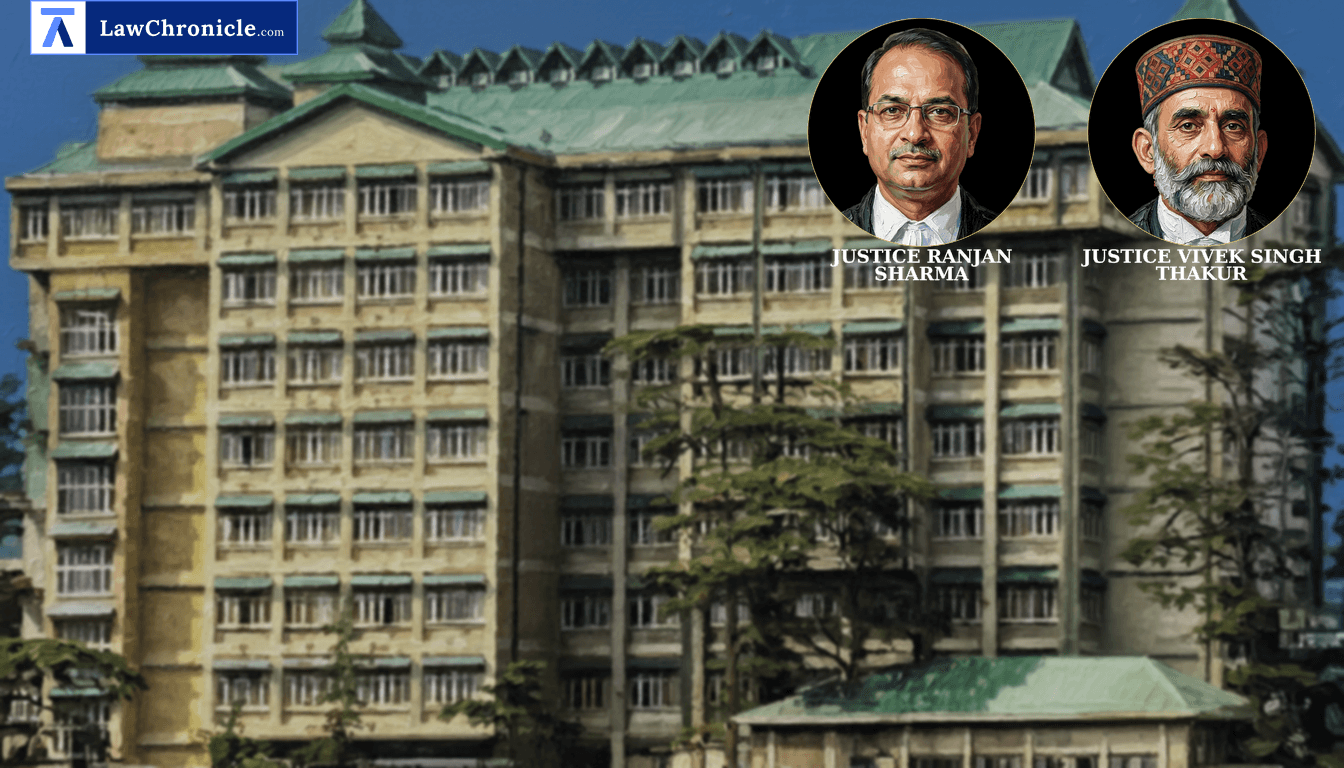
Exposing critical flaws in the prosecution's narrative, the High Court of Himachal Pradesh set aside a husband's life sentence for wife murder after finding major contradictions in the victim's purported oral dying declarations and uncorroborated allegations of cruelty. The decision underscores that when oral dying declarations lack consistency and are directly contradicted by eyewitness testimony, the benefit of reasonable doubt must inevitably accrue to the accused.
A Division Bench comprising Justice Vivek Singh Thakur and Justice Ranjan Sharma allowed an appeal challenging the conviction and life imprisonment order passed by the Additional Sessions Judge, Sarkaghat, District Mandi, under Section 302 of the IPC.
Key Takeaways
Inconsistency Undermines Prosecution Case: Alternative and contradictory theories presented by prosecution witnesses regarding the cause of death demolish the reliability of an alleged oral dying declaration.
Unexamined Key Witnesses Create Doubt: Failure to examine neutral medical or attendant personnel accompanying a victim during transit weakens claims of oral statements made during emergency transit.
Child Witness Testimony Retains Weight: Unhostile testimony of a child eyewitness supporting the defense narrative carries substantial evidentiary value when admitted by the prosecution without re-examination.
Evaluation of Dying Declarations and Judicial Rationale
The High Court carefully evaluated two conflicting versions of the incident. In her initial statement made in the presence of a doctor, the victim stated that she suffered accidental burn injuries due to a sudden fireball while preparing milk on a leaking gas stove. However, her parents asserted that during transit in an ambulance, she disclosed that her husband had poured a liquid smelling of petrol and kerosene on her.
The Court, in its reasoning, observed: "Inconsistency and uncertainty evidence in the testimony of PW-1 Krishan Chand clearly indicates that the prosecution's story is an afterthought and that even PW-1 was not certain about the actual cause of death. This inconsistency, by itself, demolishes the entire prosecution's case, which stands further weakened by the testimony of the deceased-victim's son, proving to be the final nail."
The Court highlighted that the four-year-old son, examined as PW-12, explicitly testified that his mother caught fire while boiling milk and that his father did not beat or burn her. Since the prosecution did not declare him hostile or re-examine him, his version remained accepted.
The Court has following directions:
"Release warrants be issued forthwith, if not required in any other case."
"Case property, if any, will be confiscated to the State strictly in accordance with law after expiry of period of limitation of filing further proceedings before competent Court of law."
"The fine amount, if deposited, be refunded after the expiry of period of limitation for filing the appeal, in case no appeal is preferred, and in case of filing appeal, the same be dealt with as per the orders of the Apex Court."
"In view of the provisions of Section 481 of the Bharatiya Nagarik Suraksha Sanhita, 2023 the appellant is directed to furnish his personal bond in the sum of ₹50,000/- with one surety in the like amount to the satisfaction of the Trial Court within four weeks, which shall be effective for six months with stipulation that in the event of Special Leave Petition being filed against this judgment, or on grant of the leave, the appellant on receipt of notice(s) thereof, shall appear before the Hon'ble Supreme Court."
Ratio
Where an alleged oral dying declaration is plagued by severe inconsistencies, alternative causes of death advanced by the informant, and direct contradiction by competent eyewitness testimony, it cannot form the sole basis for conviction, and the accused is entitled to the benefit of reasonable doubt.
Background
The case originated from an incident on November 12, 2018, where the victim suffered severe burn injuries at her matrimonial home and subsequently succumbed to hypovolemic shock and organ failure while being shifted to PGI Chandigarh. Initial police reports recorded an accidental gas leakage fire. However, the victim's father subsequently lodged a statement under Section 154 of the Cr.P.C. alleging that the husband either drove her to suicide or set her on fire.
During trial, charges were framed under Section 302 of the IPC. While the appellant pleaded not guilty and recorded his statement under Section 313 of the Cr.P.C., the trial court convicted him and sentenced him to life imprisonment. On appeal, the High Court scrutinized the scientific and testimonial evidence, noting the absence of kerosene smell on the appellant's clothes or in forensic debris, and highlighted the irreconcilable gaps in the prosecution's narrative.
Consequently, the High Court set aside the conviction, acquitted the appellant of all charges, and ordered his immediate release.
Case Details:
Case No.: Cr. Appeal No. 460 of 2024
Neutral Citation: 2026:HHC:33829
Case Title: Ashok Kumar v. State of Himachal Pradesh
Appearances:
For the Petitioner(s): Mr. Deepak Kaushal, Senior Advocate with Mr. Abhishek Verma and Mr. Aditya Chouhan, Advocates.
For the Respondent(s): Mr. Gautam Sood, Deputy Advocate General.
Source: 2026 CaseBase(HP) 4583
 Breaking News