Understanding Law on Criminal Case against Election Candidate | Meenakshi Natarajan Matter
 Copy Link
 Share
Share Save
Save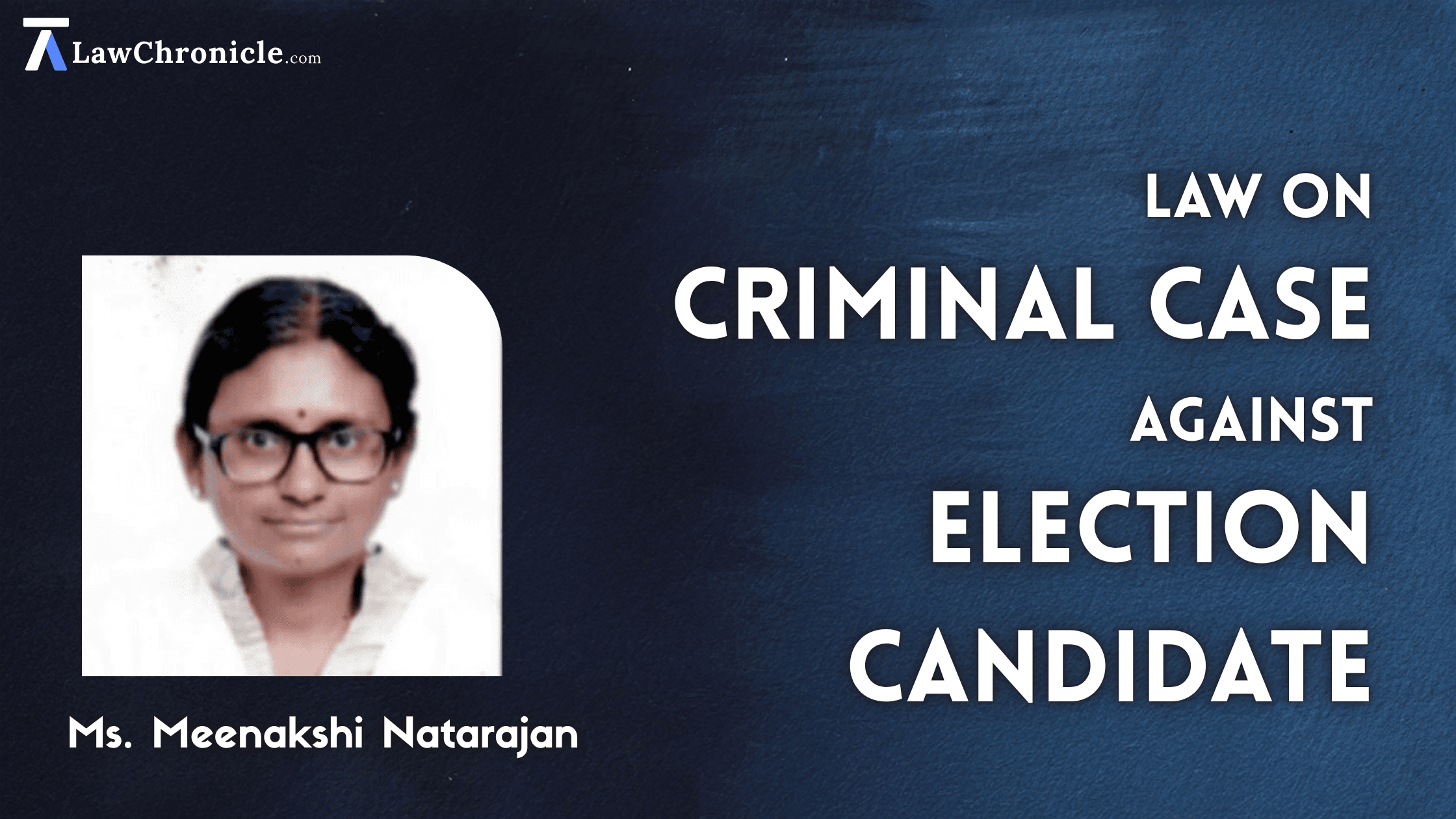
The recent news of rejection of Congress leader Meenakshi Natarajan's Rajya Sabha nomination from Madhya Pradesh made some rounds. It has raised a significant question upon the common ground of election law with criminal procedures. A criminal case is a barrier to the membership of a legislature. But the bigger question is - At what stage does a pending court proceeding become a "criminal case" that a candidate is legally obliged to disclose? The matter is now before the Supreme Court of India. This article seeks to understand the bits and pieces of the law that decide the fate of elected people.
What Happened with Meenakshi Natarajan?
On 9th June, 2026, the Returning Officer for the Madhya Pradesh Rajya Sabha election rejected the nomination of Congress's Rajya Sabha candidate Meenakshi Natarajan. The stated reasoned that she had not listed a Hyderabad court matter in her election affidavit. The objection to her nomination had been raised by BJP candidate Mahesh Kewat.
The Back Story
The BJP's strength in the 230-member Madhya Pradesh Assembly had already made the election of two of its three nominees almost certain. The third seat was expected to witness a contest between BJP nominee Mahesh Kewat and INC’s Meenakshi Natarajan. Following the rejection, the BJP effectively secured all three seats without a contest.
The Root Cause: Criminal Case against Meenakshi Natarajan
The dispute centres on a private complaint filed in September 2025 before the Nampally District Magistrate Court in Hyderabad, Telangana. In the complaint, it was alleged that Meenakshi Natarajan provided political patronage to a Congress functionary against whom she had levelled allegations of serious misconduct, and that despite repeated complaints, she and other Congress leaders in Telangana did not intervene to take disciplinary action. Meenakshi Natarajan was named as one of seven Congress leaders in the complaint.
Meenakshi Natarajan received a notice under Section 223 of the Bharatiya Nagarik Suraksha Sanhita (BNSS), 2023. Under the statutory scheme, a Magistrate considering a private complaint is required to hear the proposed accused before deciding whether cognizance should be taken. A Section 223 notice is therefore a pre-cognizance step. It is clear that it is neither a charge-sheet nor a summons following cognizance.
Law under Representation of the People Act
The legal core of the dispute lies in Section 33A of the Representation of the People Act (RPA), 1951. The distinction between a pre-cognizance notice and cognizance itself is not merely technical. Cognizance, the formal act by which a Magistrate takes judicial notice of an offence and proceeds to examine whether there is sufficient basis for trial, is a threshold that marks the transition from complaint to proceeding. A Section 223 BNSS notice is issued precisely because cognizance has not yet been taken; it is an invitation to the proposed accused to show cause why it should be taken at all. The Returning Officer's order, however, records that the court had taken cognizance and issued summons.
Before the Supreme Court
Congress leader Meenakshi Natarajan has filed a writ petition before the Supreme Court challenging her rejection. The matter was mentioned on 11th June before a Bench of Justice Prashant Kumar Mishra and Justice Atul S. Chandurkar by Senior Advocate Abhishek Manu Singhvi, who sought immediate listing and a stay on the declaration of election results.
During the hearing, Justice Prashant Kumar Mishra questioned the maintainability of the writ petition, observing that courts ordinarily refrain from interfering in election matters at an interim stage. In response, Singhvi submitted that constitutional courts could exercise jurisdiction in exceptional cases involving manifest illegality.
The Supreme Court refused to grant an interim stay on the election process in Madhya Pradesh or halt result declaration, but agreed to list the matter for hearing on 12th June. The Election Commission, and the rival candidate, both raised objections to maintainability.
The Broader Legal Question
The Natarajan matter has brought to the fore a disclosure obligation that has long occupied election law practitioners: whether the duty of disclosure under the RPA and Supreme Court directions on candidate affidavits extends to pre-cognizance proceedings or is confined to cases in which a court has formally taken cognizance.
The matter is listed as Meenakshi Natarajan v. Election Commission of India before a Bench of Justices P.K. Mishra and Atul S. Chandurkar. The Rajya Sabha polls for Madhya Pradesh are scheduled to be held on 18th June 18, 2026.
 Breaking News