


Unexplained Delay In Identification Parade Invalidates Robbery Conviction: Allahabad HC
 Copy Link
 Share
 Save
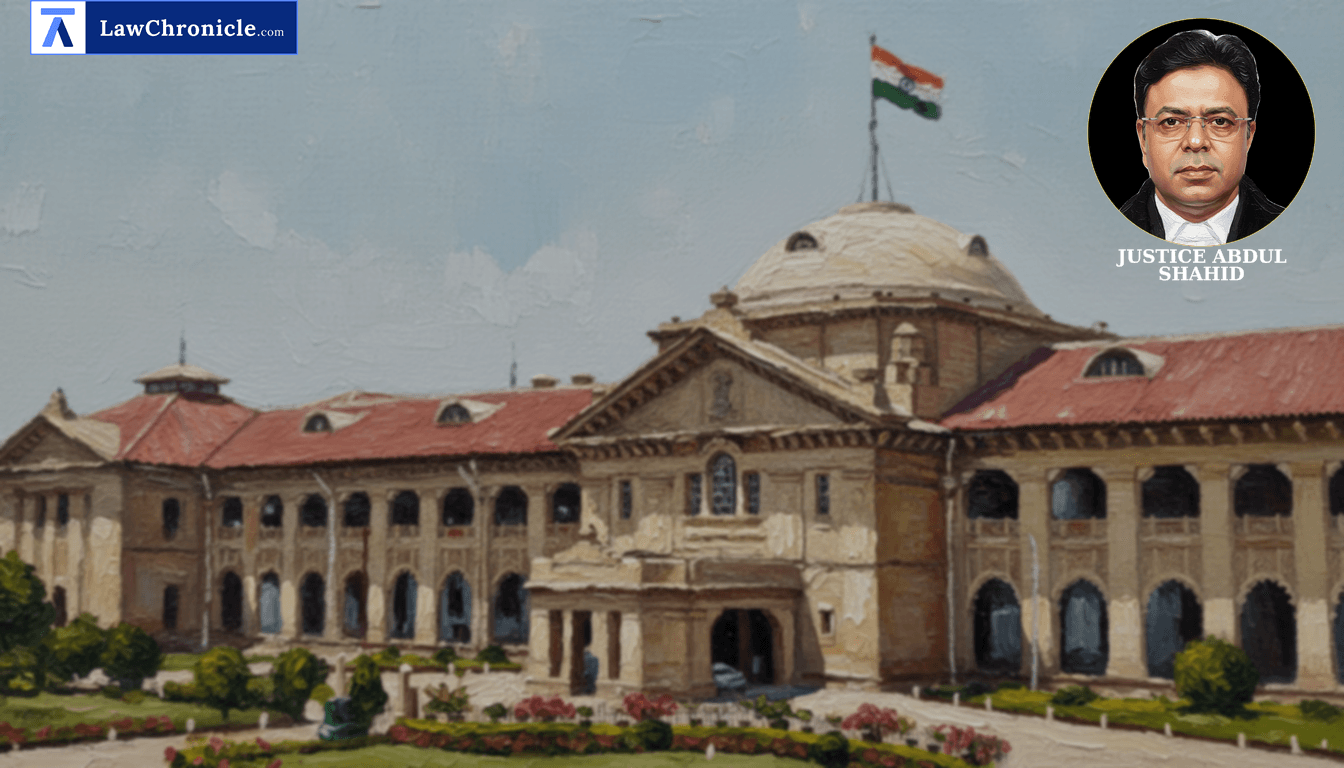
In a decisive legal blow to convictions anchored in delayed and uncorroborated evidence, the High Court has held that an unexplained delay in conducting a test identification parade combined with the non-production of source light materials fatally undermines the prosecution's case. Reversing a four-decade-old trial court judgment, the High Court emphasized that identification evidence recorded after unexplained months cannot safely sustain a criminal conviction in the absence of distinct physical descriptions or recovered weapons.
A single judge bench of Justice Abdul Shahid was presiding over a criminal appeal challenging the judgment and order of the trial court convicting the accused under Section 392 of the IPC. The appeal questioned whether the conviction could stand solely on delayed identification parade evidence and recovery of generic, market-available household items.
Key Takeaways
Delay Dilutes Evidentiary Value: Conducting a Test Identification Parade months after arrest without a valid explanation severely compromises its evidentiary worth.
Source Light Production Essential: Failure to produce the torch or light source used by witnesses to identify assailants during a night crime creates reasonable doubt.
Substantive Proof Required: Test identification is not substantive evidence by itself and requires robust, independent corroborative proof.
The Court made crucial observations on the reliance placed on delayed test identification parades and incomplete physical evidence. The Court, in its reasoning, observed: "In these circumstances, the identification evidence, the delayed test identification parade and the alleged recovery, when considered cumulatively, do not establish the guilt of the appellants beyond reasonable doubt. The appellants are, therefore, entitled to the benefit of doubt."
Ratio
Evidence of identification in a Test Identification Parade is not substantive evidence and cannot form the sole basis of conviction. An unexplained delay in holding the identification parade, coupled with the prosecution's failure to produce the source of light in court and the non-recovery of incriminating weapons, renders the identification unreliable and entitles the accused to the benefit of doubt.
Background
The dispute arose from an alleged night-time robbery on August 11/12, 1978, where four miscreants allegedly looted household items and jewelry. An FIR was lodged under Section 392 and Section 397 of the IPC. Following an investigation based on an informer's statement, the appellants were arrested, and recovery of a mosquito net and a blanket was alleged.
During the trial, the prosecution relied on witness statements and a test identification parade conducted under Section 9 of the Indian Evidence Act. The appellants argued that test identification parade evidence is not substantive, relying on precedents such as Iqbal and another Vs. State of U.P., Satrughana alias Sastrughan Parida Vs. State of Orissa ( "1992 LawSuit (SC) 829": 1992 CaseBase(SC) 947), and Nirmal Pasi Vs. State of Bihar ( "2002 LawSuit (SC) 648": 2002 CaseBase(SC) 1226). They further cited Shyam Singh Vs. State of U.P. regarding long delays in identification and Bhup Singh and others Vs. State of U.P. along with Manzoor v. State of Uttar Pradesh regarding the non-production of the torch in court.
Statements were recorded under Section 313 of the Cr.P.C., where the appellants denied all allegations. The trial court had convicted the appellants under Section 392 of the IPC, while charges under Section 397 of the IPC and Section 411 of the IPC were either dropped or not framed. The High Court allowed the appeal, set aside the conviction dated July 24, 1985, and acquitted the appellants of all charges.
Case Details:
Case No.: Criminal Appeal No. 2015 of 1985
Case Title: Chhotey And Another v. State
Appearances:
For the Petitioner(s): Mahesh Prasad Yadav, R.K. Singh Rajput, Ram Prasad Singh
For the Respondent(s): A.G.A.
Source: 2026 CaseBase(ALL) 618
Similar Articles
 Breaking News


