


Unproved Title Invalidates Subsequent Property Transfers: Orissa High Court
 Copy Link
 Share
 Save
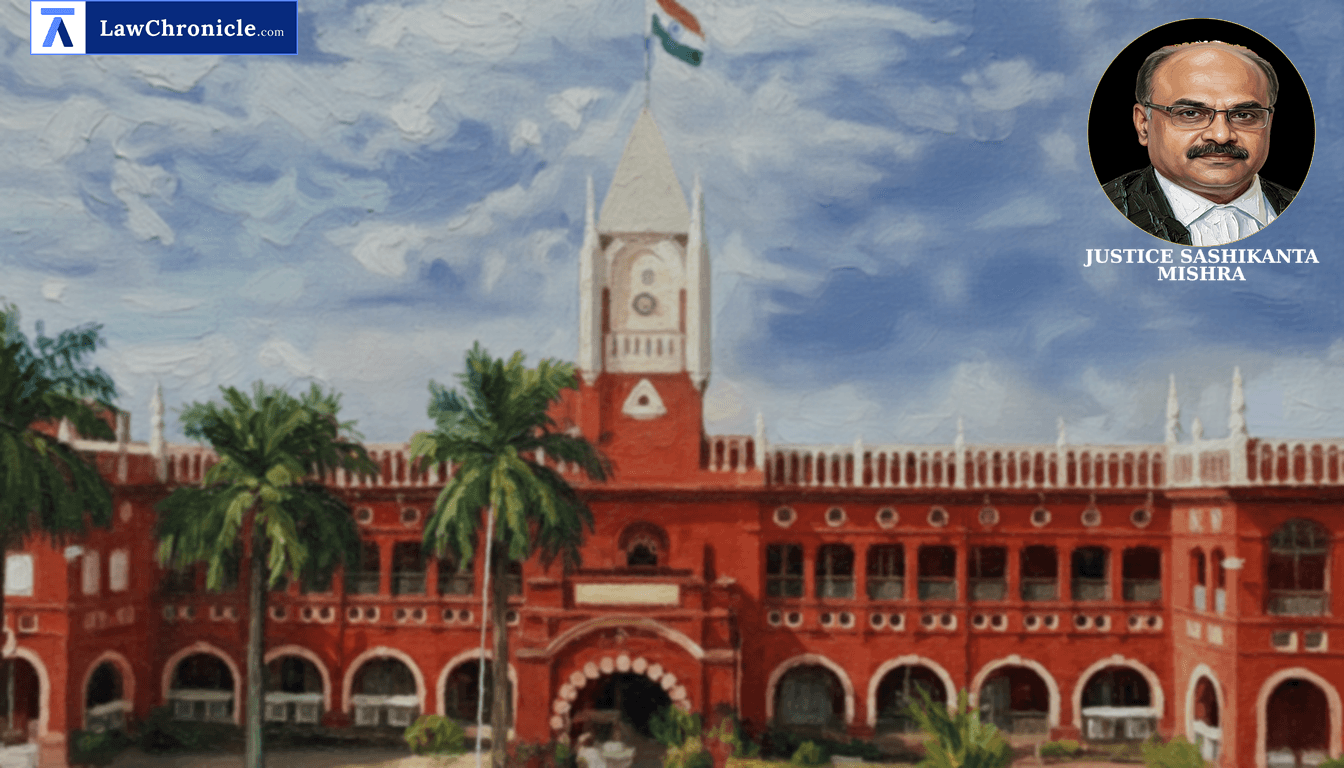
Invalidating a land transfer dating back nearly eight decades, the Orissa High Court ruled that when the foundational transaction conveying title remains unproved, all subsequent alienations, including donations to public institutions, automatically collapse under law.
Justice Sashikanta Mishra, sitting as a single judge bench, adjudicated the writ petitions challenging administrative orders that had set aside compensation directives for land used by a government school. Addressing the validity of a decades-old purported sale and subsequent gift to an educational institution, the Court examined the applicability of pre-merger laws, registration requirements, and the consequences of unestablished underlying title.
Invalidation of Unproved Title and Subsequent Transfers
The High Court held that the fundamental claim of title failed due to non-production of the primary transaction deed. Applying the principle that the collapse of a foundation dismantles the superstructure, the Court determined that an individual without valid title cannot execute a valid transfer or gift. Section 41 of the T.P. Act directly bars alienations made by individuals lacking title.
The Court observed that while the Indian Registration Act, 1908 was not in force in the ex-State of Gangpur at the time of the alleged 1946 transaction—having become applicable only on February 26, 1950, pursuant to the Merged States (Laws) Act, 1950—the failure to produce the original sale document rendered the transaction unproven. Furthermore, the Court highlighted that settlement entries do not create title where none exists.
Recognizing the public interest as a government school has functioned on the land for nearly 75 years, the Court substituted land restoration with a direction for fair compensation to all legal heirs.
The Court has following directions:
"This Court therefore, concurs with the direction of the OSD(L.R.) to the Education Department to pay compensation as fixed on the date of the order but modifies such direction to the effect that the same shall be paid in equal proportions to all the surviving legal heirs of the recorded owners. Such payment shall be made within two months from today after ascertaining the particulars and whereabouts of all the legal heirs."
The Court, in its reasoning, observed:
"Since the original transaction itself has not been proved, the natural corollary is to hold that the transferee had never acquired title over the property as claimed so as to alienate the same by way of sale, gift or otherwise... It is settled law that once the foundation goes, the superstructure collapses."
Key Takeaways
- Unproved Primary Title Vitiates All Subsequent Transfers: A party claiming rights through derivative transactions must establish the initial root of title, failing which subsequent sales or gifts are void.
- Revenue Entries Do Not Confer Legal Title: Mere recording of a party's name in settlement or mutation records cannot create ownership rights in the absence of a valid title deed.
- Equity Balances Public Interest and Tribal Rights: Where long-standing public infrastructure operates on wrongly transferred land, monetary compensation to legal heirs serves as an equitable alternative to physical restoration.
Ratio
An unproven original conveyance invalidates all subsequent alienations under Section 41 of the Transfer of Property Act, 1882, as a transferor cannot convey a better title than they possess; revenue settlement entries cannot cure an underlying absence of legal title.
Background:
The dispute concerned Ac. 0.88 decimals of land originally belonging to recorded tribal tenants, Late Sansaru Gond and Late Amar Gond. The private respondent claimed his ancestor purchased the land in 1946 via a stamp paper deed for Rs. 100, subsequently donating Ac. 0.56 decimals in 1951 for the establishment of Rastriya Vidyalaya, which was later taken over by the State Government.
In 2006, the petitioner's father initiated proceedings under Section 3-A of Regulation-2 of 1956 seeking eviction. The OSD (L.R.), Sundargarh, found no valid 1946 sale deed or required permission and initially ordered restoration, but later modified the relief to compensation based on Amarendra Pratap Singh vrs. Tej Bahadur Prajapati. The ADM, Sundargarh, set aside the compensation order in appeal, prompting the petitioner to approach the High Court under Articles 226 and 227 of the Constitution of India.
Setting aside the ADM's appellate orders, the High Court allowed the writ petitions and directed the State Education Department to distribute equal compensation to all surviving legal heirs within two months.
Case Details:
Case No.: W.P.(C). No. 22751 of 2021 and 2903 of 2022
Case Title: Akshya Kumar Naik v. Pawan Kumar Agrawal & Others
Appearances:
For the Petitioner(s): Mr. S. Sourav, Advocate; Mr. B.K. Mishra, Advocate
For the Respondent(s): Mr. S.N. Pattnaik, AGA; Mr. S. Swain, Advocate; Mr. S.K. Dash, Senior Advocate with Mr. K. Acharya
Source: 2026 CaseBase(ORI) 49
Similar Articles

 Breaking News


