Unsuccessful Candidate cannot challenge Selection Process in Endless Litigation : Supreme Court
 Copy Link
 Share
Share Save
Save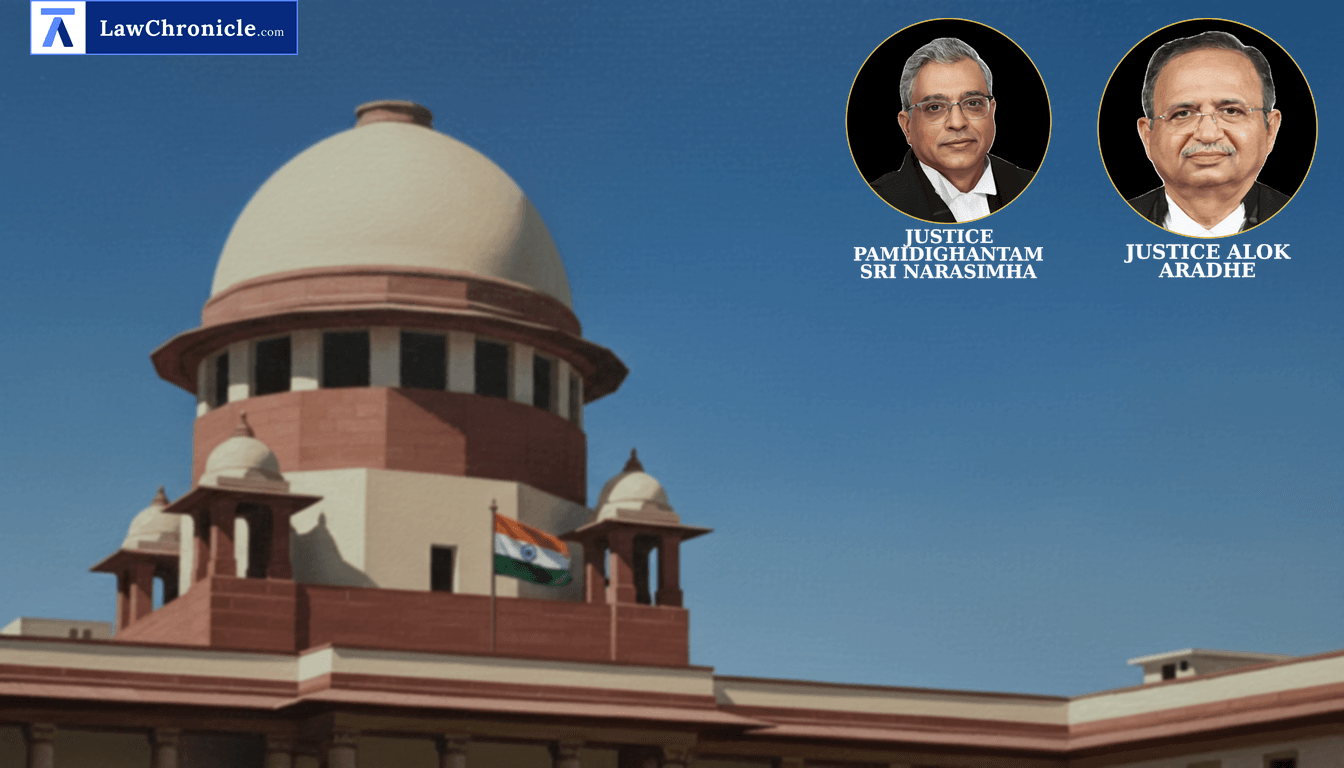
The Supreme Court has ruled that unsuccessful candidates cannot challenge the selection process. The Apex Court made it clear that candidates who fail to secure the prescribed cut-off marks cannot endlessly litigate selection processes or demand CBI probes without concrete evidence.
A Division Bench comprising Justice Pamidighantam Sri Narasimha and Justice Alok Aradhe dismissed a writ petition under Article 32 of Constitution of India challenging the revised selection list for Technician Grade-2 (Trainee) Electrical posts in Uttar Pradesh Power Corporation Limited (UPPCL).
Key Takeaways
Interim Orders Bind Litigants: Parties remain bound by interim orders restricting arguments unless formally challenged in higher forums.
Suppression Disentitles Relief: Non-disclosure of prior dismissed writ petitions involving identical claims leads to immediate dismissal.
CBI Probe Standard: Directions for a CBI investigation cannot be issued routinely without concrete pleadings or prior complaints against local authorities.
Reservation Merit Allocation: Reserved category candidates scoring above open cutoff are legitimately placed in general category seats.
Court's Scrutiny on Legal Principles and Judicial Restraint
The Supreme Court noted that the petitioners had earlier restricted their challenge solely to their claim of higher merit. Addressing the binding nature of judicial orders, the Apex Court, while holding that unsuccessful candidates cannot challenge selection process, expressed that "It is trite law that an order is effective inter partes and shall bind them until it is successfully avoided or challenged in a higher forum." Referring to State of Kerala v. M.K. Kunhikannan Nambiar Manjeri Manikoth, Naduvil (D) & Ors. ( "(1996) 1 SCC 435": 1995 CaseBase(SC) 636), the Bench held that the scope of scrutiny remained strictly confined to the terms of the Court's prior order.
Addressing the prayer for a CBI probe, the Bench relied on State of West Bengal & Ors. v. Committee for Protection of Democratic Rights, West Bengal & Ors. ( "(2010) 3 SCC 571": 2010 CaseBase(SC) 467), Himanshu Kumar and Ors. v. State of Chhattisgarh and Ors. ( "(2023) 12 SCC 592": 2022 CaseBase(SC) 679), and Legislative Council U.P. Lucknow and Ors. v. Sushil Kumar and Ors. ( "2025 INSC 1241": 2025 CaseBase(SC) 1128) to emphasize that constitutional courts must observe self-imposed limits when directing independent investigations.
Ratio
Litigants who acquiesce to specific issues during proceedings are bound by interim orders limiting the scope of inquiry. Furthermore, an investigation by the Central Bureau of Investigation cannot be ordered as a matter of routine under constitutional jurisdiction without foundational pleadings, prior FIRs, or material establishing systemic failure.
Background
The dispute originated from a 2011 recruitment drive by UPPCL for 2,974 Technician Grade-2 posts. Aggrieved unsuccessful candidates challenged the extension of timelines for submitting computer certificates. The Allahabad High Court Division Bench directed UPPCL to restrict eligibility to candidates who submitted certificates prior to March 31, 2012, which was subsequently upheld by the Supreme Court in Sanjay K. Dixit & Ors. v. State of Uttar Pradesh & Ors. ( "(2019) 17 SCC 373": 2019 CaseBase(SC) 2955).
In this writ petition, petitioners alleged irregularities and demanded a CBI probe, relying on precedents such as State of West Bengal v. Baisakhi Bhattacharyya (Chatterjee) & Ors. ( "2025 SCC OnLine SC 719": 2025 CaseBase(SC) 1057), Manoj Kumar v. Union of India & Ors. ( "(2024) 3 SCC 563": 2024 CaseBase(SC) 347), and Dinesh Kumar Kashyap v. South East Central Railway & Ors. ( "(2019) 12 SCC 798": 2018 CaseBase(SC) 219). Conversely, the respondents submitted that candidates in reserved categories scoring above open thresholds were properly assigned to general seats under the established rules of J.S. Yadav v. State of Uttar Pradesh & Anr. ( "(2011) 6 SCC 570": 2011 CaseBase(SC) 429), Union of India & Anr. v. Satya Prakash & Ors., Ritesh R. Sah v. Dr. Y.L. Yamul & Ors., and R.K. Sabharwal & Ors., v. State of Punjab & Ors.. The Supreme Court ultimately found no merit in the petition, citing suppression of facts regarding earlier litigation and lower merit scores than the prescribed cut-off.
Case Details:
Case No.: WRIT PETITION (C) NO. 123 OF 2013
Neutral Citation: 2026 INSC 997
Case Title: VINIT KUMAR & ORS. v. STATE OF U.P. THROUGH SECRETARY & ORS.
Appearances:
For the Petitioner(s): Mr. Prashant Bhushan, Advocate
For the Respondent(s): Mr. Sunil Kumar Jain, Advocate
Source: 2026 CaseBase(SC) 7002
 Breaking News