Vague Dowry Death Charges Cannot Be Used To Harass Husband: Supreme Court
 Copy Link
 Share
 Save
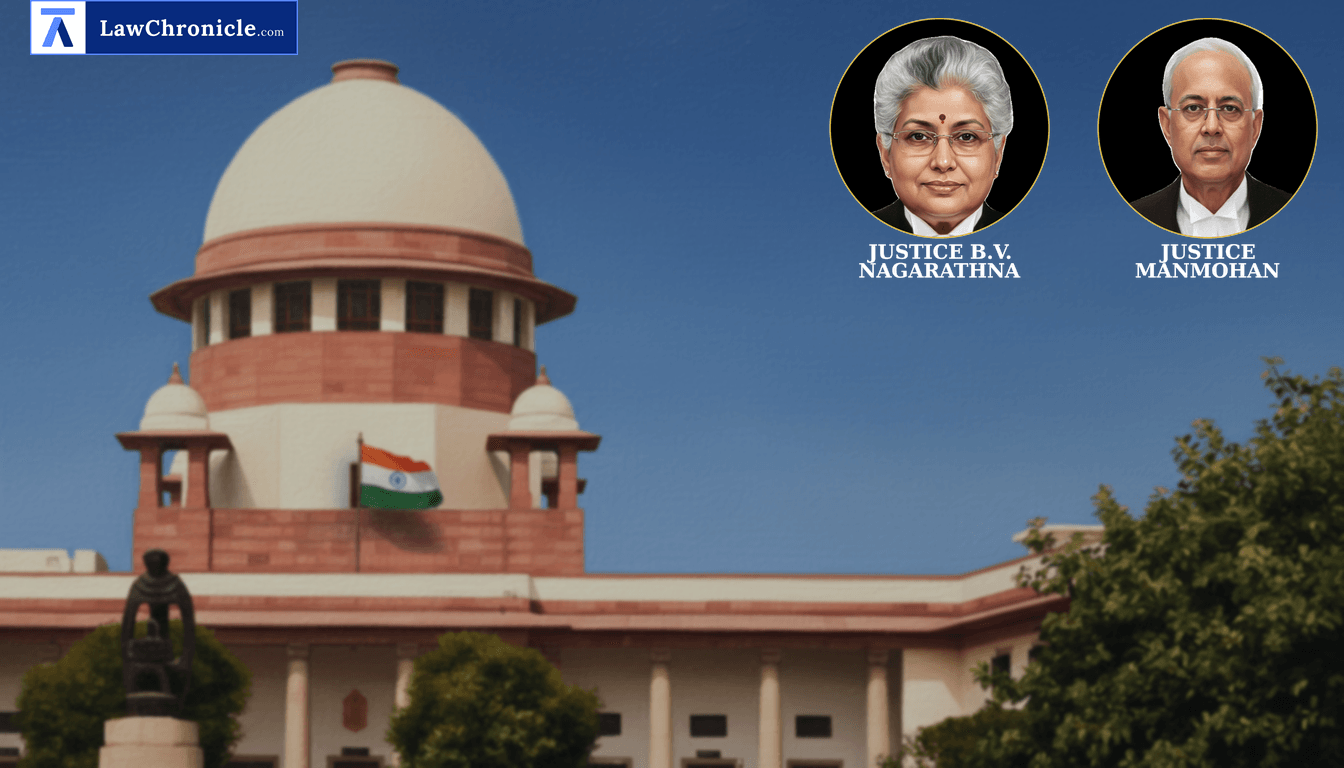
Supreme Court has quashed a criminal prosecution for dowry death and cruelty against a Canadian resident husband. The Apex Court ruled that vague and generalized allegations without a proven causal link to a spouse's suicide cannot sustain a criminal trial. A bench comprising Justice B.V. Nagarathna and Justice Manmohan quashed the criminal proceedings originating from FIR No. 212/2023, setting aside the order of the Bombay High Court which had previously refused to grant relief to the husband.
Key Takeaways
Causation Essential For Section 304B
Unsubstantiated claims of historical gift exchanges or temperamental issues do not constitute dowry harassment unless a direct nexus to the suicide is established.
Suicide Note Exoneration
Clear evidence from foreign law enforcement and clean suicide notes citing employment stress defeat presumptions of spousal torture.
Check On Matrimonial Law Misuse
Courts must exercise inherent jurisdiction under Section 482 to prevent criminal processes from turning into instruments of personal vendetta by grieving in-laws.
Court's Rationale on Matrimonial Cruelty & Dowry Death
The Supreme Court observed that customary gift-giving during weddings or festivals cannot be automatically painted with a criminal brush to manufacture dowry death charges under Section 304B of the Indian Penal Code, 1860. The Bench noted that the deceased had left behind a hand-written suicide note citing joblessness and academic stress, with no mention of harassment or dowry demands. Highlighting the scope of appellate protection against baseless prosecutions, the Apex Court relied on Central Bureau of Investigation vs. A. Ravishankar Prasad ( "(2009) 6 SCC 351": 2009 CaseBase(SC) 267) to underline that inherent powers must be exercised to prevent the abuse of process of any court. The Court also reiterated the landmark categories laid down in State of Haryana vs. Bhajan Lal for quashing untenable FIRs.
While discussing the vague allegations of dowry death, the Supreme Court observed that “A temperamental issue of a spouse cannot be equated with the offence of criminal intimidation or grievous hurt so as to make him criminally liable for the suicide of his wife as the same tantamounts to abuse of process of law, particularly when material in support of the same is conspicuous by its absence. We understand the plight and pain of the family members of the deceased who have gone through the tragedy of losing their daughter but the husband and the in-laws, cannot be made to bear the brunt of the same without first demonstrating any act or omission on their part that coerced the deceased to such an extent that committing suicide was the only way out.”
Ratio
To attract offences under Section 304B and Section 498A of the Indian Penal Code, 1860, the prosecution must demonstrate specific acts of cruelty or dowry demands having a direct and proximate causal nexus to the unnatural death; generalized, omnibus allegations and customary exchanges of gifts cannot form the basis of criminal prosecution.
Background
The appellant married the deceased in January 2021, and the couple relocated to Toronto, Canada in February 2022. Tragically, on June 11, 2023, the wife died by jumping from the 22nd floor of their apartment building. Canadian authorities, including the Toronto Police Department and the Coroner's office, investigated the incident and concluded it was a suicide driven by stress over employment and studies, finding no foul play or physical struggle.
Despite this, the deceased's father lodged FIR No. 212/2023 at Satara Police Station, Maharashtra, alleging offences under Sections 304B, 323, 498A, 504 read with Section 34 of the Indian Penal Code, 1860 and Sections 3 and 4 of the Dowry Prohibition Act, 1961 against the husband and his parents. The High Court quashed the proceedings qua the parents under Section 482 of the Code of Criminal Procedure, 1973 but refused relief to the husband, prompting him to approach the Supreme Court.
Finding that the allegations were vague and failed to satisfy the essential ingredients of Section 304B, Section 323, Section 498A, or Section 504 of the Indian Penal Code, 1860, the Apex Court allowed the appeal and quashed the FIR entirely.
Case Details:
Case No.: Criminal Appeal No. of 2026 (Arising out of Special Leave Petition (Criminal) No.12158 of 2025)
Neutral Citation: 2026 INSC 1183
Case Title: Piyush s/o Deepak Narlawar v. State of Maharashtra & Others
Source: 2026 CaseBase(SC) 9516
 Breaking News