Veritable Party To Arbitration a Question of Fact; Supreme Court rules out Straight Jacket Formula
 Copy Link
 Share
 Save
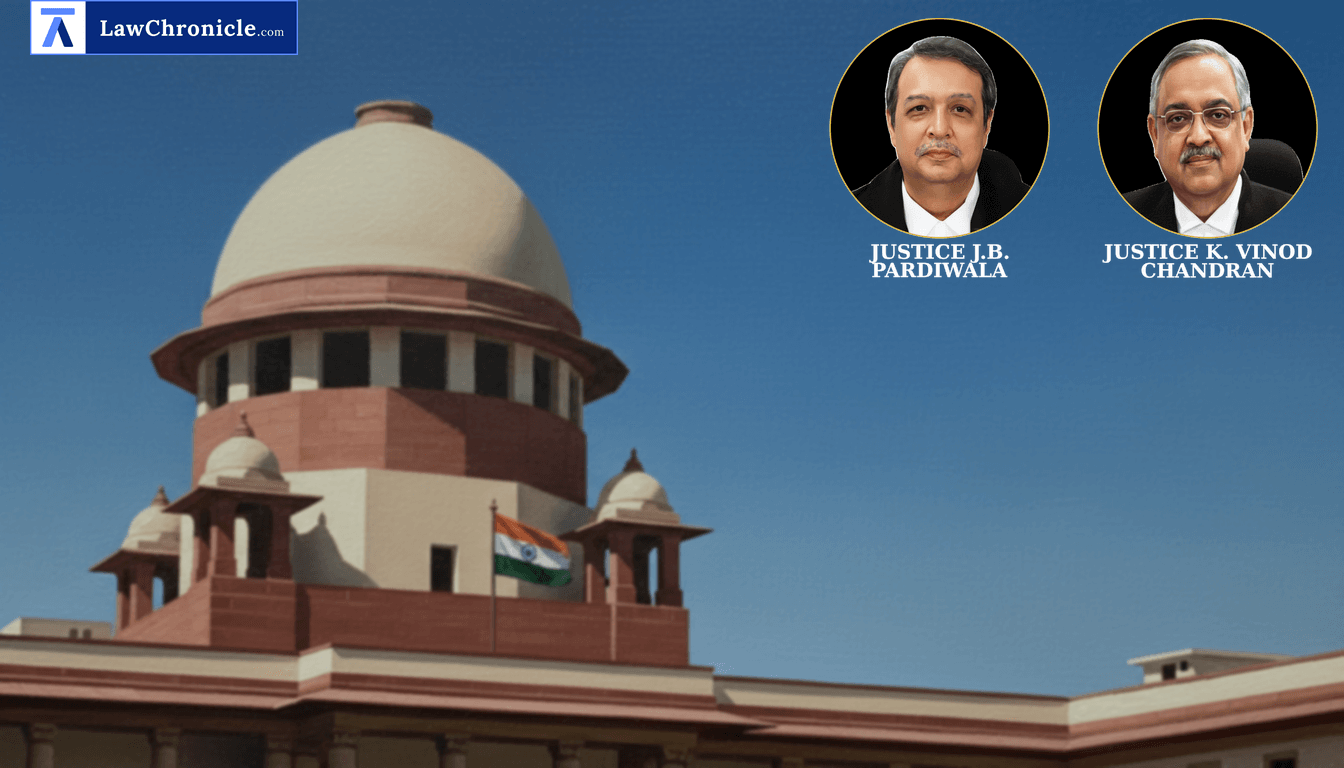
The Supreme Court has emphasized that ‘Veritable Party’ in a constituted arbitration is a frequently discussed aspect which has to be determined more on the facts, which cannot be put down in a strait jacket formula. Expanding the scope of arbitral jurisdiction over non-signatories, the Supreme Court has ruled that entities who are not parties to an underlying arbitration agreement can still be joined as 'veritable parties' if the determination of the dispute directly impacts their rights over the subject asset.
A two-judge bench comprising Justice J.B. Pardiwala and Justice K. Vinod Chandran was dealing with an appeal against a High Court order under Section 11 of the Arbitration and Conciliation Act, 1996. The High Court had refused to join third and fourth respondents in arbitral proceedings on the ground that they were non-signatories to the original partnership deed containing the arbitration clause.
Key Takeaways
- Jurisdiction Over Non-Signatories: Referral courts can include non-signatory entities as veritable parties in arbitration when disputes substantially affect their underlying legal rights.
- Arbitral Tribunal's Authority Preserved: Preliminary determinations of non-signatory status by referral courts are prima facie, leaving final issues of limitation, jurisdiction, and estoppel open for the tribunal to adjudicate.
- Holistic Evaluation of Disputes: Courts are not bound by a rigid contractual approach and can evaluate commercial obligations and relationships between parties to determine arbitrability.
Court's Rationale on Veritable Parties
The Supreme Court highlighted that deciding whether a party is a 'veritable party' in arbitration depends on the specific facts and circumstances of each case without being bound by a rigid formula. Referring to precedents such as Cox & Kings Limited v. SAP India Private Limited and Another ( "(2024) 4 SCC 1": 2022 CaseBase(SC) 870) and Hindustan Petroleum Corporation Limited v. BCL Secure Premises Private Limited ( "(2026) 3 SCC 711": 2025 CaseBase(SC) 1402), the Court reiterated that referral courts must arrive at a prima facie satisfaction regarding the existence of an arbitration agreement and whether a non-signatory constitutes a veritable party.
The Apex Court observed that “Looking at the factors holistically, it could be inferred that the non-signatories, by virtue of their relationship with the signatory parties and active involvement in the performance of commercial obligations which are intricately linked to the subject-matter, are not actually strangers to the dispute between the signatory parties.” Addressing the facts of the dispute, the Supreme Court noted that if the underlying retirement deed was declared invalid, the parties would revert to the earlier partnership deed, directly affecting the rights of non-signatory partners inducted subsequently. The Court noted that findings on whether parties are veritable parties remain prima facie and subject to final adjudication by the tribunal.
Ratio
A non-signatory to an arbitration agreement can be impleaded as a veritable party in arbitral proceedings if the resolution of the arbitrable dispute directly and substantially impacts their substantive legal rights over the subject matter. Such inclusion by a referral court under Section 11 of the Arbitration and Conciliation Act, 1996 is prima facie, leaving the Arbitral Tribunal full jurisdiction to conclusively adjudicate upon preliminary issues including limitation and estoppel.
Background
The dispute pertained to an immovable property known as Unit No. 2 at Manish Commercial Centre in Worli, Mumbai. The property was originally acquired by a partnership firm, M/s Prospective Traders, constituted in 1977. Through subsequent reconstitutions in 1985, the appellants and first two respondents became partners. However, the appellants alleged that a 1995 deed showing their retirement from the firm was forged.
Following subsequent reconstitutions and the retirement of original partners, the firm operated as a proprietorship before new partnership deeds were executed in 2009 inducting the third and fourth respondents as partners. The appellants sought arbitration under the 1985 partnership deed, asserting continuous ownership of the asset. The High Court had declined to implead the third and fourth respondents in arbitration under Section 11 of the Arbitration and Conciliation Act, 1996 as non-signatories, leading to the present appeal.
The Supreme Court modified the High Court's order, holding that the third and fourth respondents are veritable parties to the arbitration, while leaving questions of limitation and estoppel open for the Arbitral Tribunal to decide.
Case Details:
Case No.: Civil Appeal No. OF 2026 (Arising out of SLP (C) No.26474 of 2026)
Neutral Citation: 2026 INSC 1111
Case Title: Hemant D. Shah HUF & Anr. v. Chittaranjan D. Shah HUF & Ors.
Appearances:
For the Petitioner(s): Sri Ashim Sood, Advocate
For the Respondent(s): Sri Sanjay Sarin, Advocate; Sri Ritin Rai, Senior Advocate
Source: 2026 CaseBase(SC) 8257
 Breaking News