


Wages for Intervening Period After Reinstatement Award is Pre-existing Benefit: Himachal Pradesh HC
 Copy Link
 Share
 Save
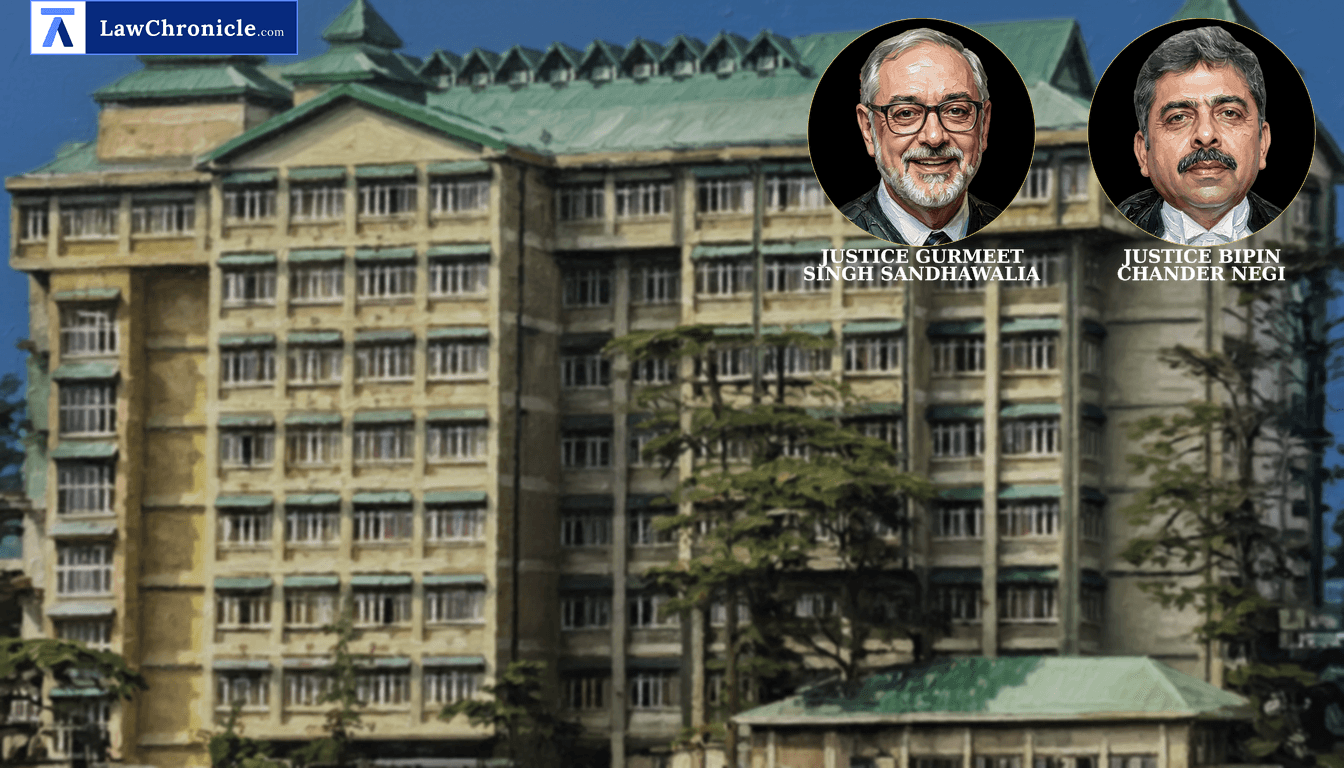
The High Court of Himachal Pradesh has slammed the state's attempt to evade wage liabilities for workmen kept out of service during unsuccessful litigation, ruling that the right to wages from the date of an award to actual re-engagement constitutes a pre-existing benefit enforceable under the Industrial Disputes Act, 1947. This decision reinforces that the state cannot profit from its own delay in implementing judicial mandates, ensuring that successful litigants do not suffer while the employer pursues failed appeals.
A Division Bench comprising Chief Justice G.S. Sandhawalia and Justice Bipin C. Negi delivered this verdict while dismissing multiple Letters Patent Appeals filed by the Executive Engineer, I & PH Division. The Court was hearing challenges against a Single Judge's order that upheld the Labour Court's direction to pay quantified wages to workmen for the period they were kept unemployed despite succeeding in their industrial dispute.
Key Takeaways
Execution as a Pre-existing Right
An award for reinstatement creates a pre-existing legal right, allowing the Labour Court to compute and execute wage claims for the intervening period without requiring a fresh adjudication.
State's Liability for Litigation Delays
The State cannot shirk its responsibility to pay wages for the period it spent unsuccessfully challenging an award in higher forums like the High Court or Supreme Court.
Scope of Section 33-C(2)
The jurisdiction of the Labour Court under Section 33-C(2) is akin to an executing court, empowered to interpret and implement benefits already flowing from an existing award.
Impact on Workers' Rights
Workmen are entitled to full wages from the date of the award to the date of actual joining if the employer fails to permit them to join service without a stay order from a superior court.
Labour Court's Jurisdiction to Compute Quantified Amounts
The Court noted that the workmen had been successful before the Labour Court as early as 2013, yet were only re-engaged in 2019 after coercive execution steps were taken. The State argued that applications under Section 33-C(2) of the Industrial Disputes Act, 1947 were not maintainable. However, the Bench observed that since the claim was already adjudicated via an award, it was ripe for execution.
The Court, in its reasoning, observed: "The order of reinstatement would relate back to the original order passed by the Labour Court... In the present case, as noticed, the claim already stood adjudicated inter-se the parties, since there was an Award dated 14.05.2013 in favour of the workman."
Addressing the State's conduct, the Court remarked that the Industrial Disputes Act, 1947 is a piece of beneficial legislation intended to ameliorate the difficulties of workmen. The Court has the following directions:
"The learned Single Judge, in sum and substance, has upheld the orders passed by the Labour Court-cum-Industrial Tribunal Kangra at Dharamshala... whereby applications filed by the respondents-workmen under Section 33-C (2) of the Industrial Disputes Act, 1947 (for short ‘the Act’) had been allowed and directions had been issued that the workmen were entitled to the quantified amount towards full wages from the date of the award to the date of their re-engagement alongwith interest @ 6% per annum till its realization."
Ratio
An award of reinstatement carries an inherent pre-existing benefit of wages for the intervening period if the employer fails to implement the award immediately and fails to secure a stay from a higher court. The Labour Court possesses the jurisdiction under Section 33-C(2) of the Industrial Disputes Act, 1947 to compute and award these wages as an executing court, as the right flows from a pre-existing adjudication and is not a fresh un-adjudicated claim.
Background
The dispute began when several daily-waged Beldars were terminated in 2000. The Labour Court, in 2013, found violations of Sections 25-G and 25-H of the Industrial Disputes Act, 1947 and ordered reinstatement with continuity of service but without back wages. The State unsuccessfully challenged this award before a Single Judge, then via a Letters Patent Appeal, and finally before the Supreme Court in a Special Leave Petition.
During this litigation, the workmen were not re-engaged. They eventually filed for execution, leading to an attachment warrant against the department's property, which finally prompted the State to re-engage them in late 2019. The workmen then sought the wages for the period between the 2013 award and their 2019 re-engagement. The Court relied on D.N. Krishnappa Versus the Deputy Manager to distinguish between un-adjudicated claims and pre-existing rights. It also referred to Municipal Corporation of Delhi Vs. Ganesh Razak to affirm that the Labour Court acts as an executing court in such matters. Relying on The Chairman-cum-Managing Director, Cement Corporation of India & another Vs. Central Government Industrial Tribunal-cum-Labour Court & others ( "LPA No. 458 of 2012, dated 25.04.2026": 2026 CaseBase(HP) 3212) and State Bank of India Versus Ram Chandra Debey & others ( "(2001) 1 SCC 73": 2000 CaseBase(SC) 871), the Bench concluded that the State must bear the cost of the intervening wages as the delay was solely attributable to its failure to comply with the non-stayed award.
Case Details:
Case No.: LPA No. 560 of 2026
Neutral Citation: 2026:HHC:45120
Case Title: The Executive Engineer, I & PH Division, Dalhousie Vs. Sh. Amar Singh
Appearances:
For the Petitioner(s): Mr. Gobind Korla, Additional Advocate General; Mr. Pranay Pratap Singh, Additional Advocate General
For the Respondent(s): Not Mentioned
Source: 2026 CaseBase(HP) 9467
Similar Articles


 Breaking News


