What prompted Bombay HC to order CBI Probe in Disha Salian death case? - Explore
 Copy Link
 Share
Share Save
Save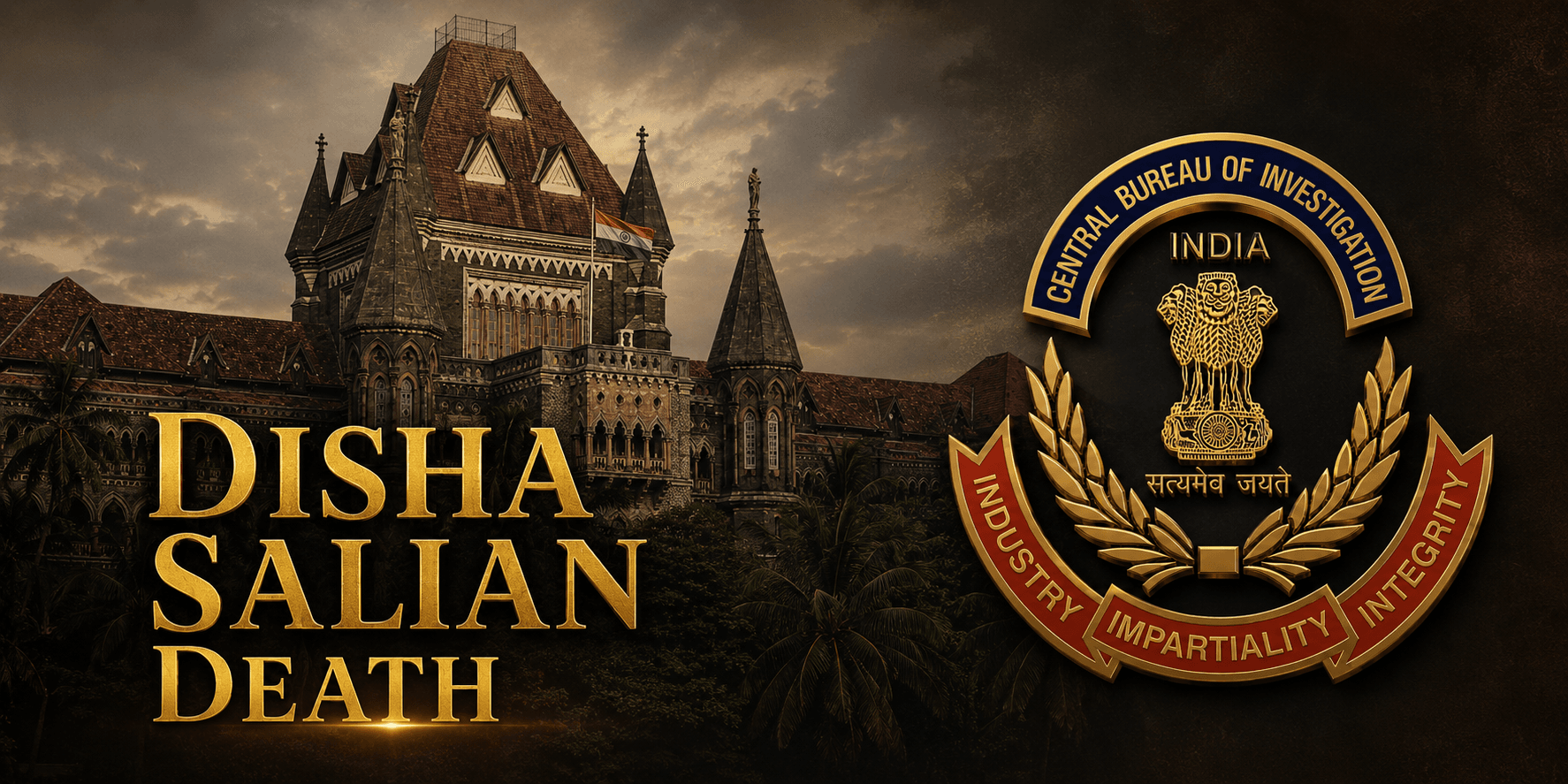
The Bombay High Court ordered CBI Investigation in a writ petition filed by her father seeking a probe into the Disha Salian death case. The Court has directed the Central Bureau of Investigation (CBI) to register an FIR and investigate the case as a cognizable offence. A Division Bench of Justices Sarang V. Kotwal and Ranjitsinha Raja Bhonsale held that the inquiry conducted by the Mumbai Police under Section 174 of the Code of Criminal Procedure (CrPC), which deals with police inquiry into the cause of death, was inadequate and insufficient. This article scans through the gaps highlighted by the Bombay High Court while order CBI probe into the case of Disha Salian’s death.
Background
A criminal writ petition was filed along with four connected Interim Applications. The Bench noted that although the Petition carried several prayers, the "most important prayer" was clause (d), seeking transfer of investigation to the CBI with supervision by the High Court. The Bench restricted its consideration to this prayer alone.
According to the Petitioner's case, his daughter, Disha Salian, who was working with actor Sushant Singh Rajput, died in what the police recorded as suicide by jumping from the 12th floor of a flat between the night of 8 and 9 June 2020. The Petitioner alleged that this was not suicide but murder, arising from a conspiracy connected to information she was said to have possessed about "objectionable activities of powerful people," and that she had also been subjected to gang rape prior to her death. The Court clarified at the outset that it was not making any observations on these specific allegations, since the matter required investigation.
An Accidental Death Report (ADR No. 85/2020) was registered by Malvani police station on 9 June 2020, and inquiry proceeded under Section 174 CrPC. A first report was submitted to the Special Executive Magistrate (Assistant Commissioner of Police, Malvani Zone) on 4 February 2021, concluding suicide. Following a Government of Maharashtra communication dated 11 December 2023 directing further inquiry, the Commissioner of Police, Greater Mumbai ordered fresh investigation under Section 174 CrPC. This second round concluded on 14 April 2026, again recording suicide, and was accepted by the Special Executive Magistrate on 6 May 2026. Counsel for the CBI, Kuldeep Patil, informed the Court on instructions that the CBI had not investigated the case and that no Supreme Court order existed directing such investigation.
Why Section 174 CrPC was held inadequate in Disha Salian Death Investigation?
The Bombay High Court Bench examined the scope of Sections 174, 175 and 176 of the CrPC. It noted that Section 174 requires the police officer to draw up a report of the "apparent cause of death" in the presence of two or more respectable inhabitants of the neighbourhood, and that neither Section 174 nor Section 175 provides for the filing of a police report before a Judicial Magistrate empowered to take cognizance of an offence. The report under Section 174 is instead sent to the District or Sub-Divisional Magistrate, locally, the Assistant Commissioner of Police (Divisional) and Deputy Commissioner of Police (Zonal), under a Government Resolution dated 19 August 1999, and not to a Judicial Magistrate. The Court held that this investigation "cannot be equated with the investigation in a cognizable offence under the provisions of Sections 154 to 173 of CrPC."
Relying on Kishwar Jahan (2008 CaseBase(CAL) 501) (which in turn cited Pedda Narayana & others Vs. State of Andhra Pradesh and Kodali Purnachandra Rao & another Vs. The Public Prosecutor, Andhra Pradesh), the Bench reiterated that the object of Section 174 proceedings is only to ascertain whether a death occurred under suspicious or unnatural circumstances, and not to determine how or by whom the deceased was assaulted. It further noted that under Section 174, unlike Section 173(8) CrPC, there is no provision for further investigation, and that Kishwar Jahan had also observed that where the CBI is to determine whether a death was suicidal or homicidal, it could exercise its powers under Chapter XII of the CrPC only upon an FIR being recorded.
The Bench found that the Section 174 inquiry in this case had continued in two phases over nearly six years, from 2020 to April 2026, which it held was "not the object of investigation under Section 174 of CrPC." It observed that "the investigation carried out by the police raises more questions than it answers."
Suspicious Circumstances Noted by the Court
The Bench clarified it was not conducting a "mini trial" or recording a finding of fact, but referred to circumstances from four compilations ("A" to "D") tendered by the Public Prosecutor, to assess whether registration of an FIR was necessary. These included:
- Belated spot panchnama: The spot panchnama was conducted between 9.40 a.m. and 9.45 a.m. on 9 June 2020, more than nine hours after the incident, despite CCTV footage showing police officers present at the building between 12.59 a.m. and 2.14 a.m. that night, a presence for which no explanation appeared in the ADR or subsequent investigation.
- Timing discrepancy in the ADR: The ADR, registered at 3.07 a.m. on 9 June 2020, referred to statements of the Petitioner recorded earlier, even though the Petitioner's own first statement recorded that he reached the hospital only at 4.00 a.m. and learnt of the death at that time.
- Absence of blood at the site of the fall: Two witnesses who stated they heard the sound of a fall described blood oozing from the deceased's head at the spot, yet the police did not recover blood-stained earth, and the postmortem recorded no bleeding head injury (only a bleeding chin injury).
- Nature of injuries in the postmortem report: The postmortem recorded six external injuries, including a 1x1x1 cm chin wound, alongside a linear skull fracture and multiple rib fractures, but no fracture of any facial bone, including the mandible or nasal bone. The Court observed it found it "difficult to accept" that a fall from the 12th floor onto the face would result in this injury pattern, subject to expert opinion.
- Chemical Analyzer's query on blood quantity: The Assistant Chemical Analyzer at the Forensic Science Laboratory, Mumbai, in a communication dated 15 September 2020, flagged that less blood was found on the articles than expected for a 12th-floor fall; the police, in a letter dated 7 October 2020, sought the postmortem doctor's opinion on this discrepancy, without arriving at a clear explanation.
- No damage recorded to the bedroom door: Witness statements indicated the deceased had locked herself in a room and that the door was forced open, but the spot panchnama recorded no damage to the lock or door.
- Swab versus smear discrepancy: The postmortem form referred to "vaginal swab" and "anal swab," while the actual exhibits sent were "vaginal smear on slide" and "anal smear on slide." The Forensic Science Laboratory sought clarification; the Medical Officer's response dated 25 September 2020 stated the form had "inadvertently" mentioned swabs instead of smears. The Chemical Analyzer's report noted no male DNA was detected on the slides.
- Query on the body being unclothed: Police wrote to the postmortem doctor on 12 August 2020 asking why the body was found nude, despite having themselves conducted a seizure panchnama of the deceased's clothes, identified by Rohan Rai.
- Delayed seizure of digital evidence: The deceased's laptop and mobile phone were seized only on 17 June 2020 from Rohan Rai's custody, and were not seized during the spot panchnama conducted on 9 June 2020.
Investigating Agency and Remedy
The Bombay High Court held that these "too many glaring discrepancies" necessitated "proper and substantive investigation under the provisions of Sections 154 to 173 of CrPC," which had not been carried out. It rejected the submission that the Petitioner should be directed to approach the Magistrate under Section 175 of the BNSS (akin to Section 156(3) CrPC), noting the Magistrate has no power to direct a CBI investigation, and that in view of the case's six-year history, it "would not be proper" to relegate the Petitioner to that remedy. The Court agreed with Ojha that the Petitioner had no equally efficacious and effective remedy except investigation by the CBI.
The Bombay High Court Bench declined the Petitioner's request that the investigation be supervised by the High Court, stating it had "no reason to doubt the effectiveness of the investigation to be conducted by CBI" or to assume it would not be fair, impartial and effective.
Directions in Disha Salian Case
The Court disposed of the Petition with the following directions:
- The CBI officer in-charge for the Mumbai region shall appoint a senior officer as Investigating Officer.
- That officer shall record the Petitioner's statement and register an FIR.
- The investigation shall cover all aspects surrounding the circumstances of the death, to be carried out under the BNSS.
- No person shall be treated as an accused unless the Investigating Officer finds sufficient grounds for reasonable suspicion based on the material collected.
- If an offence is made out, a report shall be filed before the competent court; if not, a Summary report may be filed, against which the Petitioner shall have a right to file a Protest Petition.
- Malvani police station shall hand over all case papers and articles to the CBI's Investigating Officer.
- The Investigating Agency was directed to interact with the Petitioner's family "with sensitivity," while ensuring no innocent person is harassed and that offenders, if any, face trial.
 Breaking News