


Wife’s Pursuit of Career Is Not Cruelty: Supreme Court Slams Patriarchal Bias
 Copy Link
 Share
Share Save
Save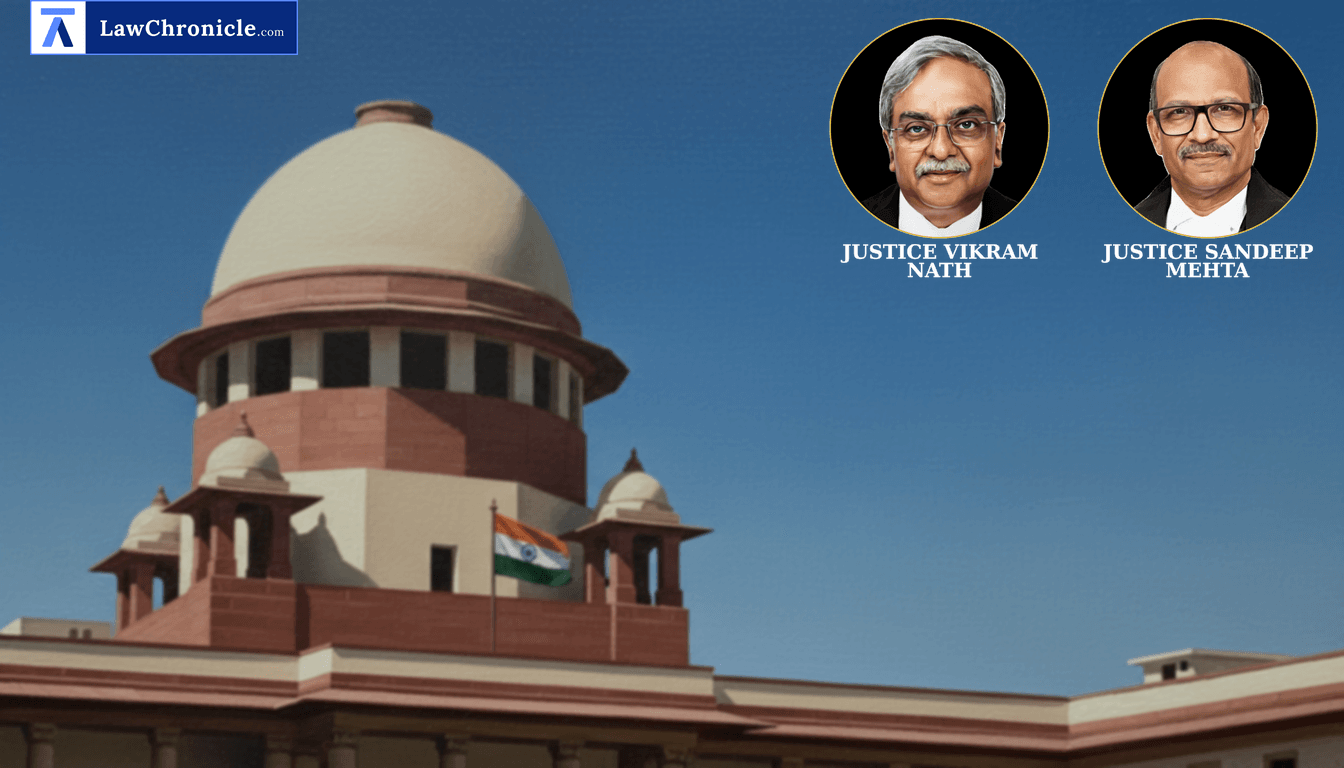
In a landmark decision championing gender equality and professional autonomy, the Supreme Court ruled that a woman’s decision to pursue her career and ensure a stable environment for her child cannot be categorized as matrimonial cruelty or desertion.
A bench of Justice Vikram Nath and Justice Sandeep Mehta delivered a stinging critique of "archaic societal assumptions," setting aside findings of a Family Court and High Court that had penalized a qualified dentist for choosing her profession over residing at her husband’s remote army posting. The Court emphasized that marriage does not eclipse a woman's individuality or subjugate her identity to her spouse.
Regressive Findings and Judicial Disquiet
The Court expressed deep concern over the lower courts' approach, which viewed the appellant's attempt to establish a dental clinic as a 'matrimonial default.' The bench observed that the reasoning in the impugned judgments was rooted in a conservative patriarchal understanding of marital roles, which is wholly incompatible with modern society.
The Court, in its reasoning, observed: "We are well into the 21st Century, and yet an attempt by a qualified woman to pursue her professional career and to secure a safe and stable environment for the upbringing of her child has been treated as an act of cruelty and desertion by the Courts below. We are constrained to observe that the approach adopted by the learned Family Court, as affirmed by the High Court, is not only legally unsustainable but also deeply disquieting."
Redefining Matrimonial Obligations
The Supreme Court underscored that a well-educated woman cannot be confined within the rigid boundaries of matrimonial obligations alone. It rejected the notion of an "implied spousal veto" over a wife's professional identity.
The Court has the following directions:
"The same is accordingly upheld, with the observations regarding cruelty and desertion being expressly expunged and set aside. The decree shall be deemed to have been passed on the ground of irretrievable breakdown of marriage."
The Court further noted: "Marriage does not eclipse her individuality, nor does it subjugate her identity under that of her spouse. It is for both the husband and the wife to balance their marital ties in a manner that respects mutual aspirations, and not for one to unilaterally dictate the life choices of the other."
Background:
The couple married in 2009. The appellant, a qualified dentist, initially sacrificed her practice to join her husband, a Lieutenant Colonel in the Indian Army, at his posting in Kargil. However, due to limited medical facilities for her pregnancy and subsequent medical complications of their minor daughter (seizure episodes), she returned to Ahmedabad to live with her parents and establish her own clinic.
The husband filed for divorce, and the Family Court granted it on grounds of cruelty and desertion, citing her "defiance" in opening a clinic without informing the in-laws and her refusal to live at his place of posting. The husband also initiated proceedings under Section 195 of the Code of Criminal Procedure, 1973 read with Section 340 Code of Criminal Procedure, 1973, alleging perjury. The High Court affirmed these findings, leading to the present appeal.
While the Supreme Court upheld the divorce decree given that the marriage had irretrievably broken down and the husband had remarried, it unequivocally expunged all findings of cruelty and desertion against the wife. The Court also dismissed the husband's plea for perjury, labeling it as a product of "personal vendetta."
Case Details:
Case No.: Civil Appeal Arising out of SLP(Civil) No. 25076 of 2024
NeutralCitation: 2026 INSC 475
Case Title: Ann Saurabh Dutt v. Lieutenant Colonel Saurabh Iqbal Bahadur Dutt
Source: 2026 CaseBase(SC) 397
 Breaking News