Writ Petition Against DRT Orders Not Maintainable When Statutory Remedy Exists: Madras HC
 Copy Link
 Share
 Save
The Madras High Court recently reaffirmed that the constitutional courts must exercise extreme judicial restraint and decline to entertain writ petitions when a robust and efficacious statutory remedy is available under the Securitisation and Reconstruction of Financial Assets and Enforcement of Security Interest Act, 2002. The Court emphasized that bypassing the Debt Recovery Appellate Tribunal to avoid pre-deposit requirements undermines the legislative intent of debt recovery laws.
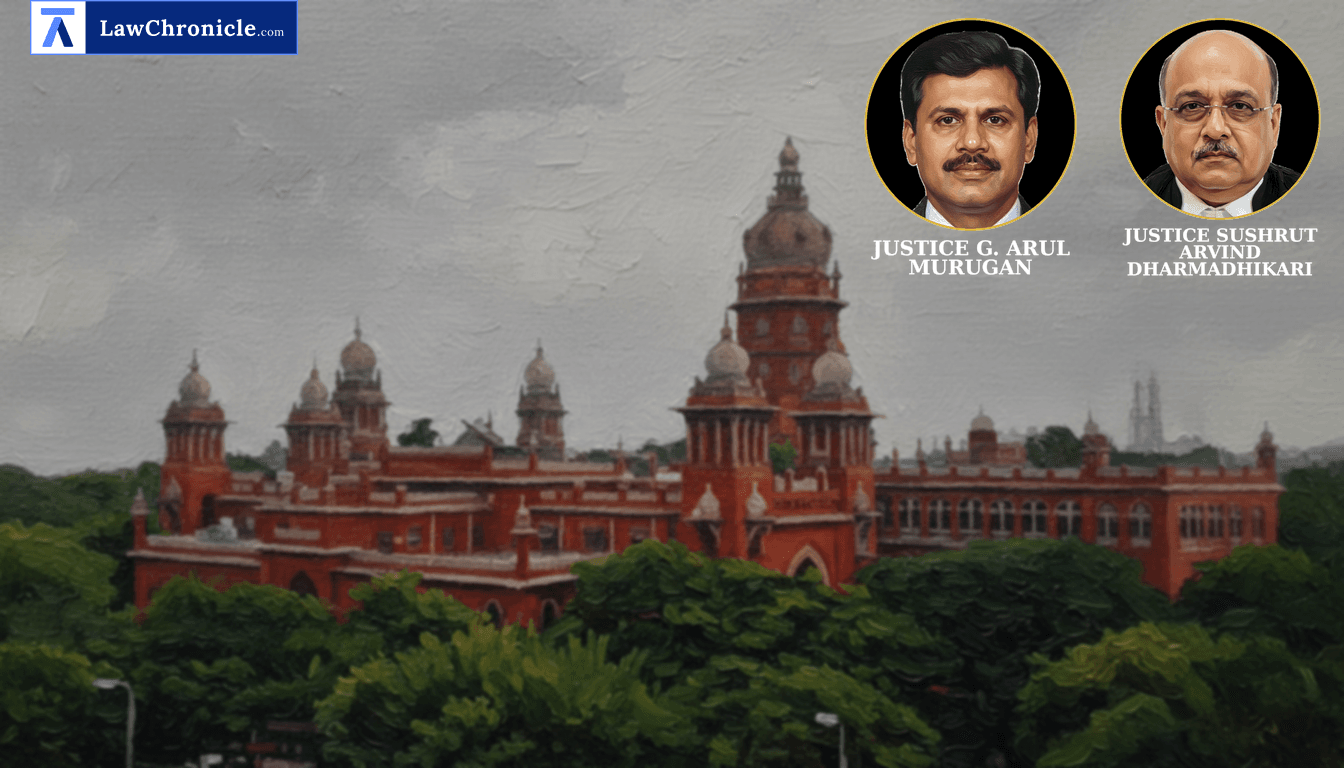
In a decision delivered by a bench comprising Chief Justice Sushrut Arvind Dharmadhikari and Justice G. Arul Murugan, the Court dismissed a challenge against proceedings in the Debts Recovery Tribunal (DRT), Chennai. The petitioners had approached the High Court under Article 226 of the Constitution of India, alleging that the DRT’s recorded docket orders did not reflect the actual oral observations made during the hearing regarding their compliance with a conditional stay order.
The Mandatory Nature of Statutory Appeals Under SARFAESI
The Court noted that the petitioners sought to quash proceedings initiated by the respondent bank after a conditional order was passed by the DRT. While the petitioners claimed they had complied with the condition to pay Rs. 6.00 lakhs, they alleged the respondent refused the payment and subsequently took physical possession of the property. The Court, however, found no reason to bypass the appellate mechanism provided under Section 18 of the Securitisation and Reconstruction of Financial Assets and Enforcement of Security Interest Act, 2002.
The Court, in its reasoning, observed: "The Supreme Court has repeatedly and unequivocally held that the SARFAESI Act is a comprehensive and complete code for the recovery of debts and enforcement of security interests. Constitutional courts must exercise extreme judicial restraint and decline to entertain writ petitions when a robust and efficacious statutory remedy is explicitly provided within the legislative framework of the Act."
Judicial Restraint and Pre-deposit Mandates
Referring to the precedent in K. Sreedhar v. Raus Constructions (P) Ltd, the Court highlighted that entertaining writ petitions against DRT orders effectively allows borrowers to circumvent the mandatory pre-deposit of 25% of the debt due required for an appeal before the Debt Recovery Appellate Tribunal. The bench warned that such judicial intervention would stall public money recoveries and render statutory provisions nugatory.
Regarding the discrepancy in court records alleged by the petitioners, the bench noted: "In the case at hand, the petitioners’ grievance concerning recording of an order in the docket contrary to what has been stated orally during the course of the proceedings is purely a factual question. The DRAT is fully empowered to evaluate these factual issues and grant complete, consequential reliefs."
Court Directions
The Court issued the following directions:
"17. In light of the explicit statutory framework and the binding precedents of the Supreme Court, we hold that this writ petition is not maintainable and is liable to be dismissed on the ground of availability of an alternative, efficacious statutory remedy. Accordingly, this writ petition is dismissed.
18. We, however, grant liberty to the petitioners to approach the DRAT by filing a regular statutory appeal under Section 18 of the Act. If such an appeal is preferred within a period of two weeks from today, the DRAT shall consider and dispose of the same on its own merits and in accordance with law, subject to the petitioners complying with all statutory conditions.
Background:
The petitioners had filed a Securitisation Application (S.A.No.612 of 2024) before the DRT-III, Chennai, challenging an order passed under Section 14 of the Securitisation and Reconstruction of Financial Assets and Enforcement of Security Interest Act, 2002. On December 24, 2025, the DRT granted an interim stay on the condition that the petitioners pay Rs. 6.00 lakhs by January 20, 2026. The petitioners alleged that they attempted to pay via RTGS and later via Demand Draft, but the bank returned the payments and proceeded to take possession. When the DRT's subsequent docket orders did not reflect these grievances as presented, the petitioners filed the present writ petition. The High Court, however, found no exceptional circumstances such as a total lack of jurisdiction or violation of natural justice to warrant a departure from the statutory route.
Case Details:
Case No.: W.P.No.17415 of 2026
NeutralCitation: 2026:MHC:1809
Case Title: Sudha RK and Another Vs IIFL Home Finance Ltd
Appearances:
For the Petitioner(s): Mr. P.Jesusmoris Ravi
Source: 2026 CaseBase(MAD) 266
 Breaking News