


Absence Of Original Deed in Forgery Case No Ground To Discharge: Supreme Court
 Copy Link
 Share
 Save
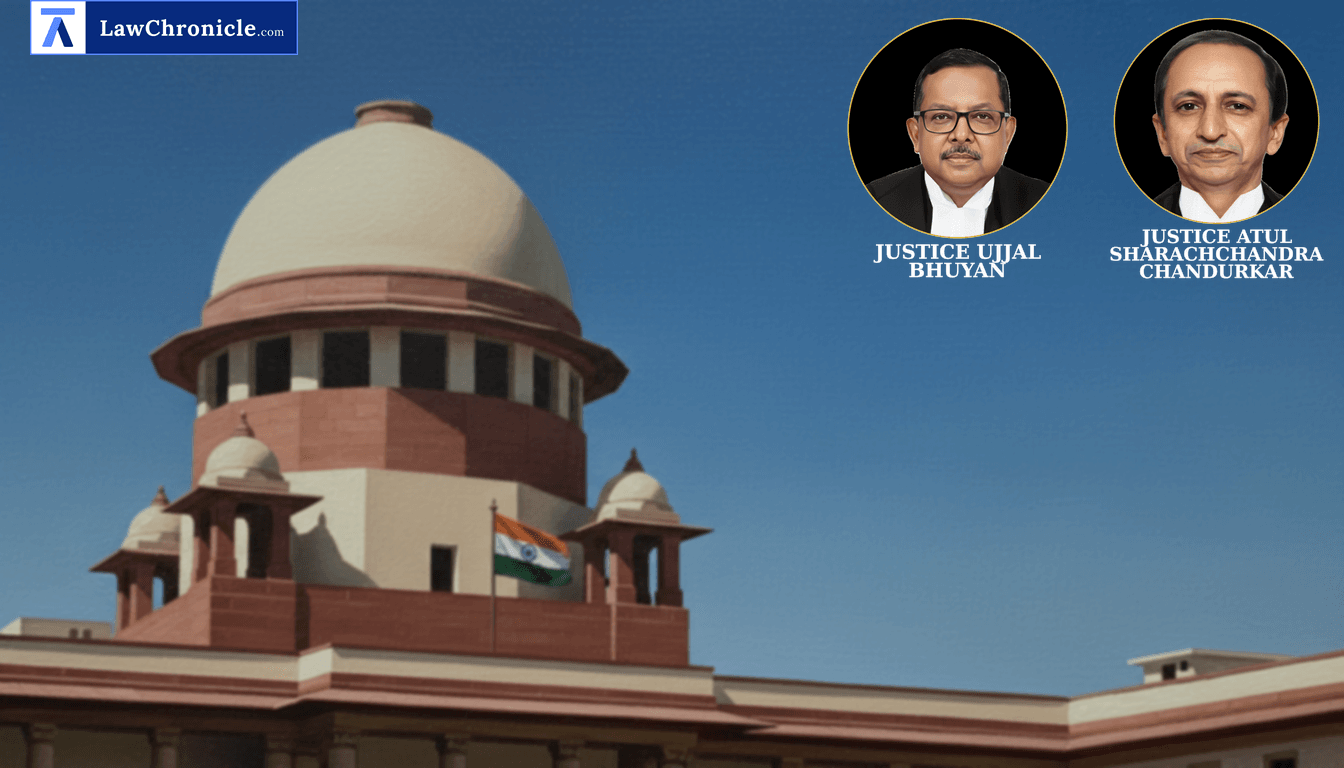
The Supreme Court has ruled that the non-production of an original forged document does not automatically collapse a prosecution or justify discharging an accused before trial. Reaffirming the application of 'issue estoppel' in criminal proceedings, the apex court held that litigants cannot repeatedly re-agitate settled discharge pleas before single benches when division benches have already upheld charge framing.
A Bench of Justice Ujjal Bhuyan and Justice Atul S. Chandurkar restored criminal proceedings against an accused, reversing a High Court order that had discharged her on the sole ground that the original interpolated building plan was not produced alongside the chargesheet.
Key Takeaways
1. Non-Production Not Fatal At Initial Stage: The absence of an original forged document during chargesheet filing cannot singularly justify discharging an accused, as forgery can still be established through circumstantial or secondary evidence during trial.
2. Application Of Issue Estoppel: Parties are legally barred from re-litigating an issue or challenge that has already been adjudicated and confirmed by a competent court bench in earlier rounds of the same proceeding.
3. Scope Under Section 227 CrPC: Courts cannot undertake a full-fledged mini-trial or sift through evidence at the stage of framing charges; establishing a grave suspicion based on available material suffices to proceed.
4. Subsequent Production Of Evidence: The investigating agency is not precluded from introducing additional documents or material gathered during or post-investigation even after filing the final report.
Scope of High Court Jurisdiction under Article 227
Evaluating the jurisdictional limits exercised by lower courts under Section 227 of the Code Of Criminal Procedure, 1973, the Supreme Court stressed that trial courts should not sift through prosecution material as if conducting a full trial.
Originals in Forged Documents Case
The Supreme Court in this case observed that “...absence of the original document relied upon by the prosecution to bring home the charge of forgery would be a matter to be considered at the trial and its absence by itself cannot be made the basis for quashing the entire prosecution. In other words, the prosecution can attempt to bring home the charge on the basis of circumstantial evidence. However, the entire proceedings would not be liable to be quashed without affording an opportunity to the prosecution to attempt to prove the charge at the trial...”
Ratio
The non-production or non-recovery of an original document alleged to be forged does not per se invalidate the chargesheet or preclude the framing of charges under Sections 468, 471, and 420 of the Indian Penal Code, 1860. Furthermore, under the principle of issue estoppel, an accused cannot repeatedly re-agitate a challenge against an order framing charges before the High Court under Section 482 of the Code Of Criminal Procedure, 1973 once the same contention has been considered and rejected by a co-ordinate bench in prior proceedings.
Background
The controversy originated from a dispute between neighbours over an allegedly illegal construction based on a forged building plan. Following a complaint, an FIR was registered under Sections 468, 471, and 420 read with Section 34 of the Indian Penal Code, 1860. Upon completion of investigation, a chargesheet was filed in 2016.
The trial Magistrate found prima facie material to frame charges. The accused filed a revision petition before the Sessions Court as well as a writ petition before the High Court of Bombay at Goa under Section 482 of the Code Of Criminal Procedure, 1973. The High Court's Division Bench dismissed the writ petition, noting that two lower authorities found sufficient material to frame charges. That order attained finality.
However, the accused subsequently filed another writ petition under Section 482 of the Code Of Criminal Procedure, 1973 before a Single Judge of the High Court, raising the exact same ground that the original plan was missing. The Single Judge allowed the petition and discharged the accused. The informant then appealed to the Supreme Court.
Reversing the Single Judge's decision, the Supreme Court relied on Piara Singh Vs. State of Punjab ( "1969 INSC 3": 1969 CaseBase(SC) 13) to emphasize the principle of issue estoppel, holding that re-litigating settled issues across sequential proceedings is impermissible. Addressing the merits, the Apex Court cited Rama Shanker Lal and others Vs. The State of U.P. to establish that the absence of a forged original document does not automatically preclude proving forgery through other evidence. Referring to Central Bureau of Investigation Vs. R.S. Pai and Another ( "2002 INSC 178": 2002 CaseBase(SC) 204), the Bench noted that Section 173 of the Code Of Criminal Procedure, 1973 does not prohibit submitting additional documents post-chargesheet. Finally, referencing K.H. Kamaladini Vs. State ( "2025 INSC 745": 2025 CaseBase(SC) 499) and Ram Prakash Chadha Vs. The State of Uttar Pradesh ( "2024 INSC 522": 2024 CaseBase(SC) 673), the Supreme Court reiterated the settled scope of framing charges, concluding that grave suspicion based on record is sufficient to sustain a trial.
Case Details:
Case No.: Criminal Appeal No. 4092 of 2026
Neutral Citation: 2026 INSC 1032
Case Title: Antonetto J D’Souza v. Aldila Braganza and Others
Appearances:
For the Petitioner(s): Ms. Vrinda Grover, Advocate
For the Respondent(s): Respondent-in-person
Source: 2026 CaseBase(SC) 7022
Similar Articles



 Breaking News


