AI-Hallucinated Case Law makes Supreme Court set aside Rs 425 Crore Customs Penalty
 Copy Link
 Share
Share Save
Save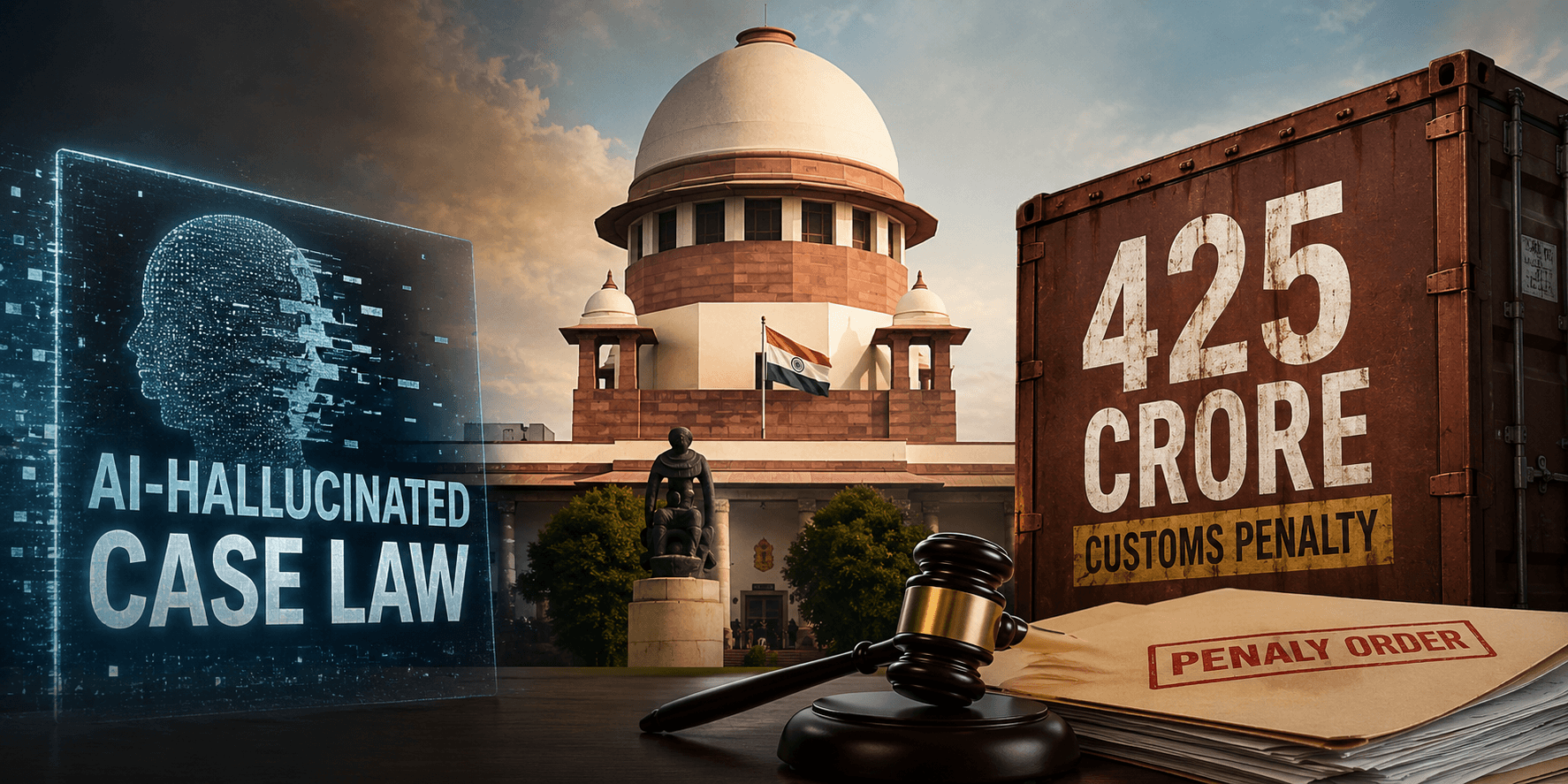
The Supreme Court has set aside a penalty of Rs. 425,27,99,100/- imposed on an appellant by the Additional Commissioner of Customs, Surat. This was the result of Apex Court finding AI hallucinated case law in the customs authority's Order-in-Original. The authorities relied on judgments and case citations that were either non-existent or misrepresented the actual ratio of the decisions. A Supreme Court Bench of Justice Dipankar Datta and Sheel Nagu in Vijay passed this order on 2nd September, 2026 in Ghanshyam Gadiya v. Union of India & Anr. (2026 INSC 947).
Background
The Additional Commissioner of Customs, Surat had passed an Order-in-Original 8th dated October 2025, imposing the penalty under Section 114 of the Customs Act, 1962. The penalty was imposed for mis-declaring a consignment of natural diamonds as lab-grown diamonds in order to pay a lower tariff.
The appellant challenged this penalty before the Gujarat High Court, but his appeal was dismissed vide order dated 20th January 2026. It was this order of the Gujarat High Court that was under challenge before the Supreme Court.
AI-Generated Case Law
The Supreme Court noted that it was unnecessary to examine the merits of the case, since the appellant's central contention was that several judgments and articles cited by the authorities in the Order-in-Original dated 8th October 2025 were generated using AI.
The Bench stated that it had made an effort to individually verify this contention. On verification, it found that the Customs authorities had relied on case laws that were either non-existent or carried fake citations. It further added that some of the case laws cited existed, but did not lay down the ratio that had been attributed to them, which the Supreme Court described as an AI hallucination.
Reference to Pooja Ramesh Singh v. Jammu & Kashmir Bank Ltd.
The Supreme Court referred to its earlier decision in Pooja Ramesh Singh v. Jammu & Kashmir Bank Ltd. (2026 CaseBase(SC) 624), a precedent dealing with the use of AI in judgments. The Bench reiterated that courts must adopt a zero-tolerance approach toward producing, citing, or relying on AI-generated precedents without verification. It observed that citing such material without verification amounts to misconduct on the part of an advocate, and that reliance by a judge on fake or hallucinated AI-generated material as precedent is a serious lapse. The Supreme Court held that a decision tainted even by an iota of fake or hallucinated material entering the decision-making process is liable to be set aside, since it violates the sanctity of adjudication. It clarified that this position does not affect the legitimate use of AI but is directed at the presentation or reliance on fake or hallucinated material as if it were an actual court precedent.
Use of AI in Court
The Bench added its own observations on the use of AI in adjudicatory processes. It noted that the use of AI in adjudication is not unprecedented, pointing out that the Supreme Court has recently released draft Regulations for Use of Artificial Intelligence in Courts, 2026, inviting comments and suggestions. The Court observed that, notwithstanding these regulations being yet to be finalised, the use of AI as an assistive tool to speed up decision-making cannot be denied. At the same time, it cautioned that such assistance can never be a substitute for adjudication itself. The Bench explained through an interesting and practical example, stating that AI may serve as training wheels, but entrusting it with the pilot's seat would be both imprudent and dangerous.
Findings and Directions
The Supreme Court held that the use of AI in the present case, resulting in the second respondent's reliance on dubious material, proved fatal to the sustainability of the Order-in-Original imposing the penalty. It recorded that the learned Additional Solicitor General appearing for the respondents did not join issue on this point. Accordingly, the Court:
- Set aside the impugned order of the High Court of Gujarat confirming the penalty.
- Set aside the Order-in-Original dated 8 October 2025.
- Directed that the proceedings against the appellant before the second respondent shall stand revived, to be decided afresh by an officer of the same rank, other than the officer who had passed the original order.
- Allowed the civil appeal, with pending applications, if any, disposed of.
- Left it to the appointing authority to decide, in accordance with law, whether any action needs to be initiated against the author of the 8 October 2025 order.
 Breaking News