


Allahabad HC: Appointment Obtained by Fraud Does Not Confer Right to Protection Under Article 311
 Copy Link
 Share
 Save
In a decisive crackdown on administrative fraud, the Allahabad High Court has ruled that public employment secured through forged caste certificates is void ab initio, stripping the incumbent of constitutional protections against dismissal even after fifteen years of service.
Establishing that fraud unravels every solemn act, the Court set aside a Single Judge's order that had previously protected a 'Bandi Rakshak' who entered service using a fabricated 'Scheduled Tribe' certificate.
The Bench and the Legal Conflict
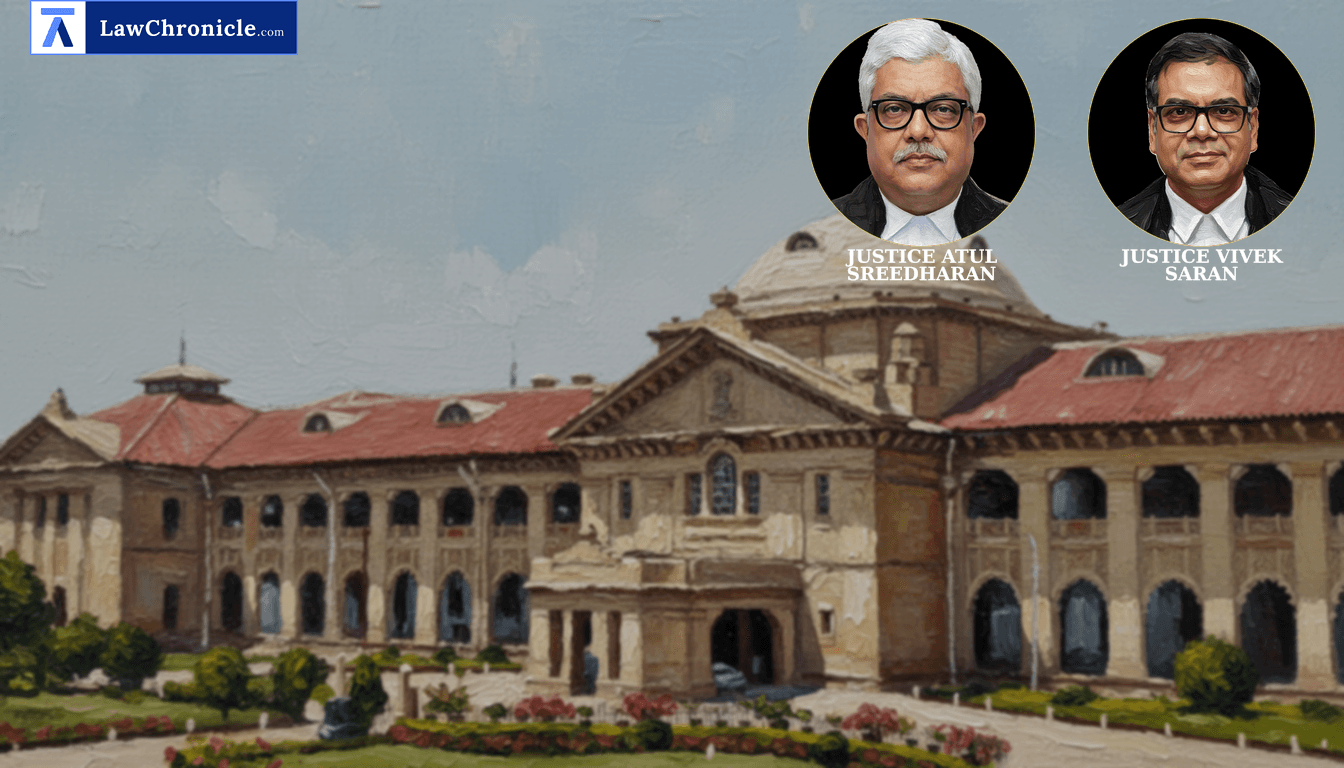
A Division Bench comprising Justice Atul Sreedharan and Justice Vivek Saran delivered the judgment while hearing an intra-court appeal filed by the State of Uttar Pradesh. The appeal challenged a 2008 decision that quashed the termination of a petitioner who had been appointed in 1992 under the reserved category but was found to have submitted a forged certificate in 2007.
The primary legal question before the Court was whether a detailed disciplinary enquiry was mandatory before dismissing an employee whose very entry into service was rooted in deception.
Fraud Vitiates Constitutional Guarantees
The Court rejected the argument that a long tenure of service provides immunity against dismissal for fraud. It observed that the constitutional guarantee provided under Constitution of India is only available to those who hold a post legally. Referring to the precedent in Vishwanatha Pillai v. State of Kerala & Ors., the Court noted that a person who usurps a post meant for a reserved candidate by playing fraud cannot be considered to be holding a post within the meaning of Constitution of India.
Judicial Rationale on Administrative Deception
Supporting the State’s action, the Bench emphasized that the passage of time does not validate an illegal appointment. It relied on the principle established in United India Insurance Co. Ltd. v. Rajendra Singh that "fraud and justice never dwell together." Furthermore, citing Union of India and others v. Prohlad Guha, the Court reiterated that fraud is established by the conduct of the person, and once proven, it vitiates all subsequent transactions.
The Court, in its reasoning, observed: "The inevitable consequence on finding the caste certificate as forged and fabricated document (as not being issued by the authority) would be that the petitioner had played fraud in securing the appointment under the reserved category and he would be ineligible to the post and the appointment order dated 08.08.1992 would be an illegal order. It is settled law that fraud vitiates all solemn acts and therefore, the appointment so sought by the petitioner on the basis of fraud becomes void ab initio and non-est. Any order which is de-hors the constitutional provision is an illegal order."
Observations on Single Judge’s Jurisdiction
The Court also found that the learned Single Judge had exceeded his jurisdiction by attempting to classify castes and holding 'Lodh' and 'Lodhi' as synonyms. The Division Bench noted that a judge hearing 'service matters' cannot adjudicate on the classification of Scheduled Tribes, as that power is restricted and defined by constitutional procedures.
The Court has the following directions:
"The judgment and order 01.07.2008 passed by the learned Single Judge in Civil Misc. Writ Petition No.585 of 2008 is hereby set aside and the writ petition is accordingly, dismissed. The order impugned dated 28.11.2007 is affirmed. Since the petitioner has worked during the pendency of the appeal before this Court without there being any interim order therefore the salary and other emoluments already paid to the petitioner, pursuant to his working, shall not be recovered."
Key Takeaways:
No Immunity for Long-Term Fraud: Length of service, even spanning 15 years, does not regularize an appointment obtained through forged documents or fraudulent means.
Article 311 Protections Restricted: The procedural safeguards under Constitution of India are unavailable to individuals who secure public employment through deception, as they are not deemed to be "holding a post" in the eyes of the law.
Administrative Autonomy in Fraud Cases: When a document like a caste certificate is found to be forged and the finding attains finality, a simple show-cause notice is sufficient for dismissal, and a full-scale disciplinary enquiry is not required.
Jurisdictional Boundaries: Service Benches cannot adjudicate the classification of castes, which remains a specialized legal and constitutional domain.
Ratio Decidendi:
An appointment secured by playing fraud on the State and the Constitution is void ab initio and non-est. Such an appointee does not enjoy the protection of Constitution of India, as the very foundation of their employment is illegal. The legal maxim 'sublato fundamento cadit opus' applies once the foundation (valid appointment) is removed, the superstructure (rights of service) falls.
Background:
The respondent was appointed as a 'Bandi Rakshak' (Prison Warder) in 1992 under the Scheduled Tribe category. In 2007, during a state-wide verification drive of documents in the Jail Department, his caste certificate purportedly issued from Lucknow was found to be forged and never issued by the authorities. District officials confirmed that the respondent belonged to the 'Lodhi' caste, which was not a Scheduled Tribe in his home district.
Following a show-cause notice and news publication, the Senior Superintendent of Mandal Karagar, Moradabad, dismissed him. A Single Judge later quashed this dismissal on grounds of delay and procedural lapses. The High Court, in this appeal, analyzed Section 420, 467, 468, and 471 of the IPC in the context of the FIR lodged, ultimately holding that fraud overrides procedural delays and procedural technicalities in service law.
Case Details:
Case No.: SPECIAL APPEAL No. - 301 of 2014
Case Title: State of U.P. and others Versus Ranveer Singh
Appearances:
For the Petitioner(s): Pankaj Rai A.C.S.C.
For the Respondent(s): Narendra Kumar Maurya, P.k. Chauhan, R.a. Verma, Yogendra Kumar, V.K. Singh (Senior Counsel)
Source: 2026 CaseBase(ALL) 250
Similar Articles



 Breaking News


