


Police Service Cannot Be Tool For Deception: SC Dismisses Fraudulent Constable
 Copy Link
 Share
 Save
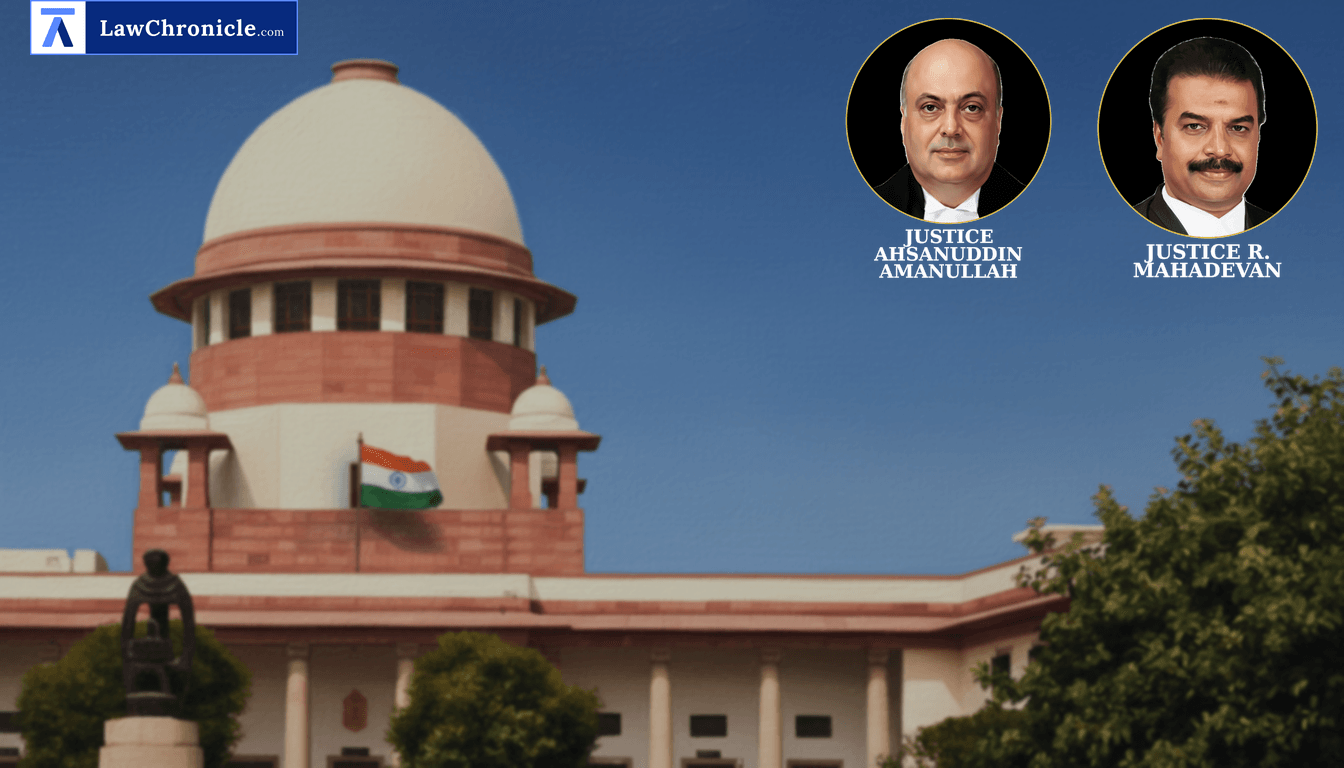
In a stern warning against the erosion of integrity within disciplined forces, the Supreme Court set aside a Jharkhand High Court decision that had reinstated a constable accused of securing dual employment through impersonation and forged documents. The Court emphasized that public employment, especially in the police service, must not be converted into an instrument of fraud.
A bench comprising Justice Ahsanuddin Amanullah and Justice R. Mahadevan heard the appeal filed by the State of Jharkhand against a Division Bench order that had quashed the dismissal of a constable. The Bench observed that the High Court had overstepped its jurisdiction by reappreciating evidence in a departmental proceeding where concurrent findings of guilt were already established by the disciplinary, appellate, and revisional authorities.
Supreme Court Upholds Dismissal for 'Identity Trail' Manipulation
The Court noted that the respondent had initially joined the Jharkhand Police and, while on unauthorized leave, allegedly secured another appointment with the Bihar Police under the name 'Santosh Kumar' using fabricated credentials. The Court, in its reasoning, observed: "It is well settled that a member of the police force is expected to maintain the highest degree of integrity, honesty and discipline. Fraud at the threshold of entry into service strikes at the very root of public employment. In the present case, the material available goes far beyond mere suspicion and reasonably establishes a conscious course of deceit adopted by Respondent No. 1 for obtaining employment benefits from two sovereign employers in a disciplined force."
Limits of Judicial Review in Disciplinary Matters
Addressing the scope of Article 226 of the Constitution of India, 1950, the Court reiterated that High Courts should not act as appellate authorities in departmental inquiries. Relying on the principles in Union of India and others v. Subrata Nath ( "Civil Appeal Nos. 7939- 7940 of 2022 decided on 22.11.2022": 2022 CaseBase(SC) 1275), the Court maintained that as long as the inquiry followed procedural fairness and was based on some probative evidence, the judiciary should not interfere with the findings of fact or the proportionality of the punishment.
Directions Issued to State Authorities
Beyond restoring the dismissal, the Apex Court invoked its extraordinary powers under Article 142 of the Constitution of India, 1950 to address the criminal nature of the deceit. The Court has following directions:
"The Director General of Police, Bihar and the Director General of Police, Jharkhand, shall ensure that the matter is examined by the competent jurisdictional police authority and appropriate steps be taken, in accordance with law... Patna District Order No. 10524 of 2007 dated 26.12.2007 is quashed, and the appointment of Respondent No. 3, 'Santosh Kumar', son of Kamta Sharma as a Constable in the Bihar Police is set aside."
Background:
The dispute began when the respondent, appointed as a Constable in Jharkhand in 2005, failed to return from leave in 2007. Investigations by the Bihar and Jharkhand police suggested he had simultaneously joined the Patna District Force under a different name and parentage. A departmental inquiry under the Jharkhand Police Manual (Rule 828) found him guilty of forgery, cheating, and unauthorized absence, leading to his dismissal in 2010. While a Single Judge of the High Court upheld the dismissal, a Division Bench later reversed it, citing 'no evidence' because witnesses from Bihar were not examined. The Supreme Court, however, utilized forensic reports and biometric data during the appeal to confirm the dual identity, ultimately restoring the dismissal and directing criminal prosecution for violations under the Indian Penal Code, 1860 (or Bharatiya Nyaya Sanhita, 2023).
Case Details:
Case No.: CIVIL APPEAL NO. 7364 OF 2026
Case Title: THE STATE OF JHARKHAND & ORS. v. RANJAN KUMAR & ORS.
Appearances:
For the Petitioner(s): Counsel for the State of Jharkhand
For the Respondent(s): Counsel for Ranjan Kumar (Respondent No. 1), Counsel for the State of Bihar (Respondent No. 2)
Source: 2026 CaseBase(SC) 396
Similar Articles


 Breaking News


