


Allahabad High Court Acquits Man in Murder Case Citing Unreliable Witnesses
 Copy Link
 Share
 Save
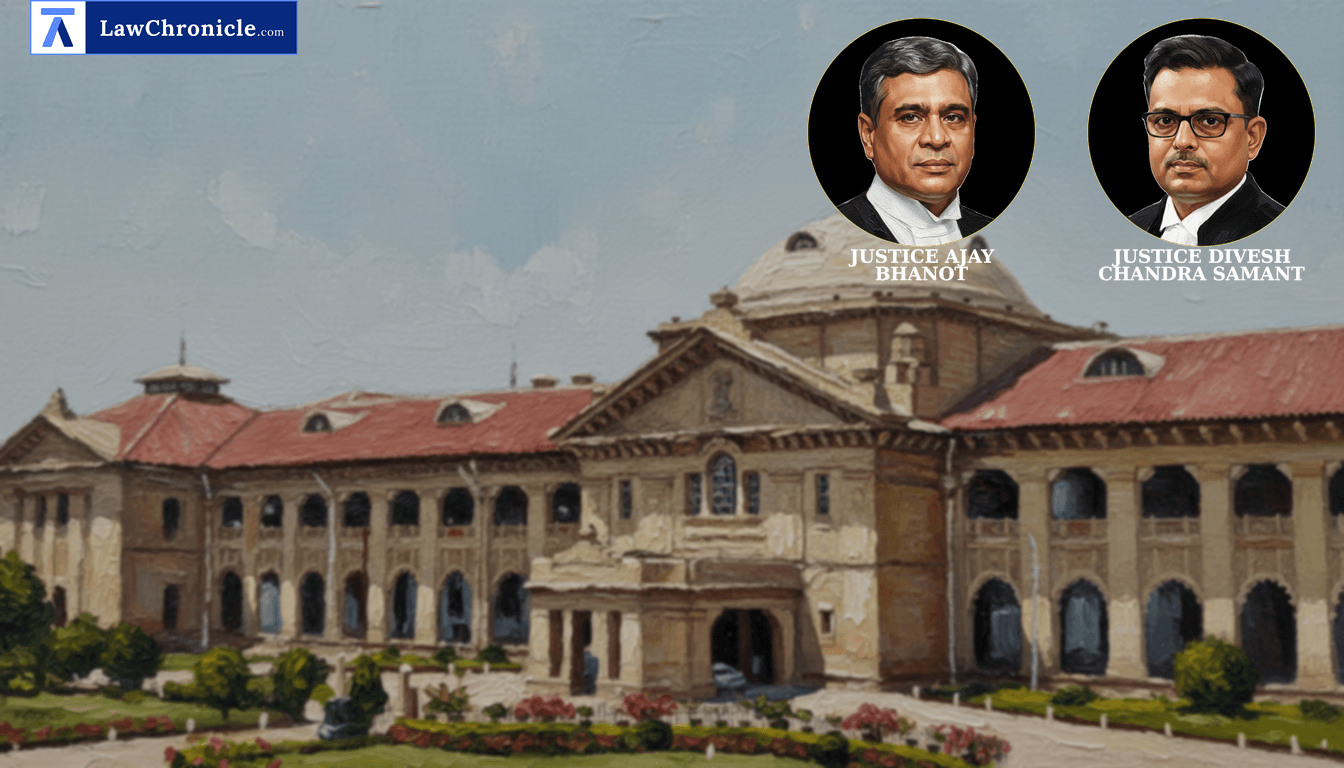
The Allahabad High Court set aside the life imprisonment of a man convicted of murder, holding that material contradictions in ocular testimony and an unexplained delay in recording witness statements can prove fatal to the prosecution's case.
A division bench comprising Justice Ajay Bhanot and Justice Divesh Chandra Samant heard the jail appeal challenging the conviction of the appellant for the alleged murder of his cousin. The Court scrutinized the reliability of the family members' testimonies, which formed the bedrock of the trial court's conviction under Section 302 of the Indian Penal Code.
Fatal Inconsistencies in Eyewitness Testimonies
The Court observed that the presence of the purported eyewitnesses the father, mother, and step-brother of the deceased at the site of the incident was highly doubtful. While the site plan placed the witnesses in an open courtyard, their testimonies suggested they were inside their respective houses when the altercation began. The Bench noted that these 'grave and irreconcilable' contradictions between the site plan and oral depositions impeached the credit of the witnesses.
Furthermore, the Court pointed out the sharp variance regarding the arrest of the accused. While the family claimed they had overpowered and tied the accused to a tree with the murder weapon, the Investigating Officer testified that the arrest was made near the accused's doorstep based on a tip-off from an informer. The Court, in its reasoning, observed: "In view of the aforesaid inconsistencies the presence of the witnesses at the site of the incident and their claims to have witnessed the incident are seriously in doubt... The aforesaid contradictions in the prosecution case set out in the F.I.R., testimonies of P.W.1, P.W.2, P.W3, testimony of P.W.7 and other documentary evidences tendered by the prosecution are grave and irreconcilable."
Unexplained Delay in Recording Statements and Lack of Motive
The Bench expressed concern over the nearly one-month delay in recording the statement of P.W.2, who was a witness to the inquest. Citing the precedent in Shahid Khan v. State of Rajasthan ( "(2016) 4 SCC 96": 2016 CaseBase(SC) 133), the Court held that such unexplained silence casts serious doubt on the witness being a genuine eyewitness.
Regarding the motive, the Court found that the initial allegation of an 'illicit relationship' between the accused and the deceased’s wife was contradicted by the mother and step-brother of the deceased. The Bench suggested that the possibility of false implication to usurp the accused's property could not be ruled out, as the accused was the sole heir to his father's property and unmarried.
Final Directions and Acquittal
Concluding that the prosecution failed to prove the guilt beyond a reasonable doubt, the Court set aside the trial court's judgment. The Court has the following directions:
"71. The Jail Appeal is allowed.
72. The appellant shall be forthwith released from prison and set forth at liberty unless required in any other criminal case.
73. The Court would like to accord its deep appreciation for the scholarly assistance rendered by Shri N.I. Jafri, learned Senior Counsel/Amicus Curiae assisted by Shri Ali Jamal Khan, learned Amicus Curiae for the appellant.
74. A copy of this judgement translated in Hindi to be communicated to the appellant by the Secretary, District Legal Services Authority."
Case Details:
Case No.: JAIL APPEAL No. - 169 of 2018
Case Title: Summilal Ahirwar vs. State of U.P.
Appearances:
For the Petitioner(s): Shri N.I. Jafri (Senior Advocate/Amicus Curiae), Ali Jamal Khan (Amicus Curiae), Gyan Chandra Verma, Ramesh Prajapati, Sanjay Singh
For the Respondent(s): A.G.A.
Source: 2026 CaseBase(ALL) 189
Similar Articles

 Breaking News


