Amid Calls for Dharmendra Pradhan's Resignation - What Does the Law Permit?
 Copy Link
 Share
Share Save
Save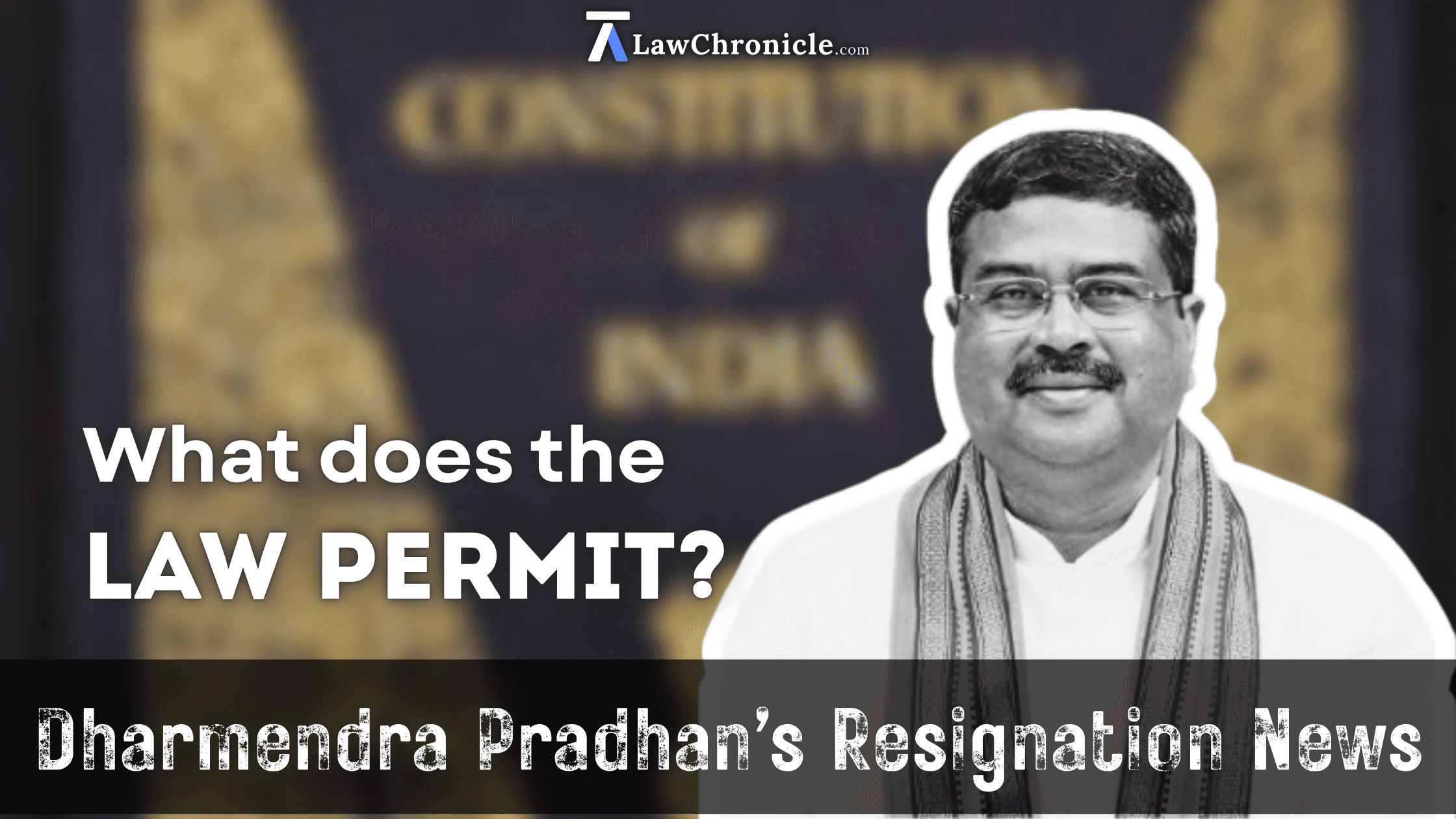
The Dharmendra Pradhan resignation news cycle has dominated headlines this week. It’s all centered at the protest at Jantar Mantar and near Parliament, entering its fourth week over alleged irregularities in the NEET-UG examination. Matters escalated further after Rahul Gandhi detained by police made national news, following a march to the Prime Minister's residence demanding accountability. The face of this political storm is education minister Dharmendra Pradhan, whose resignation has been demanded by opposition parties, student bodies, and civil society groups over the NEET paper leak issue. Beyond the political noise, the episode raises a genuine constitutional question: What does the law actually say about removing a sitting Union Minister?
Let us delve into the applicable statutes to understand the possibilities of Dharmendra Pradhan resignation news.
Who Appoints and Removes a Union Minister?
As per Article 75(1) of the Constitution of India, Ministers of the Union, including Cabinet Ministers, are appointed by the President, but on the advice of the Prime Minister. This is a settled constitutional position: the President does not independently select or dismiss Ministers.
Article 75(2) states that Ministers hold office "during the pleasure of the President." In practice, this "pleasure" is exercised in accordance with the advice of the Prime Minister, not at the President's own discretion. India follows a system of parliamentary democracy, with the President acting as a constitutional head under Article 74.
This means, legally, only two routes exist for a Minister's removal from office:
- Resignation: The Minister voluntarily tenders resignation to the President.
- Dismissal on the Prime Minister's advice: If the President withdraws "pleasure", only when so advised by the Prime Minister.
There is no constitutional provision empowering Parliament, the Opposition, protestors, or even the Judiciary, to directly remove a Union Minister from the Council of Ministers. A demand for resignation of Education Minister Dharmendra Pradhan, however widespread, is a political demand, and not a legal mechanism having binding force.
The Doctrine of Collective Responsibility
Article 75(3) establishes that the Council of Ministers is collectively responsible to the House of the People, the Lok Sabha. This is the only constitutionally recognized route by which the legislature can act against the government as a whole, through a motion of no-confidence. If such a motion is carried, the entire Council of Ministers, not an individual Minister, must resign.
There is no equivalent constitutional instrument for removing a single Minister through a legislative vote. Individual ministerial responsibility for departmental lapses is a political convention, which is enforced through public and parliamentary pressure, not through statute.
Role and Legal Powers of the Education Minister
The Ministry of Education, headed currently by Dharmendra Pradhan, functions under the Government of India (Allocation of Business) Rules, 1961, framed under Article 77(3) of the Constitution. These rules assign subjects, including school education, higher education, and bodies such as the National Testing Agency (NTA), which conducts NEET-UG, to specific ministries.
The National Testing Agency (NTA) is a registered society, and the conduct of NEET-UG is an executive/administrative function delegated to NTA. Education Minister Dharmendra Pradhan exercises policy oversight and is answerable to Parliament for the Ministry's functioning. However, he is not personally the examining authority. Legal accountability for an examination-paper leak, therefore, ordinarily runs through statutory bodies and criminal law (such as the Public Examinations (Prevention of Unfair Means) Act, 2024), rather than attaching automatically to the Minister as an individual.
Can Courts Order a Minister's Removal?
Indian courts, including the Supreme Court and High Courts, have consistently held that the removal of a Minister is a matter falling within the executive's discretion and is not ordinarily justiciable. Courts may, however, intervene on connected legal questions. For instance, directing an inquiry, quashing a flawed examination process, or ordering re-examination, without touching the Minister's tenure itself. Courts do not and cannot issue writs of mandamus directing a Prime Minister or President to dismiss a Minister. That would result in breach of separation of powers.
Political Demand vs Legal Obligation
Education Minister Dharmendra Pradhan’s resignation news is making rounds due to political protests from multiple sides. Whether it is a demand from the public or has a moral, or legal obligation, that needs to be analyzed. To summarise the legal position clearly:
- No law compels a Minister to resign merely because of public protest, opposition demand, or media pressure.
- Resignation is voluntary, tendered by the Minister to the President.
- Dismissal requires the Prime Minister's advice to the President under Article 75(2).
- A no-confidence motion affects the entire Council of Ministers, not one Minister individually.
- Courts do not adjudicate on whether a particular Minister should continue in office.
The Outcome
The buzz surrounding NEET paper leak issue and the consequent demand for Education Minister Dharmendra Pradhan resignation is, in constitutional terms, a political question rather than a legal one. The Constitution of India vests the power to appoint and remove Ministers exclusively within the domains of the President and the Prime Minister, insulated from direct legislative or judicial compulsion. Whatever the outcome of the ongoing CJP protest in Delhi or the opposition protest outside parliament, any change in Pradhan's ministerial status will occur only through resignation or the Prime Minister's advice, not through the strength of the protest itself.
Also read: PM Modi Announces Fast-Track Courts for Paper Leak Cases
 Breaking News