


Anti-Suit Injunctions in Matrimonial Cases Cannot Be Granted As Routine Exercise: Supreme Court
 Copy Link
 Share
 Save
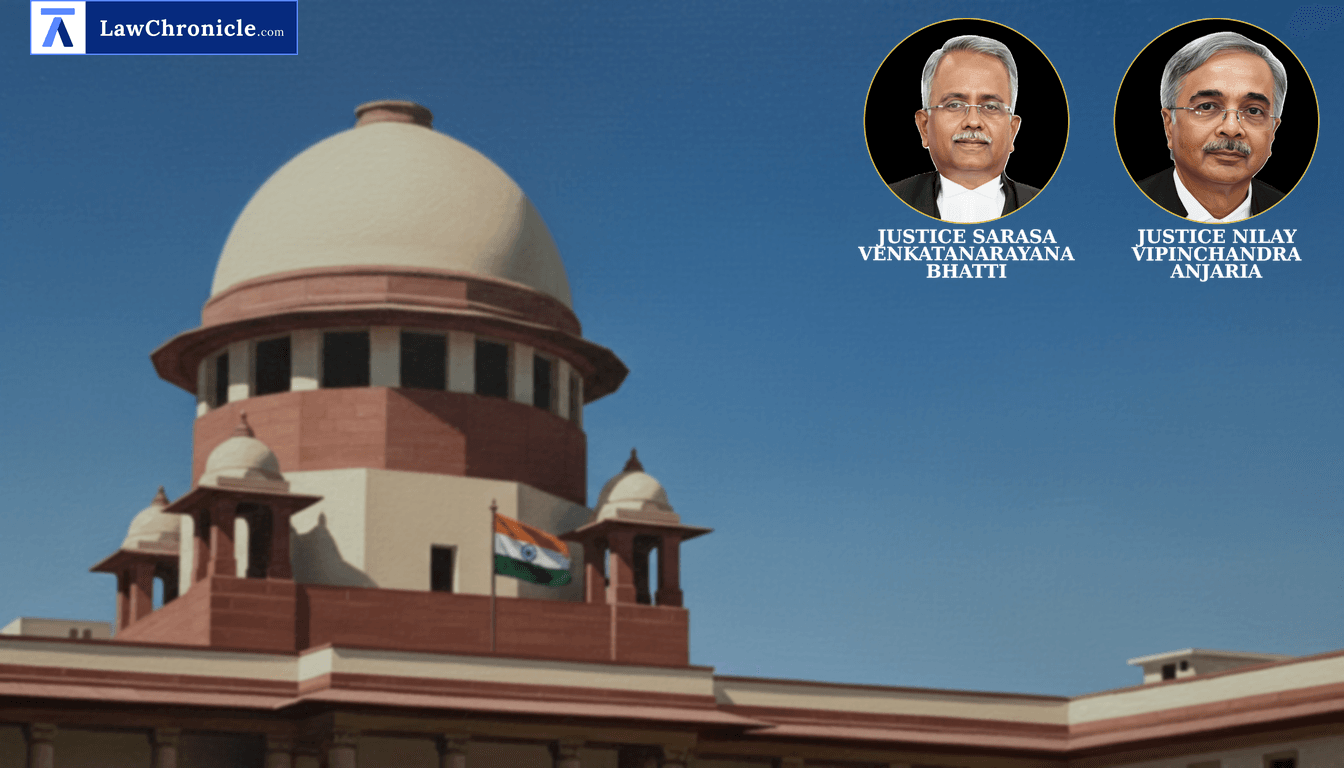
Supreme Court has expressed concern that Indian courts cannot routinely grant anti suit injunction in matrimonial cases merely on the apprehension that a potential foreign divorce decree might rely on grounds unrecognized under domestic law. Restraining a party from pursuing legal remedies in a foreign forum at an inchoate stage impermissibly breaches the comity of courts and interjects into sovereign judicial jurisdictions.
A bench comprising Justice S.V.N. Bhatti and Justice N.V. Anjaria upheld a judgment of the Calcutta High Court which set aside an ex-parte ad-interim anti-suit injunction granted to a husband by an Alipore Trial Court. The Supreme Court emphasized that judicial discretion to restrain foreign court proceedings must be exercised with extreme caution and guided strictly by equitable principles.
Key Takeaways
Anti-Suit Injunctions in Matrimonial Cases Are Not Routine Remedies: Indian courts must exercise extreme circumspection and issue anti-suit injunctions sparingly, avoiding automatic intervention in foreign court proceedings.
Comity of Courts Preserved: Unmindful restraint orders breach judicial comity and amount to impermissible interjection into foreign sovereign jurisdictions.
Pre-mature Apprehensions Rejected: Seeking an anti-suit injunction on the ground that a foreign court might grant divorce on irretrievable breakdown, a ground not recognized under the Hindu Marriage Act, 1955, is speculative and premature while proceedings remain inchoate.
Forum Non Conveniens Application: Substantial connecting factors like habitual residence, joint property, and prolonged marital cohabitation govern the determination of the convenient forum.
Legality of Anti Injunction Suit
Evaluating the legal parameters governing anti-suit injunctions, the Supreme Court affirmed that oppressive or vexatious proceedings and irreparable harm remain the primary factors for Indian courts to consider before putting foreign judicial processes on hold. Citing precedent from Modi Entertainment Network and Another vs. W.S.G. Cricket Pte. Ltd. ( "(2003) 4 SCC 341": 2003 CaseBase(SC) 271), the bench observed that an anti-suit injunction, in matrimonial cases or otherwise, operates against the party in person and not as a direct interference with the foreign court.
Limits of Anti-Injunction Suit
The Apex Court further elaborated that "As a matter of principle of law and the judicial discretion, the grant of anti-suit injunction is not a matter of course. The anti-suit injunction orders are not supposed to be a routine judicial exercise. The anti-suit injunction order is not the one which the court may grant on an askance. The court should be extremely slow, unless the pure legal or jurisdictional considerations are applicable, to issue the anti-suit injunction and thereby stall the proceedings in a court in the foreign country."
Addressing the potential for jurisdictional conflict, the Supreme Court cautioned: "Frequent and unmindful resort would not only undermine the concept of comity of courts but such orders would be tantamount to interjection by the court into the sovereign judicial jurisdiction of a court functioning in the foreign country."
Regarding the husband's argument on non-enforceability under Section 13 of the Code of Civil Procedure, 1908, the Supreme Court noted that relying on decisions such as Dinesh Singh Thakur vs. Sonal Thakur ( "(2018) 17 SCC 12": 2018 CaseBase(SC) 1322) to block foreign suits at an interim stage was misplaced. Paraphrasing the principle from Dinesh Singh Thakur vs. Sonal Thakur ( "(2018) 17 SCC 12": 2018 CaseBase(SC) 1322), the Court highlighted that the mere filing of a foreign proceeding on grounds unavailable under Indian personal law does not automatically warrant an anti-suit injunction. The Apex Court held that "On the speculative consideration that the suit would be decreed by the UK Family Court on the ground of irretrievable breakdown of marriage, anti-suit injunction would not have been granted by the Alipore Trial Court. It adverted to a pre-mature ground at pre-mature stage and thus erred in proceeding to pass the anti-suit injunction order projecting that ground."
On the issue of appropriate forum, the Supreme Court aligned with principles from Arif Azim Company Limited vs. Micromax Informatics FZE and Baksish Ahmad vs. Union of India and Another ( "2026 SCC OnLine SC 1098": 2026 CaseBase(SC) 560) regarding the doctrine of forum non conveniens, as well as Spiliada Maritime Corporation vs. Cansulex Ltd. regarding trial suitability. The Supreme Court noted that the UK was the proper forum due to prolonged habitual residence and matrimonial ties.
Ratio
An anti-suit injunction against foreign judicial proceedings cannot be granted as a matter of routine or on premature speculations regarding the non-enforceability of a future decree under Section 13 of the Code of Civil Procedure, 1908. When foreign proceedings are inchoate and the foreign tribunal possesses substantial territorial and personal connecting factors over the parties, Indian courts must respect the comity of courts and refrain from issuing injunctive orders unless the foreign proceedings are demonstrably vexatious or oppressive.
Background
The parties married in Kolkata in December 2018 as per Hindu rites and spent substantial time living together in London, UK. In November 2023, after returning to India, they separated. In September 2024, the husband filed a divorce petition before the Alipore Family Court under Section 13 of the Hindu Marriage Act, 1955.
In October 2024, the wife initiated divorce and financial maintenance proceedings before the Central Family Court, UK, citing irretrievable breakdown of marriage. The UK court subsequently considered jurisdiction and preliminary issues, while appointing an expert on Indian law. In response, the husband filed a title suit before the Civil Judge (Senior Division), Alipore, seeking a declaration that the UK proceedings were vexatious and an ex-parte anti-suit injunction. The Alipore Trial Court granted the ad-interim anti-suit injunction under Order XXXIX Rules 1 and 2 read with Section 151 of the Code of Civil Procedure, 1908.
On appeal, the Calcutta High Court set aside the anti-suit injunction, holding that the UK Family Court was the forum conveniens and that principles of comity under Section 13 and Section 14 of the Code of Civil Procedure, 1908 barred such injunctive relief. The High Court also noted that the UK court was already examining jurisdictional requirements under Section 5(2)(d) of the Domicile and Matrimonial Proceedings Act, 1973. Distinguishing the applicability of Raaj Unocal Lubricants Limited vs. Apple Energy Private Limited and Another regarding foreign decree execution at preliminary stages, the High Court vacated the restraint.
Dismissing the husband's appeal against the High Court order, the Supreme Court confirmed that the High Court rightly vacated the anti-suit injunction, leaving parties liberty to challenge any final decisions of the foreign court in accordance with law.
Case Details:
Case No.: Civil Appeal No. of 2026 (Arising out of SLP(C) No. 15849 of 2026)
Neutral Citation: 2026 INSC 1034
Case Title: Mihir Prakash Bajoria v. Vidushi Jain Bajoria
Appearances:
For the Petitioner(s): Ms. Meenakshi Arora, Senior Advocate
For the Respondent(s): Ms. Shobha Gupta, Senior Advocate
Source: 2026 CaseBase(SC) 7190
Similar Articles


 Breaking News


