


Appellate Tribunal Need Not Remand If Full Hearing Is Possible: Karnataka HC
 Copy Link
 Share
 Save
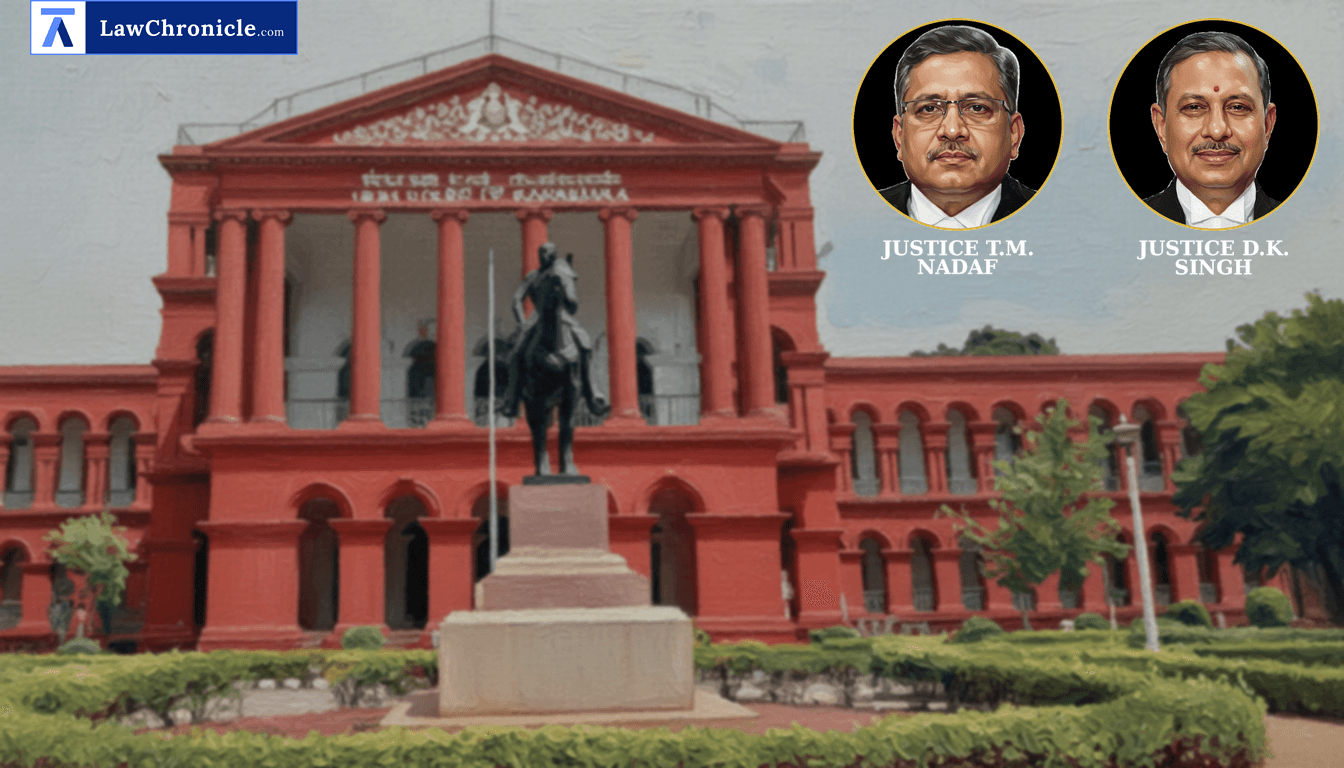
The Karnataka High Court has rebuked attempts to stall money laundering proceedings through technical natural justice claims, ruling that an Appellate Tribunal's decision to hear a case on merits rather than remanding it for non-consideration of written submissions does not constitute a jurisdictional error.
In a decisive move to prevent the abuse of judicial process, a Division Bench comprising Justice D K Singh and Justice T.M. Nadaf dismissed a challenge against an interim order of the PMLA Appellate Tribunal, holding that the right to a fair hearing does not mandate the verbatim reproduction of every synopsis or written submission in a court order.
Key Takeaways
No Automatic Right to Remand
Failure to specifically mention a written synopsis in an adjudicatory order does not automatically vitiate the proceedings if a real opportunity for hearing was provided.
Curing Procedural Defects at Appeal
Any perceived lack of detail at the initial adjudicatory stage can be effectively cured at the appellate level when the Tribunal allows parties to argue all facts and law afresh.
Discouraging Litigation Tactics
Approaching High Courts against interim procedural orders of Tribunals, especially when main appeals are pending, is viewed as a tactic to prolong proceedings and may be treated as an abuse of process.
Meaningful Hearing vs. Procedural Formalism
The Court emphasized that the principles of natural justice require a "meaningful consideration" of submissions rather than a mechanical answer to every argument. The Bench noted that the petitioner had a fair opportunity to represent its case through counsel and reply to show cause notices. Referring to Union Of India Vs Jyoti Prakash Mitter ( "[1971] 1 SCC 396": 1971 CaseBase(SC) 595), the Court reiterated that in judicial proceedings, while basic rules of natural justice must be followed, a personal or oral hearing is not an absolute necessity unless the statute or complexity of the case demands it.
Regarding the duty of authorities, the Court observed: "The duty of an Authority/Court is of meaningful consideration of the submissions and need not answer every argument in elaborate detail. However, the order should disclose that the authority/Court has applied its mind to the material on record and substantial contentions which have bearing on the decision."
The High Court found that the petitioner's rush to the court while the appeal was still active before the Tribunal was a "trick/tactics" to delay the quantified recovery of alleged proceeds of crime. The Court further noted that the petitioner had previously failed to interdict criminal proceedings in JSW Steel Ltd. Vs Enforcement Directorate.
Court Directions
The Court has following directions:
"Accordingly, the writ petitions are dismissed, however, without costs. Pending applications, if any, do not survive for consideration and accordingly, they stand disposed of."
Ratio
The non-mentioning of separately filed written submissions or synopses by an Adjudicating Authority does not amount to a denial of natural justice if the party had an effective opportunity to present its case. An Appellate Tribunal, being a continuation of the original proceedings, possesses the jurisdiction to decide issues on facts and law, and its choice to hear the matter on merits instead of remanding it for procedural irregularities does not warrant interference under Section 482 of Code of Criminal Procedure, 1973 or Article 226 of the Constitution of India, 1950.
Background
The dispute originated from an FIR registered by the CBI in 2011 involving illegal mining allegations against G. Janardhana Reddy and others. The Directorate of Enforcement (ED) subsequently initiated an investigation under the Prevention of Money Laundering Act, 2002, alleging that the petitioner held 'receivables' worth Rs. 33.80 Crores for iron ore supplied from illegal mines.
A Provisional Attachment Order (PAO) was issued in 2015, which was confirmed by the Adjudicating Authority in 2021. The petitioner appealed this confirmation before the PMLA Appellate Tribunal, arguing that the Adjudicating Authority ignored its written submissions and seeking a remand. The Tribunal declined the remand, instead granting liberty to the petitioner to argue all issues on merits. The petitioner challenged this refusal before the High Court under Articles 226 and 227 of the Constitution of India, 1950 read with Section 482 of the Code of Criminal Procedure, 1973.
The Court relied on precedents including Union Of India Vs Amrik Singh (Ex Constable), Lt. Col. K.N.S. Sidhu Vs Union Of India, and Captain Harish Uppal Vs Union Of India ( "[1973] 3 SCC 319": 1972 CaseBase(SC) 336) to conclude that special enactments like PMLA do not require the rigid importation of every principle of natural justice if the statutory scheme provides sufficient safeguards.
Case Details:
Case No.: WRIT PETITION NO. 9583 OF 2025 (GM-RES) C/W WRIT PETITION NO. 8943 OF 2025
Case Title: JSW Steel Limited V. Deputy Director, Directorate Of Enforcement
Appearances:
For the Petitioner(s): Sri Gopal Jain, Senior Advocate for Sri Aditya Narayan, Advocate
For the Respondent(s): Smt. Anuparna Bordoloi, Sri Dhanush M & Sri Ajaypal Singh, Advocates
Source: 2026 CaseBase(KAR) 22382
Similar Articles


 Breaking News


