


Appointment of Election Commissioners Act, 2023 Challenge: Supreme Court delivers Split Verdict
 Copy Link
 Share
 Save
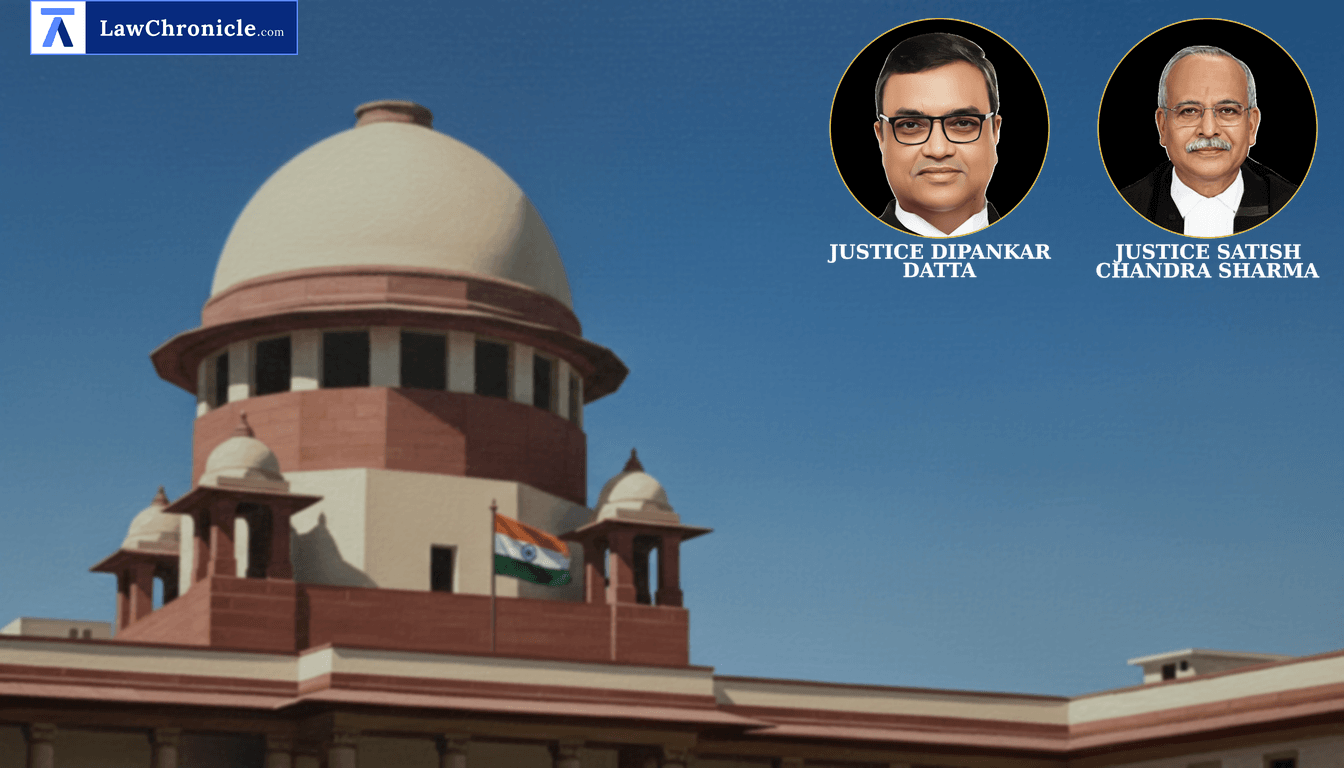
In a profound split within the top court over the mechanics of democratic safeguards, the Supreme Court has referred the challenge against the 2023 Election Commission appointment law to the Chief Justice of India for constituting a larger Constitution Bench.
A Division Bench comprising Justice Dipankar Datta and Justice Satish Chandra Sharma delivered a split opinion on whether the petitions challenging the validity of the 2023 legislation regulating appointments to the Election Commission of India should be referred to a 5-Judge Constitution Bench. Justice Datta held that no substantial question of law regarding constitutional interpretation remained since the core principles were settled in Anoop Baranwal v. Union of India ( "(2023) 6 SCC 161": 2023 CaseBase(SC) 186), whereas Justice Sharma concluded that the novelty and constitutional significance of the enactment necessitated an authoritative ruling by a 5-Judge Bench.
Key Takeaways
Judicial Split on Constitutional References: The two-judge bench differed on whether an application of established principles to a new legislative framework warrants a reference under Article 145(3) of the Constitution of India, 1950.
Challenge to Executive Dominance: The petitions question the validity of the Selection Committee composition under Section 7 of the 2023 Act, alleging that executive majority undermines the independence of the Election Commission.
Call for Permanent Constitutional Bench: The Supreme Court collectively requested the Chief Justice of India to explore establishing a permanent 5-Judge Bench to prevent decades-long delays in resolving pivotal constitutional references.
Election Commissioners Act 2023 Challenge
Examining the constitutional scheme and historical context, Justice Dipankar Datta noted the necessity of institutional insulation for free and fair elections. The Supreme Court expressed that "While making the arrangement purely transient and requiring the Parliament to frame a law on the lines of Article 324, the Constitution Bench provided the rationale for the course it chose to adopt. It acknowledged that independence of the ECI was part of the basic structure and, hence, the need for an arrangement arose to fill up the vacuum caused by absence of law. Thus, instead of a constitutional norm, the Court provided an interim arrangement."
Addressing the request for a reference, Justice Datta highlighted that the primary constitutional principles regarding the ECI's independence were already settled in Anoop Baranwal v. Union of India ( "(2023) 6 SCC 161": 2023 CaseBase(SC) 186), People’s Union for Civil Liberties v. Union of India ( "(2003) 4 SCC 399": 2001 CaseBase(SC) 736), and Shrimanth Balasaheb Patil v. Karnataka Legislative Assembly ( "(2020) 2 SCC 595": 2019 CaseBase(SC) 511). However, Justice Sharma emphasized that the validity of a statutory selection committee excluding a neutral judicial member is a novel question of law that must be tested by a Constitution Bench.
Due to the divergence in views, the Division Bench issued the following directions:
"Thus, we direct that the papers be placed before the Hon’ble the Chief Justice for considering the desirability of constituting a Constitution Bench of such number of Judges to decide the question of vires of Section 7 and the other provisions of the Chief Election Commissioner and other Election Commissioners (Appointment, Conditions of Service and Term of Office) Act, 2023."
Ratio
Where the governing principles of constitutional law are authoritatively settled by precedent, the mere application of those principles to a new statutory scheme does not automatically raise a substantial question of law as to the interpretation of the Constitution requiring a reference under Article 145(3). However, when a statutory framework establishing key constitutional machinery is challenged for the first time as infringing upon basic structure principles like independence of elections, it presents an unsettled constitutional issue fit for determination by a Constitution Bench.
Background
A cluster of writ petitions under Article 32 of the Constitution of India, 1950 was filed by public-spirited individuals and organisations including the People’s Union for Civil Liberties v. Union of India ( "(2003) 4 SCC 399": 2001 CaseBase(SC) 736) and Supreme Court Advocates-on-Record Association v. Union of India ( "(2016) 5 SCC 1": 2015 CaseBase(SC) 35). The petitioners challenged Sections 6, 7, and 8(2) of the Chief Election Commissioner and other Election Commissioners (Appointment, Conditions of Service and Term of Office) Act, 2023. The main target of the challenge was Section 7, which establishes a Selection Committee consisting of the Prime Minister, a Union Cabinet Minister, and the Leader of the Opposition, effectively granting executive dominance in selecting members of the Election Commission of India.
The petitioners argued that the Constitution Bench in Anoop Baranwal v. Union of India ( "(2023) 6 SCC 161": 2023 CaseBase(SC) 186) mandated an independent selection process free from exclusive executive control and that the 2023 Act impermissibly overrode this ruling. Relying on precedents like Shrimanth Balasaheb Patil v. Karnataka Legislative Assembly ( "(2020) 2 SCC 595": 2019 CaseBase(SC) 511), State of J&K v. Thakur Ganga Singh ( "AIR 1960 SC 356": 1959 CaseBase(SC) 107), Abdul Rahim Ismail C. Rahimtoola v. State of Bombay ( "1959 SCC OnLine SC 60": 1959 CaseBase(SC) 132), Manoj Narula v. Union of India ( "(2014) 9 SCC 1": 2014 CaseBase(SC) 379), Supreme Court Advocates-on-Record Association v. Union of India, In Re: Special Reference No.1 of 1998, Vineet Narain v. Union of India ( "(1998) 1 SCC 226": 1996 CaseBase(SC) 1764), and Vishaka v. State of Rajasthan ( "(1997) 6 SCC 241": 1997 CaseBase(SC) 1720), they asserted that smaller benches frequently adjudicate constitutional challenges when underlying principles are settled.
Conversely, the Attorney General and Solicitor General argued that the directions in Anoop Baranwal v. Union of India ( "(2023) 6 SCC 161": 2023 CaseBase(SC) 186) were merely interim measures under Article 142 meant to fill a legislative vacuum until Parliament enacted a law. Citing decisions like Abdul Rahim Ismail C. Rahimtoola v. State of Bombay ( "1959 SCC OnLine SC 60": 1959 CaseBase(SC) 132) and T.N. Seshan v. Union of India, the Government contended that the 2023 Act represents parliamentary wisdom and its validity involves substantial questions of constitutional interpretation under Article 145(3).
Owing to the deadlock between the two judges on whether a 2-judge bench could decide the merits, the matter was referred to the Chief Justice of India to consider forming a 5-Judge Constitution Bench.
Case Details:
Case No.: Writ Petition (Civil) No. 14 of 2024
Neutral Citation: 2026 INSC 1040
Case Title: Dr. Jaya Thakur and Ors. v. Union of India and Anr.
Source: 2026 CaseBase(SC) 7186
Similar Articles

 Breaking News


