Arbitration Power under Section 37 Cannot Be Used To Reduce Arbitral Award: Supreme Court
 Copy Link
 Share
 Save
The Supreme Court has ruled that Courts exercising limited appellate jurisdiction cannot modify or reduce arbitral awards simply because the claim for additional work appears high enough to shock judicial conscience, especially when the award is grounded on valid evidence. Reaffirming that state entities cannot claim special judicial indulgence, the Supreme Court restored an arbitral award and held that Section 37 powers cannot be exercised on mere lip service to statutory catchphrases.
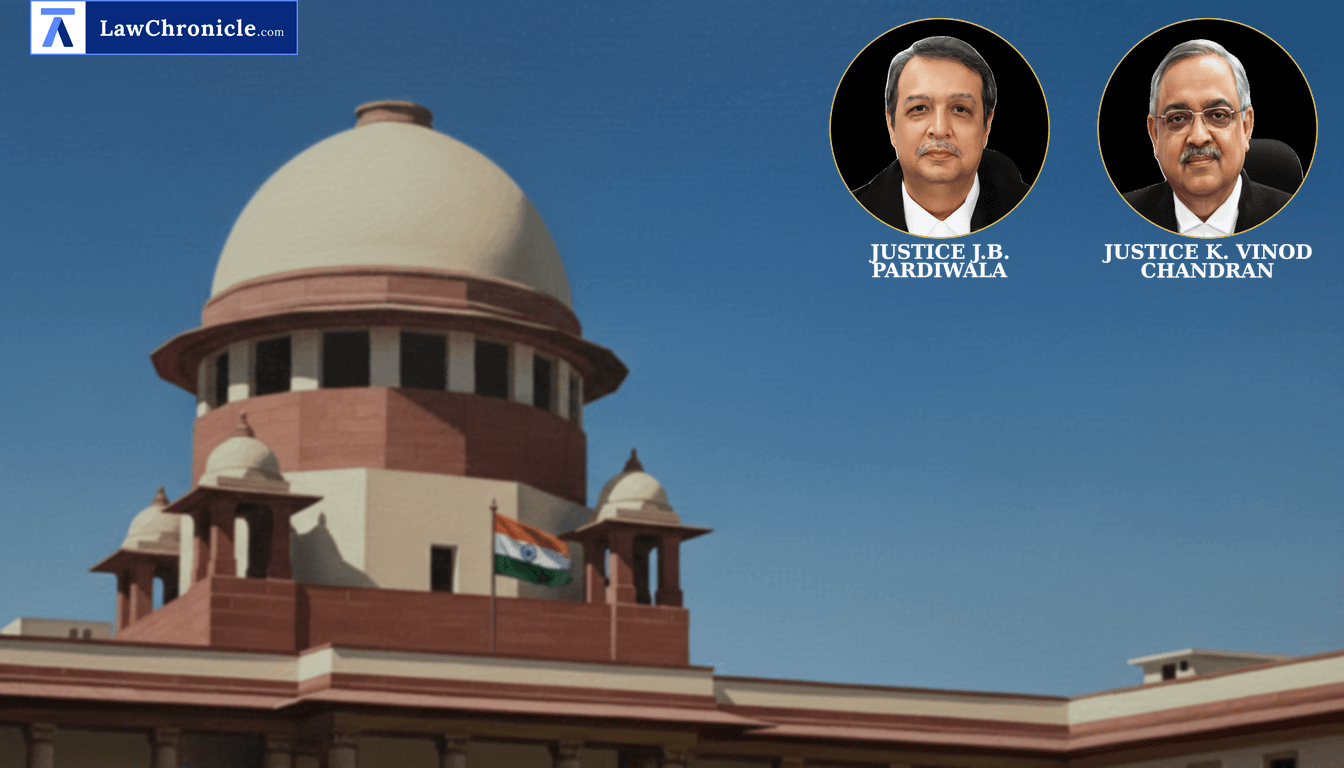
A bench of Justice J.B. Pardiwala and Justice K. Vinod Chandran set aside a Division Bench order of the Calcutta High Court that had halved a contractor's awarded amount. The court was considering appeals arising out of proceedings under Section 37 of the Arbitration and Conciliation Act, 1996.
Key Takeaways
- No Merit Adjudication Under Section 37: Appellate courts cannot recalculate claim amounts or re-evaluate measurements and invoices under the guise of conscience-shocking claims.
- Equal Treatment for State Entities: Government bodies and port trusts cannot seek special relief or modification of awards simply because the awarded sum is substantial.
- Mere Catchphrases Insufficient: Using expressions like 'patent illegality' or 'opposed to public policy' without substantive reasoning cannot justify setting aside an award.
Court Observations and Directions
The Supreme Court observed that the High Court had recorded that the award was neither perverse nor lacking evidence, yet interfered merely because the additional work claims exceeded 70% of the original contract value. The Court emphasized that invocation of public policy and morality cannot be done on lip service. It added that “However, the words are not to be applied on a mere lip service and there should be a substantive reason which blatantly and patently brings forth the conflict with the most basic notions of morality or justice, resulting in the conscience of the Court being shocked.”
Ratio
An arbitral award based on valid evidentiary material and joint measurements cannot be modified or set aside under Section 37 of the Arbitration and Conciliation Act, 1996 on the ground of shocking the court's conscience merely because the quantification for additional works is high or because the award debtor is a State entity.
Background
The dispute arose from a contract for dredging the river bed and shores at Sagar Island to create an approach channel and basin. Though original work was substantially paid, additional re-dredging work became necessary due to force majeure weather conditions, inaccurate soil data supplied by the Port Trust, and non-construction of protective walls.
When the contractor raised claims for additional work based on pre- and post-work levels, the dispute was referred to arbitration, resulting in an award dated November 3, 2003, in favor of the contractor. A Single Judge of the High Court dismissed the Port Trust's challenge under Section 34 of the Arbitration and Conciliation Act, 1996. However, on an appeal under Section 37, the Division Bench reduced the quantified amount to 50% and slashed the interest rate to 6%, reasoning that claims exceeding 70% of the original contract value shocked its conscience.
Reversing this decision, the Supreme Court relied on Somdatt Builders–NCC–NEC (JV) v. National Highways Authority of India & Ors. ( "(2025) 6 SCC 757": 2025 CaseBase(SC) 122) and Ssangyong Engineering & Construction Co. Ltd. v. National Highways Authority of India (NHAI) ( "(2019) 15 SCC 131": 2019 CaseBase(SC) 2149) to reiterate the narrow scope of appellate interference under Section 37. The Apex Court noted that partial modification or severance was impermissible here as valid and invalid portions were intertwined, citing Gayatri Balasamy v. M/s ISG Novasoft Technologies Limited ( "2025 INSC 605": 2025 CaseBase(SC) 781). It further relied on Pam Developments Private Ltd. v. State of West Bengal ( "(2019) 8 SCC 112": 2019 CaseBase(SC) 3841) to hold that government entities deserve no special treatment. Dismissing the argument based on Batliboi Environmental Engineers Ltd. v. Hindustan Petroleum Corporation Ltd. (HPCL), the Court noted that damages principles do not apply to valid invoices raised for extra work performed.
Case Details:
Case No.: Civil Appeal No. 14303 of 2026
Neutral Citation: 2026 INSC 1238
Case Title: M/s Marino Dredgeco Limited v. The Board of Trustees of the Port of Kolkata
Appearances:
For the Petitioner(s): Mr. R. Anand Padmanabhan, Sr. Adv., Mr. Amitava Mukherjee, Sr. Adv.
For the Respondent(s): Mr. Siddharth Bhatnagar, Sr. Adv.
Source: 2026 CaseBase(SC) 10301
Similar Articles
 Breaking News