


CBI Case 'Fully Fabricated': SC Clears Former Indian Bank Branch Manager
 Copy Link
 Share
 Save
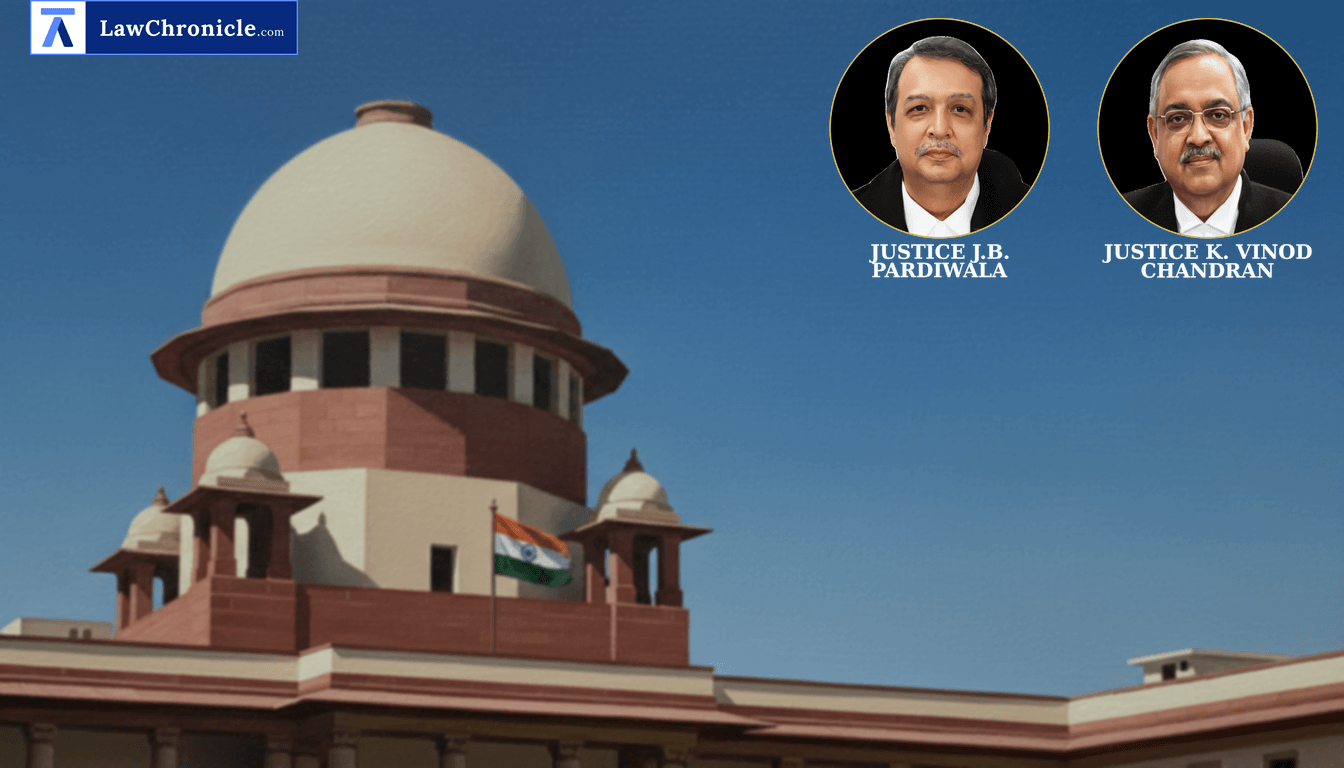
Exposing a groundless probe, the Supreme Court completely exonerated a former Indian Bank Manager while severely censuring the Central Bureau of Investigation for prosecuting a fully fabricated financial fraud case. Uncovering that the bank had actually recovered proceeds far exceeding the loan amounts through property auctions, the apex court ordered a probe into why the excess funds were withheld instead of being released to the legal heirs.
A Division Bench comprising Justice J.B. Pardiwala and Justice K. Vinod Chandran set aside the conviction and sentence passed by the trial court and affirmed by the High Court against a former Branch Manager. The appellant was prosecuted under Section 420 read with Section 120B of the Indian Penal Code, 1860 alongside Section 13(2) read with Section 13(1)(d) of the Prevention of Corruption Act, 1988.
Key Takeaways
Exoneration of Bank Officials: Sanction of loans following due procedure and approval from regional authorities cannot be treated as criminal collusion.
Rejection of CBI Probe: The Court condemned the prosecution for building a criminal case on baseless presumptions without verifying fundamental financial recovery details.
Accountability for Retained Funds: Banks cannot indefinitely hold onto excess money generated through auction of mortgaged properties even if borrowers face criminal proceedings.
Rebuking the prosecution, the Supreme Court observed that the allegations of illegal loan sanctioning, overvaluation of properties, and siphoning of funds were baseless constructs unsupported by evidence. The Court found that the Regional Office had approved the loans and that the subsequent auction of mortgaged properties fully satisfied the loan accounts, leaving significant surplus funds with the bank.
The Court issued the following directions:
"Having found the case to be fully fabricated, we call for a report from the Branch Manager, Indian Bank, Anna Nagar Branch, who is impleaded herein as a respondent with regard to the loan accounts which are the subject matter of this case booked by the CBI and the satisfaction of the same as also utilisation of the money received on auction sale of the mortgaged properties. The title deeds of the properties mortgaged shall also be produced before us. The Branch Manager, Indian Bank, Annanagar Branch shall be issued a copy of this judgment by the Registry of this Court and directed to comply with the directions herein. The case, though, disposed of, shall be posted only for the purpose of ascertaining the status of the excess money received on auction and to ensure the due disbursal of the same. We direct the Registry of this Court not to return the records of the case until further orders."
The Court, in its reasoning, observed: "We are clear in our minds that the prosecution case set up is fabricated and has no legs to stand. That A1 had sanctioned loans to A4 and A5, has been proved. It is also coming out from the testimonies of the official witnesses, PW1 and PW2 that the loans were sanctioned by the Regional Office itself. Properties mortgaged were proceeded against and sold in auction, the proceeds of which satisfied the loan availed and left much more with the bank... The CBI has failed miserably in not only proving its case but also in framing the case."
Ratio
Criminal liability under the Prevention of Corruption Act, 1988 and the Indian Penal Code, 1860 cannot be sustained against bank officials on speculative allegations of cheating and conspiracy when loan sanctions are duly approved by competent higher authorities and the underlying debts stand fully satisfied with surplus proceeds through public auctions.
Background
The case originated from allegations that in 1991, while serving as Branch Manager at the Anna Nagar Branch of Indian Bank, the appellant conspired with a retired officer of another bank (A2) to illegally sanction loans to domestic helps (A4 and A5) of A2. It was alleged that mortgaged lands were grossly overvalued by a bank-engaged appraiser (A3) and that A2 appropriated the disbursed amounts.
During the trial, prosecution witnesses admitted that the credit facilities were in fact sanctioned by the Regional Office of the bank and not unilaterally by the appellant. Furthermore, evidence revealed that the bank auctioned the mortgaged properties in 2010, recovering ₹1,17,50,000 against a loan debt of ₹16,42,397 in one account, and ₹2,42,00,000 against ₹5,35,550 in another. Despite the full satisfaction of loan liabilities, the surplus funds remained unreturned with the bank. The Supreme Court allowed the appeal, granted a clean acquittal to the appellant, and scheduled the matter for 05.10.2026 to monitor the disbursal of excess auction proceeds to the legal heirs.
Case Details:
Case No.: Criminal Appeal No. 2460 of 2026
Neutral Citation: 2026 INSC 936
Case Title: V. Balakrishnan v. State Rep by the Deputy Superintendent of Police
Appearances:
For the Petitioner(s): Sri S. Nagamuthu, Senior Counsel; Mr. M.P. Parthiban, AOR
For the Respondent(s): Sri Davinder Pal Singh, Additional Solicitor General; Mr. Shreekant Neelappa Terdal, AOR; Mr. Khushal Kolwar, Adv.; Mr. Shubham Prakash Mishra, Adv.; Mr. Abhinav Singh, Adv.; Mr. Jagdish Chandra, Adv.
Source: 2026 CaseBase(SC) 916
Similar Articles


 Breaking News


