


Co-Accused Confessions Are Inadmissible Evidence For Bail: Himachal Pradesh HC
 Copy Link
 Share
 Save
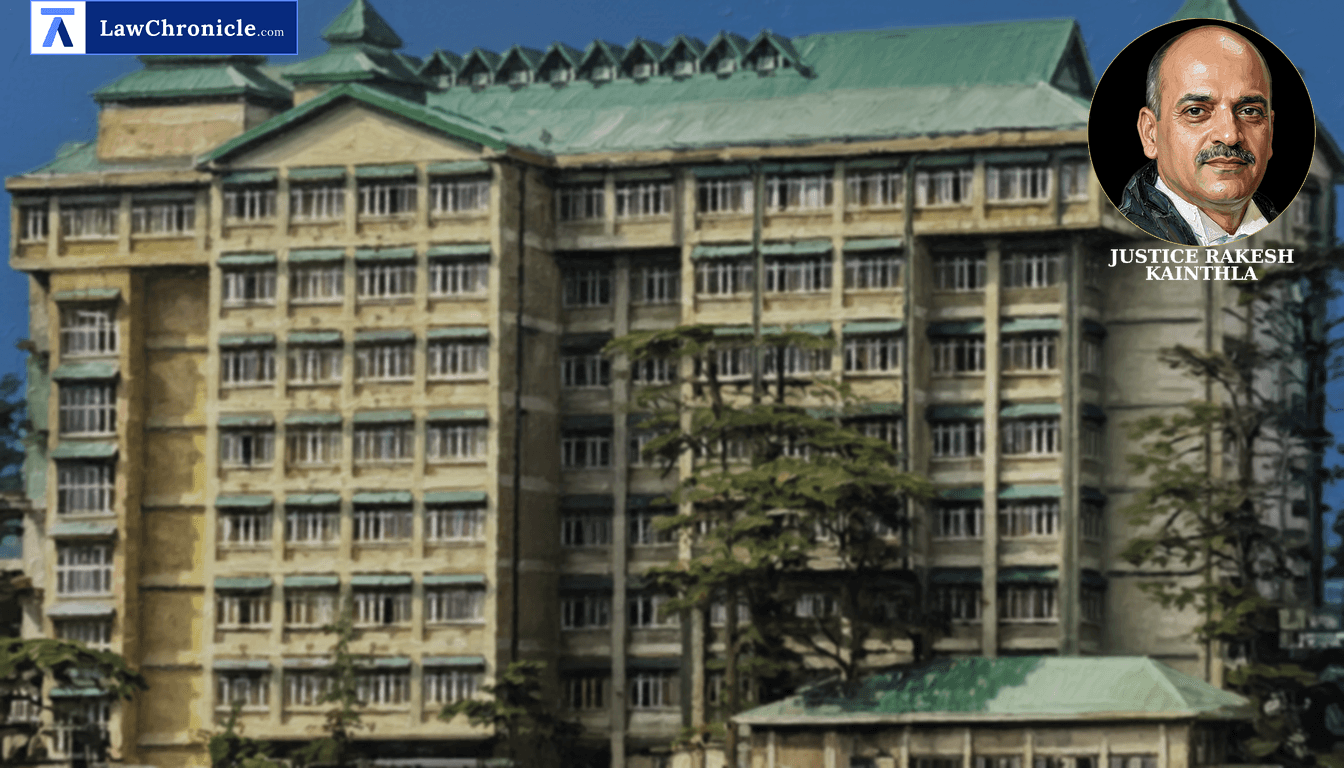
In a decisive reinforcement of personal liberty, the Himachal Pradesh High Court has ruled that incriminating statements made by a co-accused during police investigation cannot serve as substantive evidence to deny bail. The Court clarified that such confessions are hit by the bar of admissibility, ensuring that an accused cannot be detained solely on the basis of uncorroborated allegations from a fellow detainee.
Justice Rakesh Kainthla, sitting as a single judge bench, adjudicated upon a regular bail petition involving charges under the Bharatiya Nyaya Sanhita, 2023, Narcotic Drugs And Psychotropic Substances Act, 1985, and the Arms Act, 1959. The Court was tasked with determining whether the petitioner, who was seated in the rear of a vehicle where contraband was found, should be denied bail based on the driver's statement alleging abetment to run over police officials.
Key Takeaways
Inadmissibility of Co-Accused Statements
Confessions made to police officers by co-accused during investigations are legally inadmissible and cannot be used to establish a prima facie case for denying bail.
Conscious Possession Standards
While occupants of a vehicle are presumed to be in conscious possession of recovered contraband, the specific quantity and criminal history of the accused remain pivotal for bail considerations.
Reformative Justice Over Pre-trial Detention
First-time offenders with deep societal roots are entitled to the possibility of reformation, making indefinite custody without a criminal record legally unsustainable.
Inadmissibility of Statements under Section 162 CrPC
The prosecution contended that the petitioner had abetted an attempt to murder by instructing the driver to run over police personnel. However, the Court rejected this reliance on investigative statements. Referring to Dipakbhai Jagdishchandra Patel v. State of Gujarat ( "(2019) 16 SCC 547: (2020) 2 SCC (Cri) 361: 2019 SCC OnLine SC 588": 2019 CaseBase(SC) 3174), the bench noted that statements made during investigation are hit by Section 162 of the Code Of Criminal Procedure, 1973 and cannot be used as evidence.
Furthermore, the Court relied on Surinder Kumar Khanna vs Intelligence Officer Directorate of Revenue Intelligence and Tofan Singh Versus State of Tamil Nadu ( "2021 (4) SCC 1": 2020 CaseBase(SC) 1147) to reiterate that a confession made by a co-accused is not a substantive piece of evidence against another accused and is hit by Section 25 of the Indian Evidence Act, 1872. The bench observed that the rigours of Section 37 of the Narcotic Drugs And Psychotropic Substances Act, 1985 were not attracted since the quantity of methamphetamine (6.15 grams) was less than commercial, and the heroin (2.25 grams) was in a small quantity.
The Court, in its reasoning, observed: "Hence, the statement made by the driver during the course of investigation cannot be used as a legally admissible piece of evidence against the petitioner. The petitioner was not driving the vehicle and, prima facie, there is insufficient material to connect him to the commission of an offence punishable under Section 109 of the BNS."
Regarding the general principles of bail, the Court referred to Pinki v. State of U.P. and State of Rajasthan v. Balchand, emphasizing that the normal rule is bail and not jail. It also noted the principles of conscious possession as discussed in Madan Lal versus State of H.P. ( "(2003) 7 SCC 465: 2003 SCC (Cri) 1664: 2003 SCC OnLineSC 874": 2003 CaseBase(SC) 1695), but found that the lack of criminal antecedents and the non-commercial quantity of drugs justified the petitioner's release.
The Court has following directions:
"(i) The petitioner will not intimidate the witnesses, nor will he influence any evidence in any manner whatsoever.
(ii) The petitioner shall attend the trial on each and every hearing and will not seek unnecessary adjournments.
(iii) The petitioner will not leave the present addresses for a continuous period of seven days without furnishing the address of the intended visit to the SHO concerned, the Police Station concerned and the Trial Court.
(iv) The petitioner will surrender his passport, if any, to the Court; and
(v) The petitioner will furnish his mobile number and social media contact to the Police and the Court and will abide by the summons/notices received from the Police/Court through SMS/ WhatsApp/ Social Media Account. In case of any change in the mobile number or social media accounts, the same will be intimated to the Police/Court within five days from the date of the change."
Ratio
A statement or confession made by a co-accused to a police officer during the course of an investigation is hit by Section 25 of the Indian Evidence Act and Section 162 of the CrPC, rendering it inadmissible as substantive evidence. Consequently, such statements cannot form the sole basis for the deprivation of liberty or the denial of bail, especially when the statutory rigours of the NDPS Act are not applicable due to the recovery of non-commercial quantities of contraband.
Background
The case originated from a police search of a vehicle on March 29, 2026, at Kokkunala, where authorities recovered heroin, methamphetamine, and an air pistol. The prosecution alleged that when signaled to stop, the driver attempted to flee and hit police officials, purportedly at the petitioner's behest. The petitioner, who had been in custody since the incident, argued he was falsely implicated and had no prior criminal record. The State opposed the bail, citing the gravity of the attempt to run over officers. The Court, however, found that since the investigation was complete and the petitioner was a first-time offender with no risk of absconding, he was entitled to bail despite the recovery of contraband, as the quantities did not reach the commercial threshold defined by the Central Government.
Case Details:
Case No.: Cr. MP(M) No. 1858 of 2026
Neutral Citation: 2026:HHC:45691
Case Title: Ramanjeet Singh @ Raju Versus State of HP
Appearances:
For the Petitioner(s): Mr Abhimanyu Thakur, Advocate.
For the Respondent(s): Mr Jitender Sharma, Additional Advocate General.
Source: 2026 CaseBase(HP) 11140
Similar Articles


 Breaking News


