


Collaborator With Joint Liability Can Invoke Arbitration Despite Lack of Direct Signatory
 Copy Link
 Share
 Save
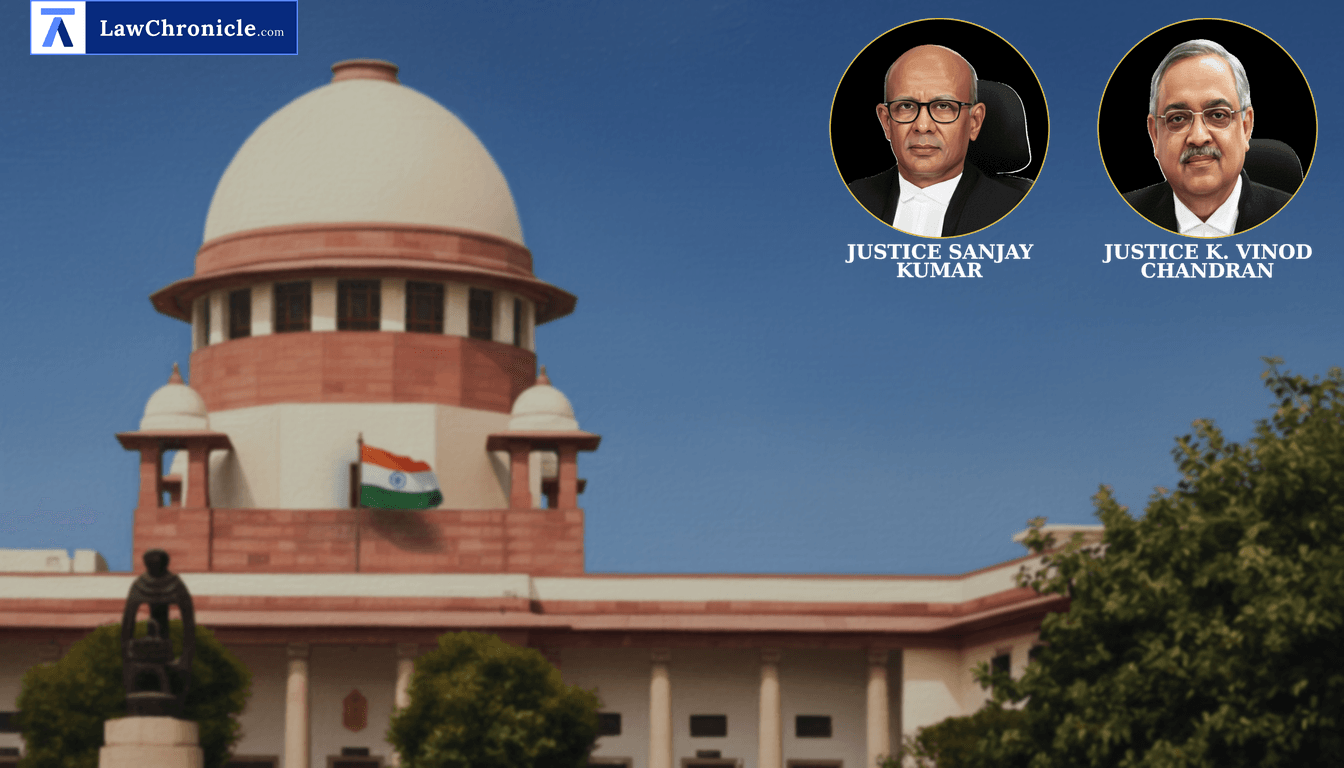
In a significant ruling for complex commercial infrastructure projects, the Supreme Court has clarified that a technical collaborator, whose involvement is essential for a contractor's eligibility, is a veritable party to the arbitration agreement despite not being a direct signatory to the primary contract.
A bench comprising Justice Sanjay Kumar and Justice K. Vinod Chandran set aside a High Court order that had declined an arbitration request filed under Section 11(6) of the Arbitration and Conciliation Act, 1996. The Court held that when a contract necessitates a 'Deed of Joint Undertaking' (DJU) and imposes joint and several liabilities on a collaborator for the project's completion, that collaborator is inextricably linked to the arbitration clause.
The Inextricable Connection Principle
The dispute arose from a Coal Handling Plant Package for the Nabinagar Thermal Power Project. The appellant, acting as a technical collaborator, provided the necessary experience and design capabilities to help the contractor qualify for the bid. The Court observed that the tender requirements specifically demanded a DJU to ensure successful performance.
The Court, in its reasoning, observed: "The DJU was executed by the Collaborator with the Contractor, in favour of the Employer which clearly indicates that the Collaborator was an inseparable part of the contract and its execution.. The communications issued pursuant to the default of the Contractor is a reaffirmation of the obligation of the Collaborator as per the contract executed, of which the DJU is an inextricable part."
Direct Payments and Tripartite Agreements
When the original contractor faced liquidation, the employer directly called upon the collaborator to fulfil obligations. A tripartite agreement was subsequently signed to facilitate direct payments to the collaborator. The Supreme Court noted that this agreement did not 'wipe out' the earlier contract but rather asserted the collaborator's responsibility to fulfil it. The Court emphasized that since the employer had invoked the collaborator's joint and several liability, they could not later deny the privity of contract to avoid arbitration.
Directions Issued by the Court
The Court has following directions:
"Justice (Retd.) Chakradhari Sharan Singh, (former Chief Justice of the Orissa High Court, Mobile No.: +91 94310 15002) is appointed as the sole Arbitrator to adjudicate upon the disputes between the parties. All contentions available to the parties are left open to be urged before the Arbitrator. The learned Arbitrator will proceed in accordance with law and make his declaration in terms of Section 12 of the Arbitration and Conciliation Act, 1996 within a period of 15 days from the date a copy of this judgment is received by him. He shall be paid in terms of the Fourth Schedule to the Arbitration and Conciliation Act, 1996."
Background:
The appellant (Collaborator) and respondent (Employer) were embroiled in a dispute over delays and the alleged wrongful encashment of a bank guarantee. The High Court had originally rejected the appellant’s petition for the appointment of an arbitrator, concluding that the collaborator was not a signatory to the primary contract between the Employer and the Contractor. The High Court also interpreted the collaborator's request for 'consent' to initiate arbitration as an admission that no binding arbitration clause existed between them. However, the Supreme Court disagreed, noting that the 'consent' sought was specifically for a particular arbitration center and not for the arbitration process itself, which was already embedded in the contractual framework.
Case Details:
Case No.: Civil Appeal No. of 2026 (@ Special Leave Petition (C) No. 33128 of 2025)
NeutralCitation: 2026 INSC 458
Case Title: Elecon Engineering Company Limited v. Bhartiya Rail Bijlee Company Limited & Anr.
Appearances:
For the Petitioner(s): Sri Sridhar Potaraju, Senior Counsel
For the Respondent(s): Sri Aman Lekhi, Senior Counsel
Source: 2026 CaseBase(SC) 394
Similar Articles
 Breaking News


